What Is a Shock Absorber?
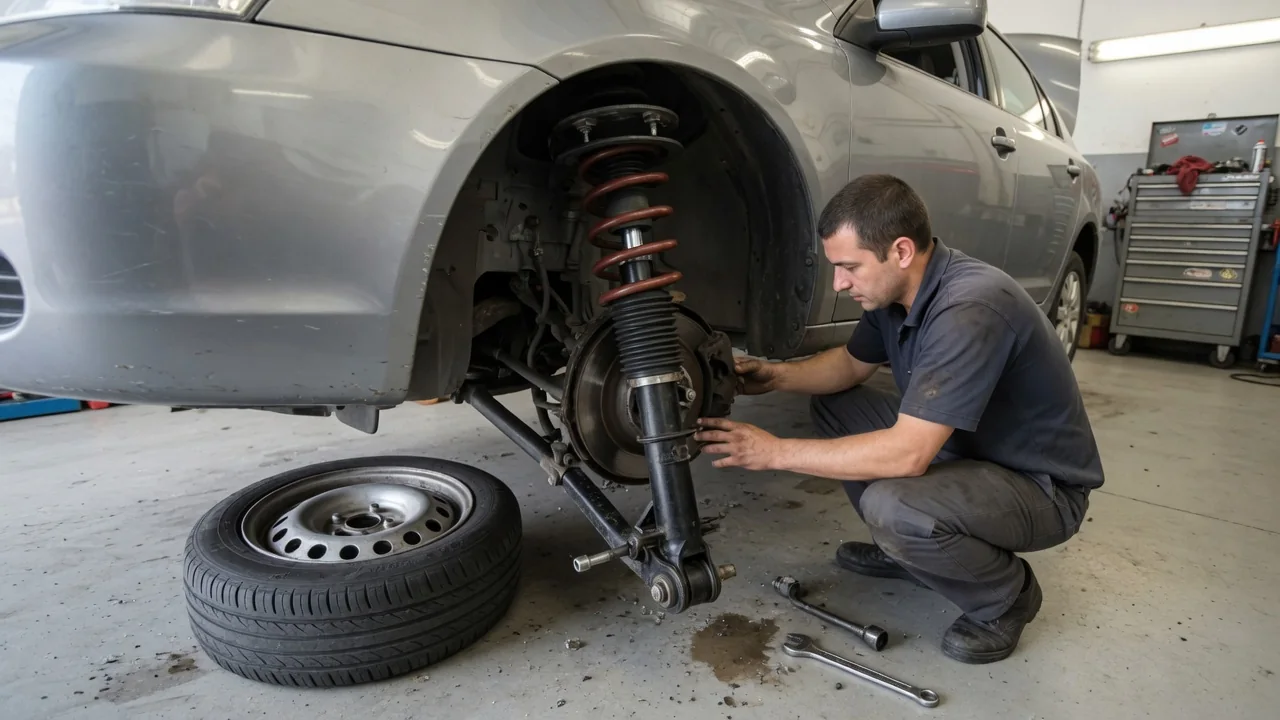
What is a shock absorber? It is a hydraulic damper that controls how quickly a vehicle's suspension moves, turning the energy of bouncing into heat. It does not hold the car up; that job belongs to the spring. Understanding the difference explains why a vehicle can sit at normal height yet still ride poorly, wander over bumps, or feel unsettled when braking.
Oil and piston concept
Inside a typical shock absorber is a sealed tube filled with hydraulic oil, and a piston attached to a rod that slides through that oil. One end of the unit mounts to the body or frame, the other to a suspension arm or axle. When the wheel rises over a bump, the piston is forced through the fluid. Small passages and valves in the piston restrict how fast the oil can pass, and that resistance is what slows the movement.
The resistance depends on speed: push the rod slowly and it moves with modest effort, push it quickly and it fights back hard. A spring behaves differently, resisting according to how far it is compressed and then returning that energy. The damper returns nothing; it converts motion into heat that the tube sheds to the air. Designs vary, with twin-tube and monotube layouts, gas charging to limit oil foaming, and electronically adjustable valving on some vehicles, so the details depend on the model.
Motion control
Without damping, a spring that has been compressed by a bump would release its energy and keep oscillating, leaving the body bobbing several times after a single dip. The shock absorber cuts that cycle short, ideally letting the body settle after about one movement. It works in both directions: compression damping controls the wheel moving upward, while rebound damping controls the spring pushing it back down. Manufacturers tune each direction separately to balance comfort against control.
This control reaches well beyond ride comfort. Under braking, dampers slow the rate at which the nose dives; in a corner, they manage how quickly the body leans; over rough pavement, they keep the tire pressed against the surface instead of skipping across it. A tire that leaves the road cannot steer or brake, so damping supports grip. On many cars the damper is built into a strut that also carries the spring and steering loads, though the damping function inside remains the same.
Wear clues
Because a shock absorber wears gradually, the change is easy to miss. Oil is the most visible clue: a light film of mist near the rod seal can be normal, but wet fluid running down the body suggests the seal is no longer holding. Other visible signs include a dented tube, a bent or pitted rod, and cracked or perished mounting bushings. None of these alone proves the unit has failed, yet each justifies a closer inspection.
Tires can tell part of the story too. Scalloped or cupped patches around the tread sometimes appear when a wheel has been bouncing instead of rolling steadily, although alignment, balance, and worn suspension joints can produce similar patterns. Knocking over bumps may point to loose mounts rather than internal wear. A sagging corner, by contrast, usually points toward the spring, because ride height is the spring's responsibility. Vehicles with air or self-leveling systems are an exception that needs model-specific checking.
Everyday Use and Observations
In daily driving, weak damping tends to show up as motion that carries on too long. The car may float over highway undulations, rock for a moment after a speed bump, or bounce at the rear when loaded with passengers and luggage. Braking can bring more nose dive than before, and crosswinds or passing trucks may make the body sway. Comparing how the vehicle behaves now with how it felt when newer is often more revealing than any single symptom.
A common driveway check is to press down firmly on one corner and release it, then watch how the body recovers. Continued bobbing hints at poor damping, but the test is crude, and stiff modern suspensions may hide a tired unit. Expectations should also match the vehicle: a pickup built to carry loads rides firmly when empty, a sports sedan feels taut by design, and a car with selectable drive modes changes its damping character at the touch of a button.
Limits and Next Steps
A shock absorber cannot correct everything that feels wrong with a ride. It will not restore lost ride height, cure a broken spring, fix worn ball joints or bushings, or compensate for incorrect tire pressure. Replacing dampers when the real fault lies elsewhere leaves the complaint unchanged. Likewise, a harsh ride is not always a damper problem; low-profile tires, heavy-duty springs, and seized suspension components can all make a vehicle feel stiff or unsettled.
When symptoms suggest worn dampers, a professional inspection on a lift is the sensible next step, since a technician can check for leaks, mount condition, and play in related parts together. Dampers are commonly replaced in axle pairs so both sides respond alike, and strut work involves a compressed spring that stores considerable energy, so it is best left to a properly equipped shop. Vehicles with adaptive or air suspension may also set warning messages that require vehicle-specific diagnosis before any part is condemned.