What Is a Series Hybrid? How the Powertrain Works
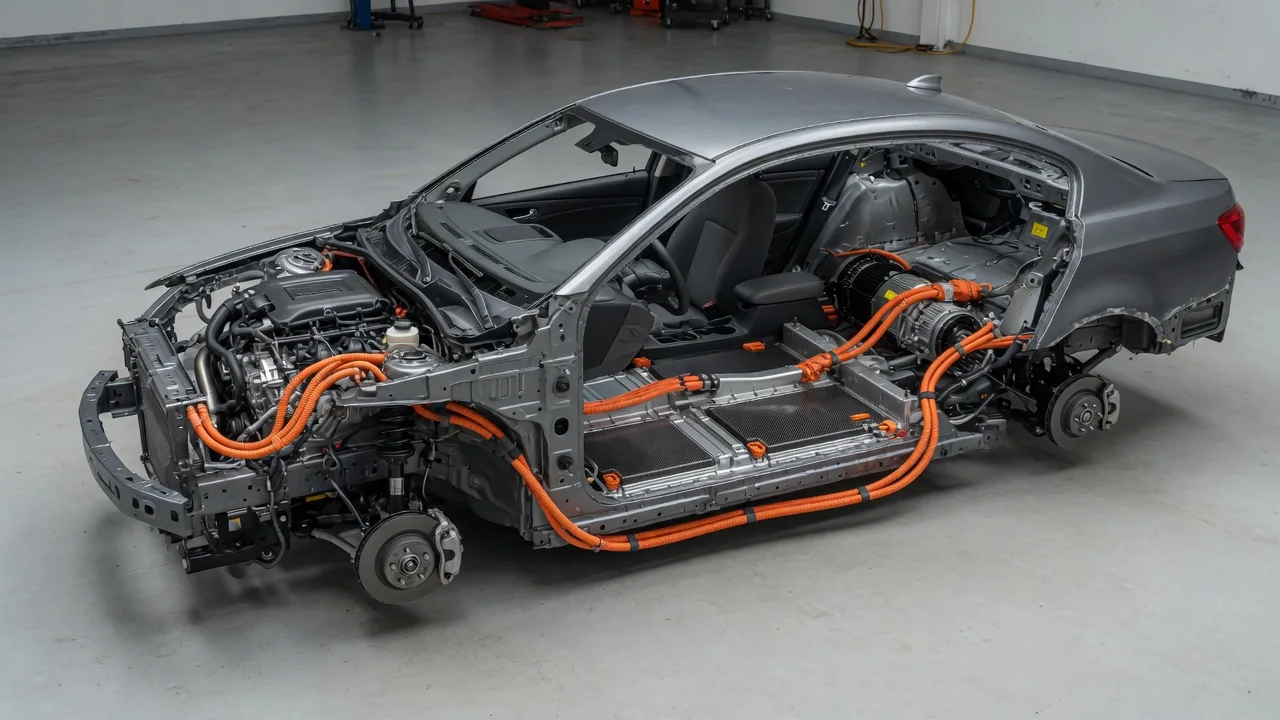
A series hybrid is a vehicle in which the gasoline engine never turns the wheels directly. The engine spins a generator, the generator produces electricity, and an electric motor does all the work of moving the car. A battery sits between these parts as an energy buffer. Understanding a series hybrid car powertrain comes down to three ideas: how the engine generator makes power, how the motor drive delivers it, and how energy flows between them.
Engine generator
In a series layout the combustion engine is mechanically coupled only to a generator. There is no driveshaft, clutch, or gearbox linking it to the wheels. Because the engine is decoupled from road speed, the control system can choose engine speed and load on its own terms. Every engine has an operating region where it converts fuel into work most efficiently, and series hybrid control logic tries to keep the engine in or near that region whenever it runs, instead of forcing it to follow every change in vehicle speed.
The generator produces alternating current, which power electronics convert into direct current for the high-voltage system. In many designs the same generator can also work in reverse as a motor to crank the engine, so starting is smooth and quick. Control strategies vary. Some systems run the engine at a steady output and switch it on and off as the battery state of charge moves between upper and lower limits. Others let engine output rise and fall more closely with driver demand. Many real systems blend both approaches depending on conditions.
Since the battery can cover short power peaks, the engine generator does not always need to match the motor's maximum output. How far a designer can take this depends on battery size. With a small battery, the engine generator must be able to supply most of the power needed for sustained demands such as long climbs or extended high-speed driving.
Motor drive
The electric traction motor is the only component that delivers torque to the wheels. Electric motors produce strong torque from a standstill and operate across a wide speed range, so series hybrids typically use a simple fixed reduction gear rather than a multi-speed transmission. As a result, acceleration and top-end performance are defined mainly by the motor and its power supply, not by the size of the engine.
An inverter sits between the high-voltage DC system and the motor. It converts direct current into precisely controlled alternating current, setting motor torque based on accelerator pedal position and other inputs. From the driver's seat this produces a feel similar to a battery electric vehicle: smooth, continuous acceleration without shift points, and quiet operation whenever the engine is off.
The motor also handles regenerative braking. When the driver lifts off the accelerator or presses the brake pedal, the motor can act as a generator, converting the vehicle's kinetic energy into electricity and sending it back to the battery. Friction brakes blend in when more stopping force is needed. How much energy can be recovered depends on how much charge the battery can accept at that moment, which is affected by its state of charge and temperature.
Energy path
Energy in a series hybrid can follow several routes, and the supervisory controller decides which ones are active at any moment. Electricity from the engine generator can flow straight to the motor, into the battery, or be split between the two. The battery can power the motor alone with the engine off. During deceleration the flow reverses, with the motor sending recovered energy into the battery. The controller balances these paths to meet driver demand while keeping the battery within its intended charge window.
Every conversion step costs some energy. Mechanical power becomes electrical in the generator, passes through power electronics, may be stored and later withdrawn from the battery, and is turned back into mechanical power by the motor. Sending generator output directly to the motor avoids the extra losses of a battery round trip, so control logic generally prefers that route when the engine is running and the battery does not need charging. Storing energy is worthwhile when it lets the engine run in a more efficient region or shut off entirely for a while.
The same series architecture appears in different forms. In a charge-sustaining hybrid, all energy ultimately comes from fuel and the battery acts as a short-term buffer. In a plug-in version, often called an extended-range electric vehicle, the battery can be charged from the grid, so the car may drive mostly on stored electricity with the engine generator acting as a backup. Both differ from parallel and power-split hybrids, where the engine can also drive the wheels mechanically.
Practical implications and limits
Series operation tends to suit stop-and-go driving, where frequent braking offers energy to recover and low speeds would otherwise force a conventional engine to run inefficiently. Steady high-speed cruising is a weaker case, because the chain of conversions can waste more energy than a direct mechanical connection would. For this reason, some manufacturers add a clutch that lets the engine drive the wheels at higher speeds. Such systems are no longer pure series designs, and their behavior should be judged from the specific vehicle's documentation.
Drivers may notice that engine sound does not match road speed. The engine might rev up while the car is slowing, keep running while stopped at a light, or start unexpectedly to recharge the battery. This is normally intended control behavior rather than a fault. Cold weather can change patterns too, since many vehicles run the engine more often to warm it up, manage emissions equipment, or provide cabin heat.
Sustained heavy demand exposes the system's main limit. If the battery is depleted during a long grade or extended towing, available power may fall to what the engine generator can supply continuously, and some vehicles reduce output to protect components. Ownership also involves two systems: the engine still needs oil, coolant, and filter service, while high-voltage components require trained technicians. Service intervals, warning indicators, and any driver-selectable charging modes are vehicle-specific, so the owner's manual remains the reference for how a particular series hybrid behaves.