What Is a Sequential Racing Gearbox? Gear Selection, Mechanism and Service
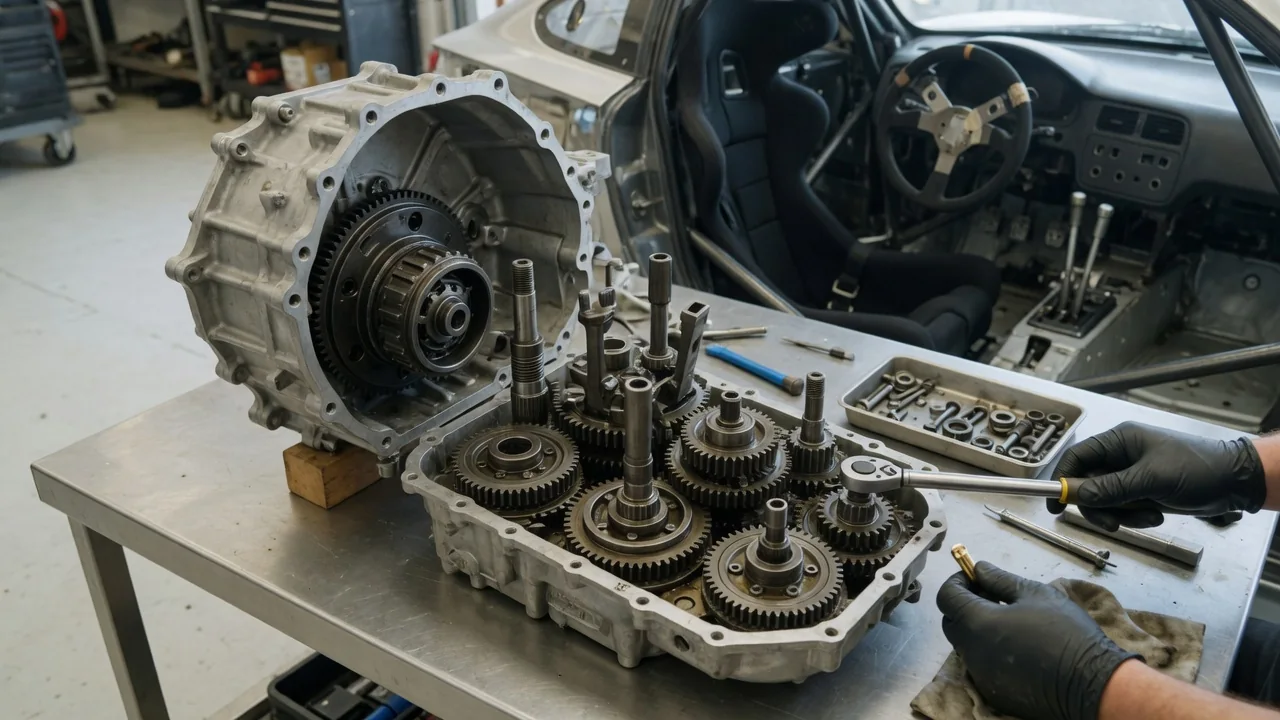
A sequential racing gearbox is a manual transmission that selects gears in a fixed order, one step up or down at a time, instead of letting the driver move a lever freely across an H-pattern gate. This type of motorsport sequential transmission gives up road-car refinement in exchange for fast, consistent shifts and fewer missed gears. Knowing how it selects gears, what happens inside the case, and why it needs regular attention explains both its appeal and its limits.
Gear selection
The defining feature of a sequential gearbox is how the driver asks for a gear. On a lever-operated unit, a common setup is to pull the lever back for an upshift and push it forward for a downshift, although the direction can be reversed depending on how the linkage is installed. Paddle-shift versions do the same job through buttons or paddles on the steering wheel, with an actuator moving the selector mechanism. In either case, each movement selects exactly one gear, and the lever or paddle returns to its rest position afterward. The driver cannot jump straight from fourth to second; the gearbox has to pass through third, even if the two shifts happen in very quick succession.
Because the lever always returns to the same place, its position no longer tells the driver which gear is engaged. For that reason, sequential gearboxes are usually paired with a gear position sensor and a display on the dashboard. Neutral is typically located between first and second, and many designs protect it with a lockout, such as a button or collar that must be operated deliberately, so that a hurried shift does not land in neutral by mistake. Reverse, where fitted, is generally locked out as well.
Clutch use also differs from a typical road car. In many installations the clutch is needed mainly to pull away from a standstill. Upshifts are often made without lifting off the throttle, with a brief ignition or fuel cut momentarily unloading the drivetrain so the next gear can engage. Downshifts usually benefit from a throttle blip to match engine speed, done either by the driver or by the engine electronics on systems equipped for it. The exact technique depends on the specific gearbox and control system, so the manufacturer's instructions take priority.
Mechanism
At the heart of most sequential gearboxes is a selector barrel, sometimes called a drum. It is a cylinder with curved tracks machined into its surface. Each shift fork carries a pin that rides in one of these tracks. When the barrel rotates by a fixed step, the shape of the tracks moves one fork sideways to engage a gear while the others stay put or retract. A ratchet and pawl arrangement converts each stroke of the lever or actuator into one consistent step of barrel rotation, and a spring-loaded detent holds the barrel firmly in each gear position. This indexing is what forces the strict up-and-down order.
Gear engagement is also different from a typical road-car manual. Most road manual gearboxes use synchronizer rings that match shaft speeds before a gear locks in. Racing sequentials typically rely instead on dog engagement: a sliding ring with a small number of large, square-faced teeth, or dogs, locks into matching dogs on the side of the gear. With no synchronizer to slow the process, engagement depends on a quick, decisive movement and a momentary reduction in drivetrain load. Many racing units also use straight-cut gears, which avoid the sideways thrust produced by helical gears but tend to whine loudly. These are common traits rather than universal rules, and individual designs vary.
Electronics often surround the mechanical core. Typical additions include a barrel position sensor, a load sensor in the shift linkage that tells the engine control unit when to cut power, and pneumatic, hydraulic or electric actuators on paddle systems. Some designs are built so gear ratios can be swapped without removing the entire gearbox, though this depends on the specific unit. It is also worth separating a true sequential racing gearbox from road cars that offer a sequential mode on an automatic, automated manual or dual-clutch transmission. Those share a similar up-and-down control style but use different internal hardware.
Service
Sequential racing gearboxes are generally maintained on a life basis rather than on road-car mileage intervals. The manufacturer usually specifies inspection and rebuild intervals in terms such as running hours, distance or number of events, and teams commonly log usage for the gearbox and its major components. Because these intervals vary widely between designs and applications, the documentation for the specific unit is the only reliable guide.
A typical inspection focuses on the parts that carry the shock of each shift. Dog faces are checked for rounding, chipping or cracks, since worn dogs can let a gear jump out under load. Gear teeth are examined for pitting and damage, selector forks for wear where they contact the dog rings, and the barrel tracks, pawl and detent for wear or damage. Bearings, seals and shaft end float are checked and set to specification during reassembly. Many programs also crack-test highly stressed parts at rebuild. Oil changes follow the specified fluid and interval, and the drained oil and any magnetic drain plug are inspected for metal particles, which can give early warning of wear.
Between scheduled services, certain symptoms suggest the gearbox needs attention before it is used again: jumping out of gear, false neutrals, unusually hard or notchy engagement, new or louder noises, a gear display that disagrees with the gear actually engaged, or an increase in debris on the drain plug. Rebuilds are commonly handled by specialists who have the manufacturer's data, tools and parts, because incorrect shimming or assembly can shorten component life or cause failures on track.
Practical implications and limits
In use, the main advantage is predictability. Every pull or push gives the next gear, so the driver can concentrate on braking points and the racing line rather than finding the correct gate under pressure. That consistency matters most in endurance racing, rallying and other events where fatigue builds over a long stint. The one-step rule, however, means a large drop in speed still calls for several individual downshifts, and the time saved depends on how well the driver and electronics manage each one.
The trade-offs are real. These gearboxes tend to be noisy and harsh, low-speed manoeuvring can be clumsy, and parts, rebuilds and specialist labour cost far more than ordinary road-car transmission upkeep. Where shifting depends on sensors, actuators or a power cut, a fault in that system can degrade or prevent normal shifts. The sequential layout also does not eliminate every driver error: it prevents selecting the wrong gate, but a downshift made at too high a road speed can still over-rev the engine unless the electronics are designed to block it.
For road use, a sequential gearbox is rarely a practical choice, because short service lives and refinement compromises suit a racing schedule better than daily driving. Whether one makes sense for a particular car depends on how it will be used, the budget for maintenance and access to specialist support. Shift technique, oil choice and service intervals vary between designs, so the specific gearbox's documentation should always be the final reference.