What Is a Seat Occupancy Mat? Detection, Airbag Control and Service
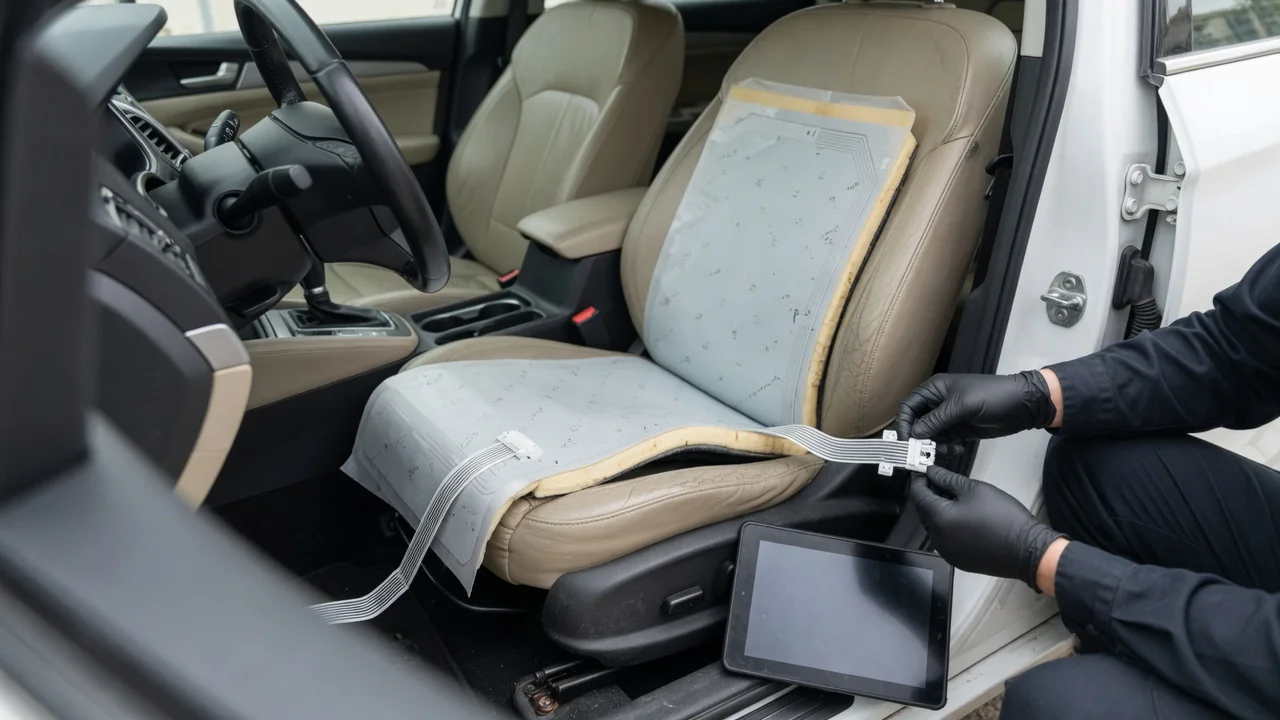
A seat occupancy mat is a thin sensor layer built into a vehicle seat cushion, most often the front passenger seat. It tells the car whether someone is sitting there and, in many designs, roughly what kind of occupant it is. That information drives the seat belt reminder and, more importantly, helps decide whether the passenger airbag is allowed to deploy. This guide explains how detection works, how the mat ties into airbag control, and what servicing it involves.
Detection: how the mat senses an occupant
The mat sits between the cushion foam and the upholstery cover, spread across the area where a seated person's weight lands. Most mats fall into a few general families. Pressure-sensitive mats use a grid of small sensing points, often force-sensing elements printed on flexible film, whose electrical resistance changes as load presses on them. Capacitive mats instead use conductive electrodes and measure how a human body, which contains moisture and conducts slightly, alters an electric field above the cushion. Some manufacturers skip the mat entirely and use a fluid-filled bladder with a pressure sensor, or strain gauges in the seat frame, but the goal is the same: turn the presence of an occupant into an electrical signal.
Simple versions answer only one question: is something on the seat? That is enough to trigger a seat belt reminder. More capable mats feed a dedicated control module that reads both the total load and the pattern across the sensing points. Because an adult, a small child in a booster, and a grocery bag press on the cushion differently, the module can compare the reading against calibrated thresholds and place the occupant into a category such as empty, child seat, small occupant or adult. The exact categories, thresholds and logic vary by manufacturer and model year, so the vehicle's own service information is the only reliable reference for how a specific car classifies its passengers.
Airbag control: deciding whether the passenger airbag can deploy
The occupancy or classification result is sent to the airbag control module, the computer that decides when and how the supplemental restraints fire. Frontal airbags deploy with considerable force, which protects a belted adult but can seriously injure an infant in a rear-facing child seat or a small child sitting close to the dashboard. In the United States, the advanced airbag requirements of Federal Motor Vehicle Safety Standard 208 led manufacturers to adopt systems that can suppress or adapt the passenger airbag for smaller occupants, and a passenger seat occupancy sensor mat is one common way to gather the input those systems need.
When the system classifies the seat as empty or occupied by a child or child seat, it typically suppresses the passenger frontal airbag, and in some vehicles other passenger-side airbags as well. When it detects an adult, deployment is enabled. Many vehicles display the decision through a passenger airbag status indicator with separate on and off lamps. Some systems go further and adjust how the airbag deploys, for example selecting a lower-energy stage, by combining occupant information with seat belt status and crash severity data. If the mat or its module reports a fault, the airbag control module usually stores a diagnostic trouble code and turns on the airbag warning light, because it can no longer confirm that its deployment decision is correct.
Service: diagnosing and replacing a seat occupancy mat
Typical symptoms of a problem include an airbag warning light that stays on, a passenger airbag off indicator that lights while an adult is seated, or a seat belt reminder that chimes for an empty seat or stays silent for an occupied one. Common causes are physical damage to the mat from kneeling, standing or sharp objects, wear from repeated flexing near the cushion edges, corroded or loose connectors under the seat, and wiring pinched by seat movement. Diagnosis normally begins with a scan tool that can communicate with the restraint system, read stored codes and, where supported, display live occupant classification data.
In many vehicles the mat is not sold as a separate part. It may come only as an assembly with the seat cushion, or as a kit paired with its control module. After replacement, many systems require a calibration or zero-point reset with a scan tool, performed with the seat empty and under the conditions the procedure specifies. Because this work sits inside the airbag system, the manufacturer's steps for disconnecting the battery and waiting before unplugging restraint connectors should be followed, and the warning light and status indicator should be checked afterward.
Upholstery jobs deserve special care. Replacing a seat cover, adding a seat heater or reshaping foam can shift the mat, crease it, or puncture it with hog rings and clips. The mat needs to return to its original position, and extra layers between the occupant and the sensor can change its readings. Aftermarket bypass or emulator devices that send a constant occupied signal may clear the warning light, but they defeat the suppression logic, so the passenger airbag could deploy toward a child. They are not a proper repair.
Practical implications and limits
For owners, the most useful habit is a quick glance at the passenger airbag status indicator whenever someone rides up front. If it does not match the occupant, have the system checked rather than assuming it is right. Readings can be influenced by things the system cannot interpret well: thick aftermarket seat cushions, beaded or massage covers, a passenger perched on the front edge of the seat or leaning against the door, or heavy items pressing on the cushion. Lighter adults close to a classification threshold may occasionally see the indicator change as they shift position.
It also helps to understand what the mat cannot do. It estimates load or presence; it does not know a passenger's age or height, or whether a child seat is installed correctly. The rear seat remains the recommended place for children, and child seats should be used according to both the vehicle's and the child seat maker's instructions. Avoiding kneeling, standing, or placing sharp or very heavy objects on the passenger seat reduces the risk of damage, as does cleaning up liquid spills promptly. Finally, behavior differs between vehicles, so the owner's manual is the place to learn what a given car's indicator and warnings mean and which seating situations its system is designed to handle.