What Is a Seat Back Lumbar Bladder? Air Chamber, Adjustment and Faults
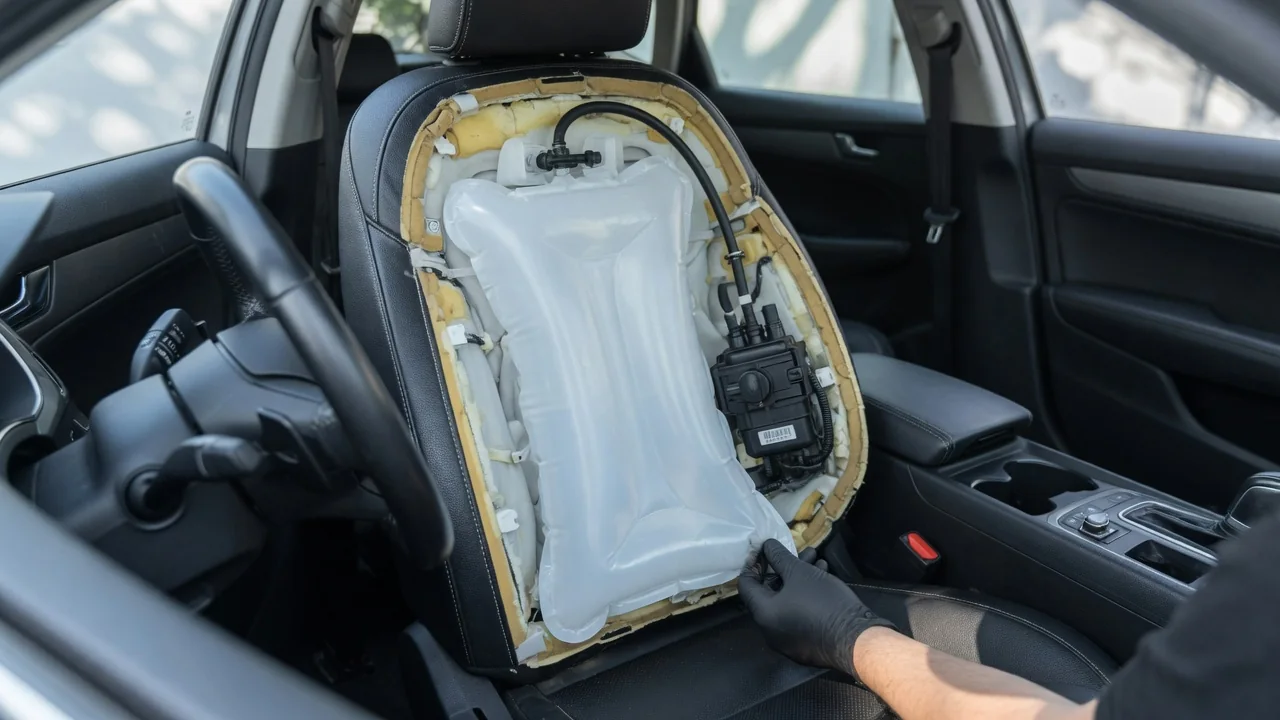
A seat back lumbar bladder is an inflatable air cell built into the lower part of a car seat back. When it fills with air, it presses the seat foam forward to support the natural inward curve of the lower spine. When the air is released, the backrest flattens again. This is the core of most car seat air lumbar support systems, and knowing how the chamber, controls and common failures work helps owners tell normal behavior from a fault.
The air chamber behind the seat foam
The bladder itself is a sealed, flexible pouch, typically made from a plastic film or coated fabric whose seams are welded or bonded to hold air. It sits behind the seat cushion foam and the upholstery, usually mounted to a support panel, wire frame or suspension mat in the lower backrest. Because it is hidden under the trim, the occupant never touches it directly. Its expansion is transmitted through the foam and cover, which spread the pressure over a wider area and turn a balloon-like shape into a gentle forward contour. When the bladder is empty, it lies nearly flat, and the seat behaves much like a version without lumbar adjustment.
Many designs use more than one chamber. A single bladder can only change the depth of support, while two or more stacked cells allow the system to shift the point of greatest pressure up or down by inflating one cell more than another. Each chamber connects through small flexible hoses to a valve assembly, and the valves connect to a compact electric air pump mounted on the seat frame or under the seat. Wiring from the seat harness powers the pump and valves. Some seats combine the lumbar chambers with additional bladders in the side bolsters or upper backrest, but the lumbar section is the part dedicated to lower-back support.
Not every lumbar bladder is powered. Some seats use a hand-operated squeeze bulb to pump air in and a small release valve to let it out. The air chamber works the same way; only the source of air pressure differs.
How lumbar bladder adjustment works
In a powered system, adjustment begins at a switch, usually a multi-direction button on the side of the seat or on a door panel. Pressing the direction for more support switches on the pump and opens the valve path to the chosen chamber, so air flows in and the backrest firms up. Releasing the switch stops the pump, and a closed valve traps the air so the setting holds. Pressing the direction for less support opens a vent path that lets air escape, gradually softening the contour. Because adding air requires the pump while releasing air only requires opening a valve, inflation is usually accompanied by a faint motor hum, whereas deflation tends to be quieter, sometimes with a soft hiss.
Height adjustment in multi-chamber designs is achieved by changing the balance between cells rather than physically moving a part. Inflating the upper cell more than the lower one raises the apparent support point, and the reverse lowers it. In seats with an electronic control module, the module decides which valves to open and for how long. Some vehicles build additional features on the same hardware, such as storing lumbar settings with seat memory or cycling chambers for a massage effect. Whether a given vehicle offers these functions depends on its equipment and design, so the owner's manual is the reliable guide to what the controls actually do.
Common lumbar bladder faults
The most common complaint is support that will not stay where it was set. A bladder that slowly softens over minutes or hours usually points to an air leak. Possible sources include a pinhole in the chamber film, a separating seam, a cracked or chafed hose, or a fitting that has worked loose from the bladder or valve block. Repeated flexing as occupants get in and out, contact with sharp edges of the seat frame, and age-related hardening of plastic materials can all contribute. A valve that does not seal fully can produce the same symptom even when the bladder itself is intact, so a slow loss of firmness does not by itself prove the chamber is punctured.
A different pattern appears when the system does nothing at all. If pressing the switch produces no pump sound and no change in firmness, the cause is often electrical: a blown fuse, a damaged or disconnected connector under the seat, a faulty switch or a failed pump motor. If the pump runs but the seat does not firm up, a large leak, a detached hose or a valve stuck in the venting position is more likely. The opposite fault, support that inflates but will not deflate, suggests a valve or vent path that cannot open. Unusual pump noise can indicate wear, while a pump that keeps running after the switch is released points toward a switch or control fault. Locating the exact cause usually requires removing seat trim, which varies widely between vehicles.
Practical implications and limits
For everyday comfort, the useful approach is to make small changes and judge them over a drive rather than inflating the support to its maximum at once. The aim is to fill the gap between the lower back and the seat, not to push the body forward away from the backrest. Thick aftermarket seat covers, cushions or heavy clothing can blunt the effect, so the same setting may feel different with and without them. Because the bladder works through the foam, worn or compressed seat padding can also change how the support feels, independent of the air system's condition.
A sealed air chamber is also affected by physical conditions. Air expands when warm and contracts when cold, so a lumbar setting chosen in a cold car may feel slightly firmer as the cabin warms, and the reverse can happen overnight. This kind of minor variation is a property of air rather than a defect; a persistent loss of support is what points to a real fault. Lumbar air support is a comfort adjustment, not a medical device, and anyone with ongoing back pain should seek advice from a qualified professional rather than relying on seat settings.
Repairs carry their own limits. Seat backs in many vehicles contain side airbags, wiring for heating or ventilation and other sensors, so removing trim or disconnecting seat connectors should follow the vehicle's service procedures, including any precautions for airbag systems. Depending on the manufacturer, replacement parts may be supplied as an individual bladder, a complete lumbar assembly with pump and valves, or only as part of a larger seat back component. Patching a punctured chamber is sometimes attempted, but its durability under constant flexing is uncertain, so replacing the affected part is generally the more dependable route.