What Is a Run-Flat Tire Sidewall? How the Reinforced Sidewall Works
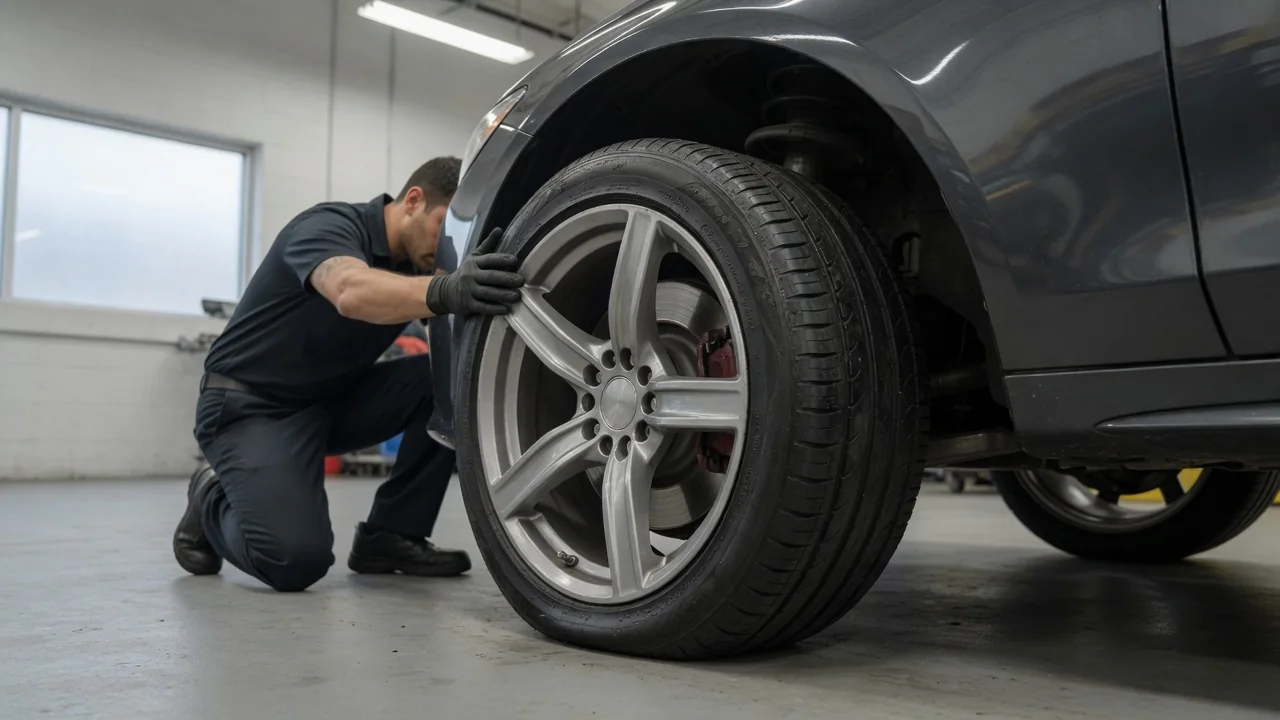
A run-flat tire sidewall is a reinforced sidewall built to keep supporting a vehicle's weight for a limited distance after the tire loses air pressure. A conventional tire relies almost entirely on inflation. A self-supporting run-flat tire adds stiffer rubber inserts and heat-resistant materials to its sidewalls, so it does not collapse right away when air escapes. This article explains how a run-flat tire's reinforced sidewall carries load, where that ability ends, and what a vehicle needs for these tires to be a proper fit.
Load after pressure loss
In a conventional tire, the compressed air does most of the work. Inflation pressure puts the carcass plies under tension, and that tension holds up the vehicle. The sidewall itself is relatively thin and flexible. When pressure is lost, the sidewalls fold and the rim drops toward the road. The tire can then be pinched between the wheel and the pavement, which damages it quickly. The bead may also come off its seat on the rim, and control suffers.
A self-supporting run-flat design adds a crescent-shaped insert of stiff rubber inside each sidewall, usually between the inner liner and the body plies. The insert is thickest around mid-sidewall and tapers toward the bead and the tread. When pressure drops, these inserts carry the load directly through compression and bending, much like a short structural column. That keeps the sidewall upright enough to hold the rim off the road and keep the tread in contact with the pavement. The bead area is also designed to stay seated on the wheel when the tire is deflated, which helps preserve steering and braking control.
Heat is the main engineering challenge. A deflated tire flexes much more with each rotation, and repeatedly flexing thick rubber generates internal heat. Run-flat sidewall compounds are formulated to resist that heat and the breakdown it causes, but they cannot eliminate it. This is why zero-pressure capability is always temporary. Other run-flat approaches exist, such as an internal support ring mounted on the wheel. However, the reinforced self-supporting sidewall is the design usually meant by the term run-flat tire.
Limits
The first limit is distance and speed. Tire and vehicle manufacturers specify how far and how fast a deflated run-flat may be driven. A commonly cited guideline is roughly 50 miles at up to 50 mph, but the actual figures vary by tire and vehicle. The owner's manual and the tire maker's documentation take precedence. These limits also assume reasonable conditions. A heavy load, hot weather, or higher speed all add heat and reduce what the sidewall can safely deliver.
The second limit is the type of damage. Reinforced sidewalls are intended to handle pressure loss from causes such as a puncture in the tread area. They do not make a tire immune to sidewall cuts, large gashes, severe pothole or curb impacts, or damage to the wheel itself. If the tire is torn open or the bead area is compromised, the structure may not support the vehicle as designed, and run-flat capability cannot be assumed.
The third limit appears after the event. Driving on a deflated tire can overheat the inserts, separate internal plies, or damage the inner liner, and none of this is necessarily visible from the outside. For that reason, many tire manufacturers restrict or prohibit repairing run-flat tires that were driven while deflated. Some do not allow repair of run-flats at all. Because policies differ, the specific tire maker's guidance decides. Handling is also reduced while running flat: steering response, cornering grip, and braking are not equivalent to a properly inflated tire.
Vehicle fit
A working tire pressure monitoring system is generally treated as a requirement for run-flat use. The same stiff sidewall that keeps the car moving also hides the deflation. A driver may not feel any change in handling or see an obviously flat tire. Without a functioning warning, a driver could unknowingly exceed the distance and speed limits, so the monitoring system must work reliably on every wheel.
Vehicles that come with run-flat tires from the factory are often engineered around them. The suspension may be calibrated for stiffer sidewalls, and many such vehicles have no spare tire or jack. Switching to conventional tires on these vehicles changes ride and handling characteristics. It also leaves the owner without a way to deal with a flat unless they add a spare, an inflator and sealant kit, or a roadside assistance plan. In the other direction, fitting run-flats to a vehicle tuned for conventional tires can produce a firmer ride and more road noise.
Self-supporting run-flats generally mount on standard wheels of the correct size. Some wheels use rim profiles intended to help keep the bead in place when the tire is deflated. Support-ring systems, by contrast, require dedicated wheels. In every case, the tire size, load index, and speed rating should match the vehicle's tire placard. Mixing run-flat and conventional tires on the same vehicle is generally discouraged because the different sidewall stiffness affects handling balance, so the vehicle manufacturer's recommendations should be followed.
Practical implications and limits
When a pressure warning appears on a car with run-flats, treat it as a countdown rather than a convenience. Slow down, avoid hard cornering and abrupt braking, and do not add cargo or passengers if you can avoid it. Note roughly where the warning came on so you can estimate how far you have driven. Then head to a tire service location instead of continuing a long trip. Checking the monitoring display or inspecting the tires once safely stopped helps identify which tire is affected.
Ownership involves trade-offs beyond the roadside. Replacement run-flat tires may cost more than comparable conventional tires, and some sizes may not be stocked at every shop, which matters if a tire must be replaced while traveling. Routine pressure checks still matter as well. A tire that runs moderately underinflated, but not low enough to trigger a warning, still flexes more and builds extra heat, and over time that can shorten its life.
It also helps to be clear about what a reinforced sidewall does not do. It does not seal a puncture, restore pressure, or make a damaged tire roadworthy again. Its value is time and control: it lets the driver reach a safe place and proper service instead of changing a wheel on a busy shoulder. Seen that way, a run-flat tire is a safety margin that works best alongside good maintenance, an attentive driver, and a clear plan for what happens after a flat.