What Is a Rubber Suspension Bushing? Function, Noise Control, and Wear
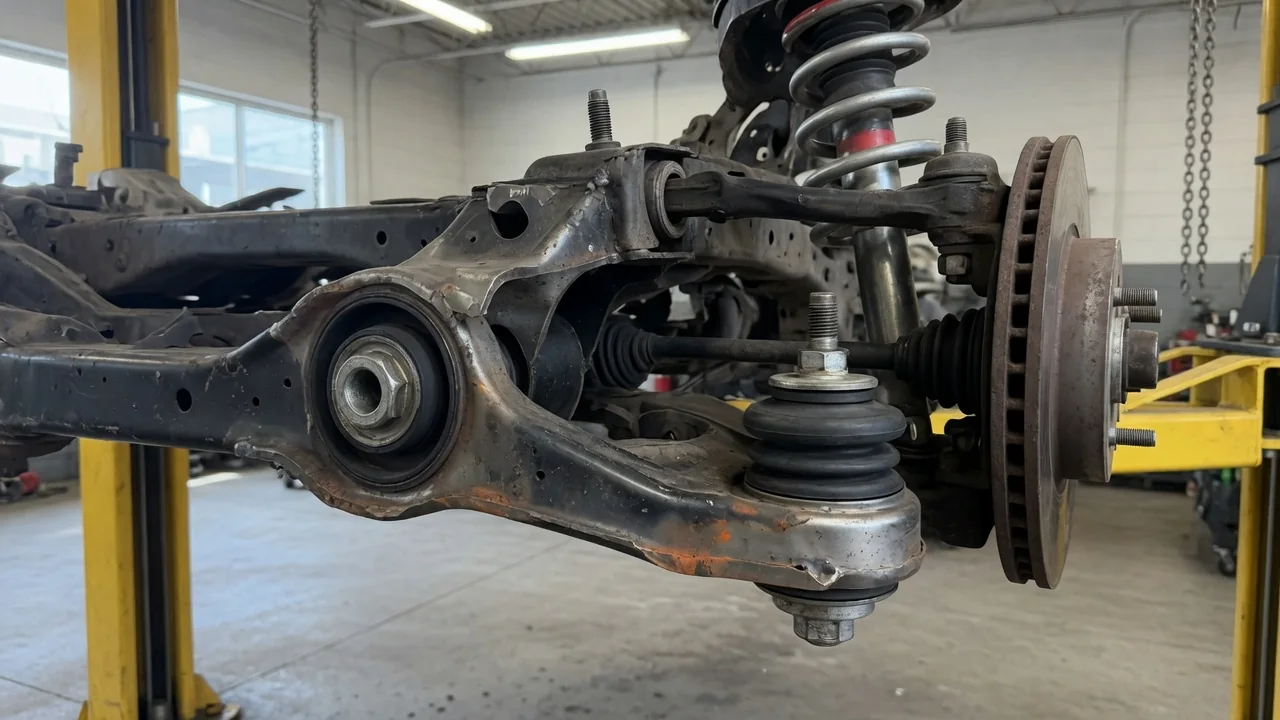
A rubber suspension bushing is a flexible cushion at the points where suspension parts attach to the body, the subframe, or each other. In its common form, it is a ring of rubber held between an inner metal sleeve and an outer metal shell. It lets parts pivot and move in controlled ways while keeping road noise and vibration out of the cabin. Because rubber ages, bushings also wear out over time.
Movement control
Suspension arms, links, and anti-roll bars must move as the wheels travel over bumps. Each connection point also has to hold the wheel in a precise position. Handling both demands at the pivot is the core function of a suspension rubber bushing. In a typical bonded design, the rubber is attached to both the inner sleeve and the outer shell. When the arm swings up and down, the rubber twists instead of sliding against metal. There is no lubricated bearing surface to maintain, and the pivot cannot rattle loose the way a worn metal joint can. The bushing flexes within its elastic range and returns toward its rest position when the load is removed.
That same flexibility gives the bushing a defined amount of compliance in other directions. Braking, cornering, and acceleration push the arm forward, backward, or sideways, and the rubber deflects slightly before it resists further movement. Engineers tune this behavior through the rubber compound, the wall thickness, and the shape. Some bushings include voids or inserts so they are softer in one direction and stiffer in another. The result is a balance between precise wheel location and a small amount of give. Precise location helps steering response and alignment stability, and the give smooths impacts. How much give a particular vehicle uses is a design choice, and it varies widely.
Noise isolation
Every bump, tire tread pattern, and road surface texture produces vibration at the wheel. If suspension parts were bolted directly metal to metal, much of that energy would travel straight into the body structure. Large panels in the body can amplify it into audible noise. Rubber breaks this path. As an elastomer, it absorbs part of the vibration energy through internal friction and turns it into a small amount of heat. Its flexibility also stops higher-frequency vibration from passing through efficiently.
This is why automakers use rubber at many connection points beyond the control arms, including subframe mounts, strut mounts, and anti-roll bar mounts. Together these isolators reduce the harshness felt through the seat and steering wheel and the rumble heard in the cabin. Some designs use fluid-filled, or hydraulic, bushings that add damping for specific vibration ranges, but conventional solid rubber bushings remain common. The trade-off is that a bushing made softer for comfort also deflects more under load. Isolation and precise control always have to be balanced against each other.
Wear
Rubber does not last forever. Over years of service, a bushing flexes countless times. It is also exposed to heat from the engine and exhaust, ozone and ultraviolet light, road salt, water, and sometimes oil or fluid leaks. These factors gradually harden the rubber, crack its surface, and reduce its ability to spring back. Petroleum-based fluids are particularly harmful to many common rubber compounds and can make them swell, soften, and lose strength.
Wear shows up in several ways. Cracks may deepen into tears through the rubber body. The rubber may separate from the inner sleeve or outer shell, which lets the parts move more than intended. A bushing can also take a permanent compression set and sag to one side under constant load. Once this happens, the arm it supports may shift during braking or cornering. Possible signs include clunking over bumps, vague or wandering steering, a shimmy under braking, and uneven tire wear. These symptoms are not unique to bushings. Worn ball joints, tie rod ends, shock absorbers, or mounts can cause similar complaints, so a physical inspection is needed to confirm the cause.
Practical implications and limits
For an owner, the main takeaway is that bushings are wear items with no single replacement interval that applies to every vehicle. Their life depends on design, climate, road conditions, driving style, and exposure to fluids. A visual check during routine service shows far more than mileage alone. Look for cracking, torn rubber, or an off-center sleeve, and do a pry-bar check with the vehicle safely supported. The vehicle's service manual shows which bushings can be replaced separately and which come only as part of a complete arm or link.
Installation details matter too. A bonded rubber bushing works by twisting, so many service procedures call for tightening its pivot bolts only after the suspension is loaded to normal ride height. Tightening the bolts with the wheels hanging can lock the rubber in a twisted position, which preloads it and shortens its life. Replacing bushings that affect wheel position is commonly followed by a wheel alignment check.
Finally, rubber is not the only option. Polyurethane bushings are widely sold as aftermarket parts and are generally stiffer and more resistant to oil. They usually transmit more noise and vibration, though, and some need periodic lubrication to avoid squeaking. Whether that trade suits a given car depends on how it is used. For most daily drivers, a quality rubber bushing that matches the original design keeps the balance of control and comfort the suspension was engineered around.