What Is a Rotisserie Restoration? Body Access, Support, and Scope
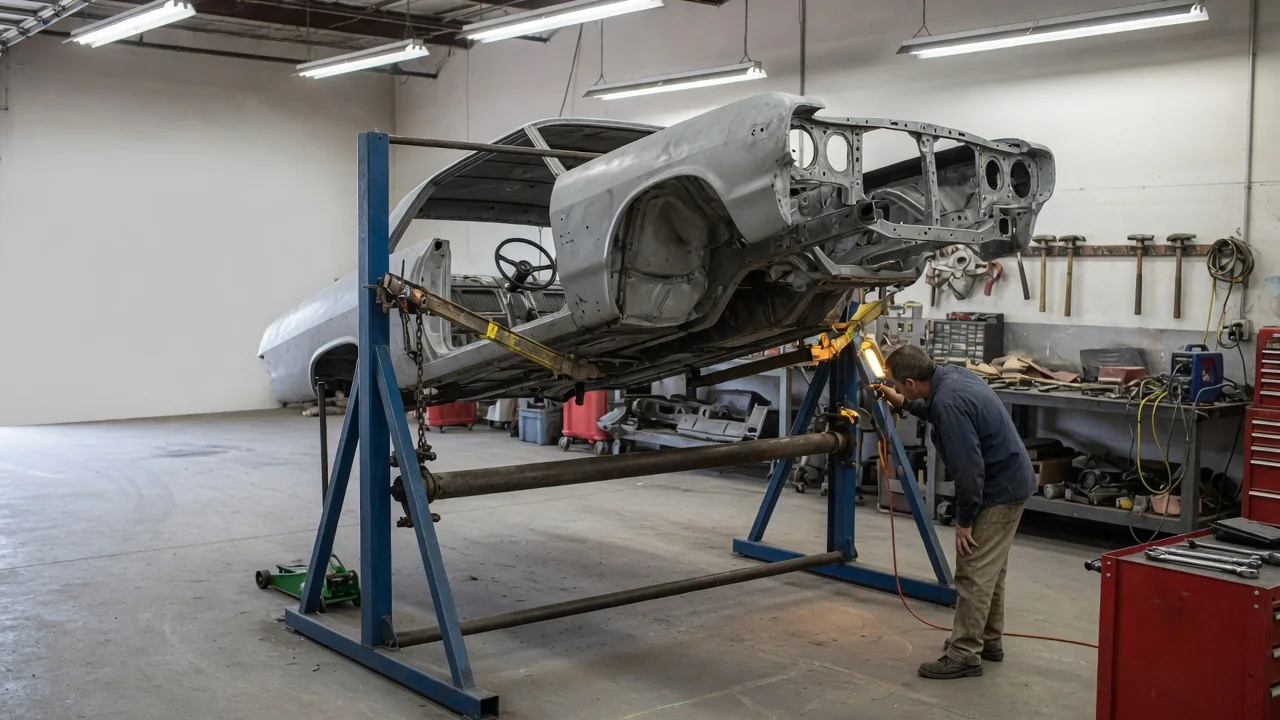
A rotisserie restoration is a body restoration in which the stripped shell of a vehicle is mounted on a rotating fixture, often called a rotisserie or body rotator, so it can be turned on its long axis. Instead of working on a car sitting on its wheels or on stands, the restorer can roll the body to almost any angle and reach the floor, underside, and inner panels directly. This article explains what that access means, how the body is held, and what the term usually covers.
Body access
The main advantage of a rotisserie is access. Once the body has been stripped of its drivetrain, suspension, glass, trim, and interior, it can be rotated so that the underside faces the restorer at a comfortable working height. Floor pans, rocker panels, wheel wells, inner fenders, and the seams where panels meet become as reachable as the roof. That matters because many of the areas most prone to corrosion on older vehicles are the hardest to see when a car is on the ground, and a lift alone still leaves the restorer working overhead.
Being able to turn the shell also changes how the work is done. Welding, grinding, and sealing are generally easier to control when the surface is positioned in front of the worker rather than above them. Stripping old coatings, undercoating, and seam sealer, whether by abrasive blasting, chemical stripping, or hand tools, can be carried out across the entire body, which helps reveal rust, previous repairs, and body filler that would otherwise stay hidden. After repairs, primer, sealer, paint, and underbody protection can be applied with more even coverage on surfaces that are normally out of sight.
Access does have a precondition. A rotisserie only helps once the body is bare enough to mount and turn safely, so the method assumes near-complete disassembly before any serious body work begins.
Structural support
A rotisserie supports the body from its ends. Typically, adjustable brackets bolt to solid mounting points at the front and rear of the shell, such as bumper mounting locations or the ends of the frame rails, and connect to a pivot on each upright stand. The pivot height is adjusted so the axis of rotation passes close to the body's center of gravity. When it is set correctly, the shell can be turned with modest effort and stays where it is placed, while locking pins or a geared mechanism hold it at the chosen angle. Suitable mounting points differ from vehicle to vehicle, so brackets must be fitted to the specific body rather than assumed.
Construction type determines what goes on the fixture. On a body-on-frame vehicle, the body is lifted off the frame, and the frame is usually restored separately while the body goes on the rotisserie. On a unibody vehicle, the shell itself is the main structure, so the whole shell is mounted. In both cases the body carries only its own weight, held at two ends, which is very different from the loads it sees when sitting on its suspension.
That difference is why support matters during repair. When rusted floors, rockers, or other structural panels are cut out, the shell can lose stiffness and may flex or shift out of shape. Restorers commonly weld temporary braces across door openings and between key points before cutting, and they check body dimensions against reference measurements for the specific vehicle before and after replacing structural metal. Where a repair affects suspension mounting points or the overall alignment of the shell, a dedicated frame or body jig may be needed in addition to, or instead of, the rotisserie.
Scope
In common usage, a rotisserie restoration describes a full restoration: the vehicle is completely disassembled, the body is mounted on a rotisserie and taken down to bare metal, corrosion and damage are repaired, and the shell is primed, sealed, and painted inside and out before reassembly. Because the car is fully apart anyway, the same project usually includes rebuilding or replacing mechanical, electrical, and interior components, although the term itself refers to how the body was handled.
The phrase is related to, but not identical with, terms such as frame-off, body-off, or nut-and-bolt restoration. Those describe the extent of disassembly, while rotisserie describes the fixture used for the body. It also differs from partial or rolling restorations, in which a car stays largely assembled and is improved in stages. There is no single binding definition, so shops, sellers, and owners do not always use these words the same way.
The term also says nothing on its own about quality or authenticity. A rotisserie makes thorough work possible, but the result depends on the repairs, materials, and finish chosen. Whether a restoration aims at factory-correct details, period-style modifications, or a modernized build is a separate decision from the method.
Practical implications and limits
Choosing a rotisserie approach commits a project to the largest practical scope of body work. The car will be off the road for an extended period, every fastener and component has to be removed, labeled, and stored, and the stripped shell often reveals more repair work than was visible at the start. Owners planning this kind of project should budget time and money with that uncertainty in mind rather than relying on the visible condition of the car.
The equipment itself has limits. A rotisserie must be rated for the weight of the shell as mounted and set up on a level, solid floor, with enough clearance for the body to rotate through its full arc. The body should be balanced and locked before anyone works on or under it, and loose or heavy parts that would shift the center of gravity should be removed. Some shells, especially those with severely weakened structures, may need bracing before they can be mounted safely at all.
A rotisserie is not always the right tool. A sound vehicle with localized rust or a single damaged area can often be repaired properly without a full teardown, and stripping a body completely removes original finishes and factory markings that some owners and collectors value. For buyers, a listing that mentions a rotisserie restoration is a starting point for questions, not proof: photographs of the bare shell, records of the repairs, and an inspection of the finished car reveal far more than the label.