What Is a Rinseless Wash Polymer? How It Works and When to Use It
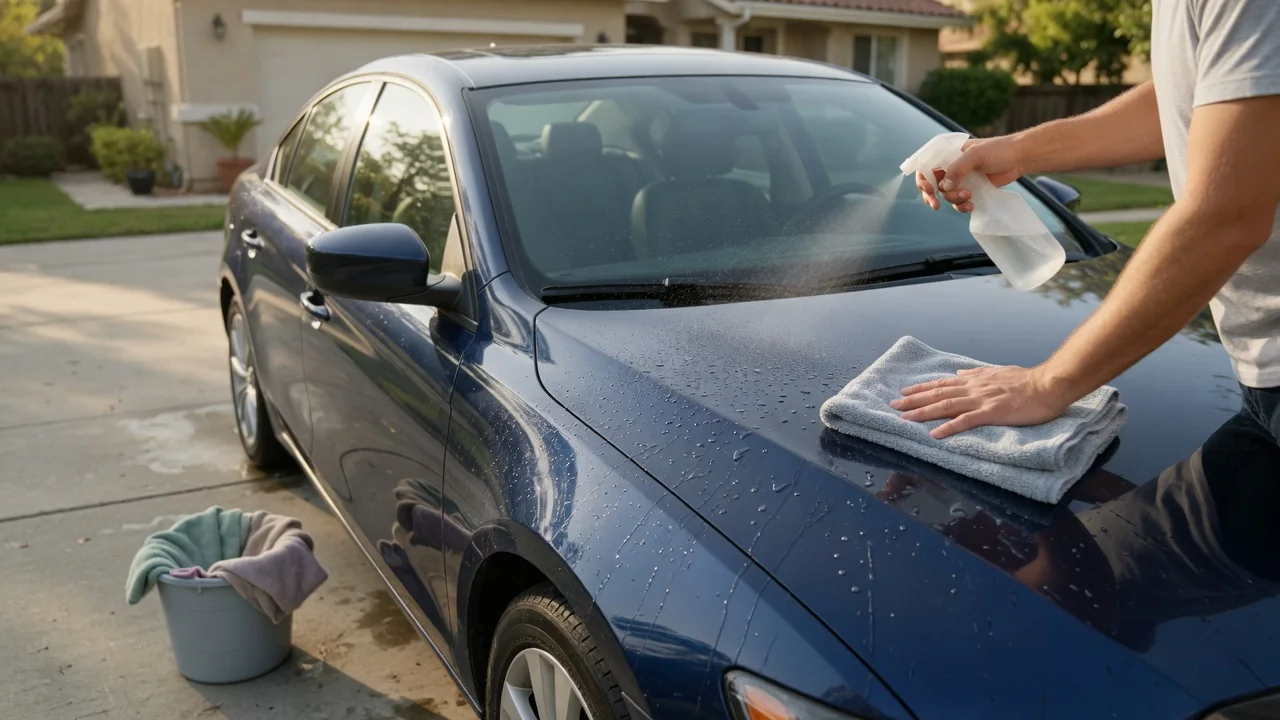
A rinseless wash polymer is the lubricating, film-forming ingredient in a rinseless car wash solution. It allows a lightly soiled vehicle to be cleaned with a bucket of diluted product and soft wash media, then dried without hosing it off. Knowing what the polymer does, and what it cannot do, explains the basics of rinseless car wash chemistry, why towel choice and technique matter so much, and which kinds of dirt this method is suited to.
Dirt encapsulation
A typical rinseless wash solution combines two groups of ingredients. Surfactants loosen soil and reduce the surface tension of water so it wets the paint evenly. Water-soluble polymers, which are long-chain molecules, add lubricity and can adsorb onto both dirt particles and the painted surface, forming a slippery, hydrated layer between them. Detailers commonly call this effect encapsulation: loosened particles become surrounded by surfactant and polymer so they are less likely to grind directly against the clear coat when a towel passes over them. Exact formulations vary, and manufacturers seldom publish their complete chemistry, so the specific polymer types differ from product to product. Some formulations are designed to leave a thin protective or glossy film after drying, which is a side effect of polymers that cling to the surface.
Encapsulation reduces friction; it does not make dirt disappear. The particles are still on the panel and still have to be lifted off and carried away by the wash media. The polymer helps during that lift by cushioning contact and by helping keep loosened soil suspended in the solution or trapped in towel fibers instead of being dragged across the next section of paint. This only works when there is enough solution on the surface. A panel that is barely damp gives the polymer little to work with, which is why many users pre-soak each panel with a pump sprayer filled with the same diluted solution and give it a short dwell time before wiping.
This liquid volume is also the main practical difference between rinseless and waterless products. Waterless sprays rely on a small amount of liquid applied from a spray bottle, while a rinseless wash uses a bucket of diluted solution, so each panel receives more lubrication and more capacity to hold loosened soil.
Towels
Because no rinse step carries dirt away, the towel or wash media is the removal step. Plush microfiber towels are widely used because their fine split fibers and deep pile give particles room to move up and away from the paint. A common technique is to soak several towels in the solution, fold one into quarters, and wipe a single panel in straight, light passes with minimal pressure. After a pass or two, the towel is turned to a clean side; once all sides are used, it goes into a separate container rather than back into the clean solution. Some people use a grit guard in the bucket or a dedicated wash mitt or sponge made for rinseless washing, but the principle is the same: never let a soiled surface make repeated contact with paint.
Drying is the second towel job. A separate, clean, absorbent microfiber drying towel is used to remove remaining solution before it dries on its own, which helps prevent streaks and spotting. Towel condition matters as much as towel type. Microfiber is usually laundered separately from other fabrics, without fabric softener that can clog the fibers, and inspected for embedded grit before reuse. A towel that touches the ground should not return to the paint until it has been washed, and towels that stay contaminated or stiff are better retired to wheels, door jambs or other less sensitive areas.
Appropriate soil
Rinseless washing fits light to moderate soil: dust, pollen, light road film, fingerprints and the general grime that builds up between regular washes. It works well for vehicles that are cleaned frequently, cars kept in a garage, and situations where running a hose is impractical, such as apartment parking, cold weather or local water restrictions. In these cases the amount of loose material on each panel is small enough for the solution and a few clean towel sides to handle.
Heavy contamination is a different situation. Caked mud, thick sand, crusted road salt, heavy grime after off-road driving, and dense bug or tar deposits put far more abrasive material on the surface than encapsulation and folded towels are meant to manage. More particles per pass means a higher chance of fine scratches. For heavily soiled vehicles, a pre-rinse with a pressure washer or garden sprayer, a dedicated pre-treatment for bugs or tar, or a conventional contact wash with full rinsing is usually the safer choice. Even on a moderately dirty car, lower panels, rocker areas and the rear often carry the most grit, so they are typically cleaned last with fresh towels.
Practical implications and limits
Any method that touches paint carries some risk of marring, and a rinseless wash polymer lowers that risk rather than removing it. Results depend on the combination of soil level, solution volume, towel quality and pressure. Dark colors and softer clear coats tend to reveal fine swirl marks more readily, so they leave less margin for rushed technique. If a panel feels gritty under the towel, stopping to pre-soak it again or switching to a full wash is more sensible than pressing on.
Dilution and working conditions also matter. Product labels often list different mixing ratios for different tasks, and using the stated ratio for washing gives the intended balance of cleaning and lubrication. Working in shade on a cool surface keeps the solution from drying before it can be wiped and dried, which otherwise leads to streaking or residue. Because many rinseless formulas leave a slight polymer film, it is worth checking the label for compatibility with any wax, sealant or ceramic coating already on the car, since the residue can change how the surface looks or sheds water.
Vehicle-specific finishes deserve extra caution. Matte paint, vinyl wraps and paint protection film can react differently to gloss-enhancing polymers, so the care guidance in the owner's manual, or from the film or wrap installer, should take priority over general detailing practice. Used within these limits, a rinseless wash is an efficient maintenance tool rather than a replacement for every type of cleaning.