What Is a Rinseless Car Wash?
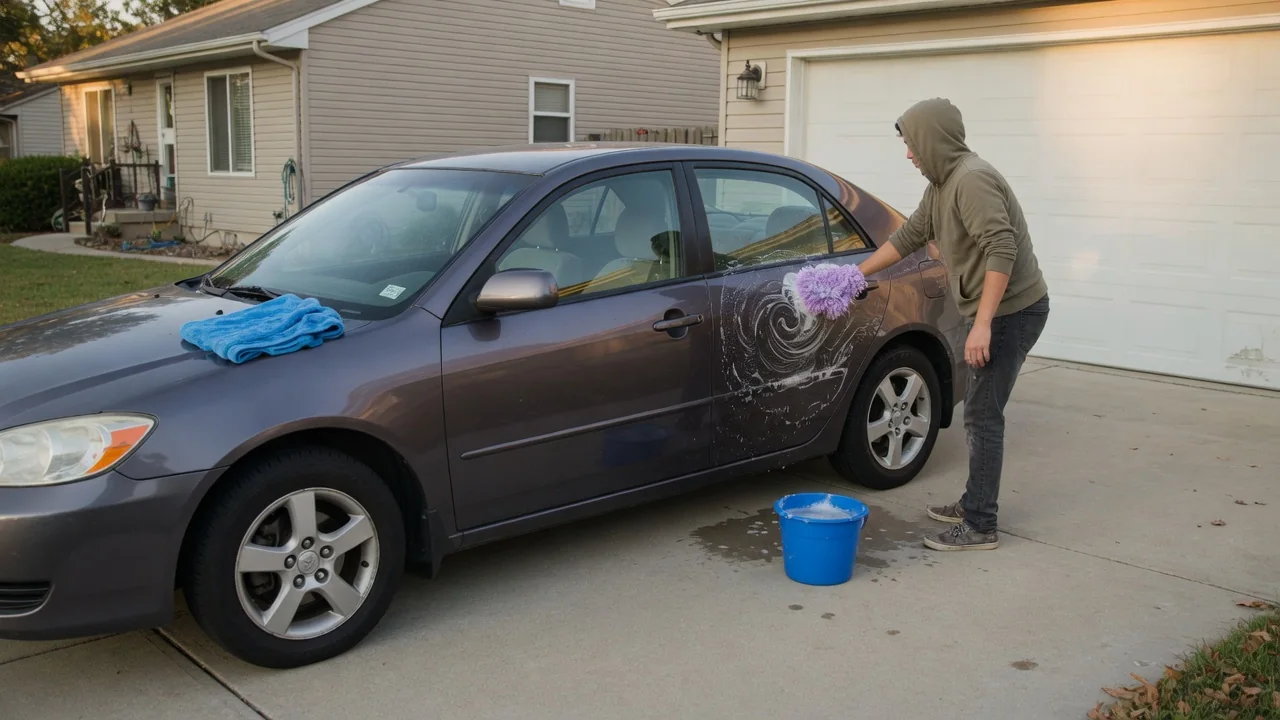
What is a rinseless car wash? It is a way of cleaning a lightly soiled vehicle with a small volume of water mixed with a concentrated solution that needs no hose rinse afterward. The solution loosens and surrounds dirt so it can be wiped away with soft towels, and each panel is then dried. It suits apartments, water-restricted areas, and winter garages.
Assess dirt load
Before mixing a bucket, look closely at what is actually on the paint. A rinseless wash works best on light dust, pollen, fingerprints, dried water spots from a recent rain, and the thin gray road film that builds up after a few days of commuting. Run your eyes along the lower doors, rocker panels, and the area behind each wheel, because those surfaces collect the heaviest grit. If the film looks even and powdery rather than gritty or caked, the car is a good candidate.
Caked mud, road salt crust, sand packed into wheel arches, or tar splatter change the picture. Those contaminants contain hard particles that a towel can drag across the clear coat, leaving fine swirl marks. In that case a pressure rinse at a self-service bay removes the bulk first, and the rinseless method can finish the job. Vehicles vary as well: a truck driven on gravel roads carries far more abrasive material than a garaged sedan, and dark or soft paints show marring more readily than light colors.
Lubricate
Lubrication is what separates this method from simply wiping a dirty car with a wet rag. Rinseless concentrates contain polymers and surfactants that, once diluted in water according to the product label, make the solution feel slick between your fingers. That slickness reduces friction between towel and paint, while the chemistry helps lift particles off the surface and hold them in suspension so they are less likely to scratch as they are carried away.
In practice, many people pre-soak each panel with a pump sprayer filled with the same diluted solution, letting it dwell briefly before touching the paint. You can watch the film begin to soften and run down the panel. The towel should glide with almost no drag; if it grabs or squeaks, the surface needs more solution. Dilution ratios differ between products, and some also serve as a quick detailer or clay lubricant at other strengths, so the instructions on the bottle matter.
Use clean towels
The towels do the job a hose would normally do, so their condition is critical. Plush microfiber towels, soaked in the bucket and lightly wrung out, are folded into quarters to give several clean faces. Wipe in straight, overlapping passes with light pressure, working from the roof down, and flip to a fresh side once the face shows visible gray. When every side is used, set that towel aside rather than returning it to the clean solution.
This approach, often called the multiple towel method, keeps removed grit out of the bucket. Some detailers prefer a single wash sponge or mitt with a grit guard at the bottom of the bucket instead; either works as long as contaminated material never goes back onto the paint. Follow immediately with a separate soft drying towel before the solution evaporates. A towel dropped on the ground should be retired from the session, since embedded sand is nearly impossible to see.
Everyday Use and Observations
For everyday use, the appeal is convenience. A whole sedan can typically be cleaned with a single bucket of water in a garage, a parking space, or a shaded driveway, with no runoff streaming down the street. That makes the method practical during winter, under drought restrictions, or in apartment complexes where hoses are not permitted. Working one panel at a time, out of direct sun and on cool paint, prevents the solution from drying into streaks.
Afterward, the paint should feel smooth and look glossy, with no soap residue left behind, because the solution is designed to be wiped away completely. Glass, door jambs, painted wheels, and plastic trim can usually be cleaned with the same mixture, though wheels with heavy brake dust deserve their own towels. Cars protected with wax, sealant, or ceramic coating tend to release dirt more easily, so the towel glides better and drying takes less effort than on unprotected, oxidized paint.
Limits and Next Steps
A rinseless wash is not a replacement for every wash. It cannot safely handle heavy off-road mud, thick winter salt, or packed debris in the undercarriage and wheel wells, and it will not remove bonded contaminants such as tar, tree sap, or embedded iron particles. Bird droppings and bug residue may need extra soaking time before they release. Forcing a towel across stubborn spots is how scratches happen, so persistent grime calls for a traditional or touchless pre-rinse.
The method also differs from a waterless wash, which is sprayed directly from a bottle and suits even lighter dust, and from a conventional two-bucket wash with foaming soap and a full hose rinse. A sensible next step is to try it on a lightly dusty car, inspect the paint under good light afterward, and adjust towel count or pre-soak as needed. If the finish feels rough even when clean, decontamination with clay or a polish may be the following stage.