What Is a Restoration Parts Catalog? Part Numbers, Variants and Sourcing
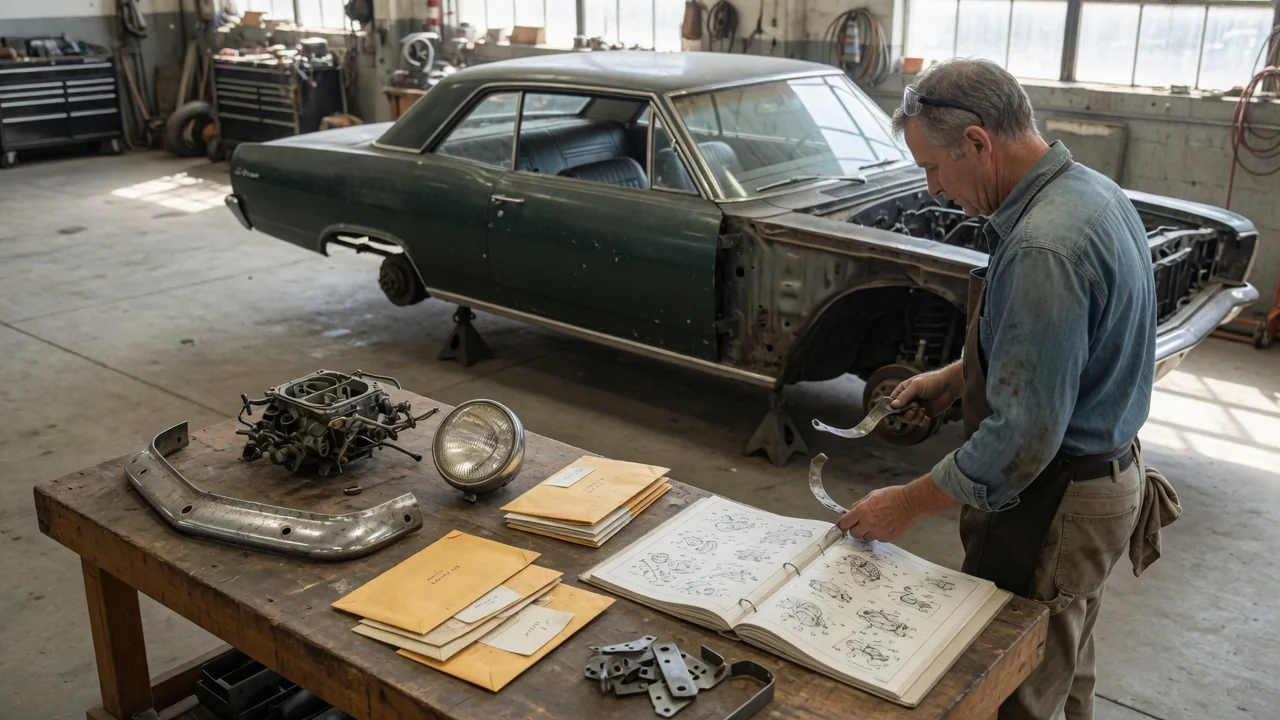
A restoration parts catalog is a structured reference that lists the components of a vehicle, shows how they relate to each other, and explains how they can be identified and obtained. For anyone planning a restoration, it turns a collection of worn, missing, or mismatched parts into an organized list for verification and purchasing. This guide explains what such a catalog contains, how it handles part numbers and production variants, and how classic car parts catalog use fits into sourcing decisions.
Part numbers: how a catalog identifies components
At its core, a restoration parts catalog is an index of part numbers. Each component a manufacturer produced, from a major casting down to a clip or grommet, was typically assigned an identifying number used for production, service, and ordering. Catalogs usually group these numbers by system, such as engine, fuel, cooling, brakes, suspension, electrical, body, and interior trim. Within each group, exploded-view illustrations show how parts fit together, with small callout numbers pointing to each piece. Those callouts are not part numbers themselves. They are keys that link the drawing to a table listing the actual number, a description, the quantity used per vehicle, and any applicability notes.
Part numbers are not always stable. Manufacturers often superseded an original number with a newer one when a design was revised, a supplier changed, or several versions were consolidated into a single service part. A good catalog records these supersessions so you can follow a number forward or backward. Reproduction and aftermarket suppliers frequently assign their own catalog numbers as well, ideally cross-referenced to the original. It also helps to know that numbers stamped or cast into a part are not necessarily the same as the service part number listed in a catalog, so a marking found on a component should be treated as a clue for research rather than a direct ordering reference.
Variants: matching parts to the right version
A single model name rarely describes a single set of parts. Over a production run, manufacturers commonly introduced running changes, offered different engines, transmissions, axle ratios, and body styles, and built versions for different markets with their own lighting, emissions, or safety equipment. Trim levels added or removed badges, upholstery patterns, and convenience features. A restoration parts catalog handles this by attaching applicability information to each entry: production date ranges, serial or VIN ranges, model or body codes, option codes, or notes such as left-hand versus right-hand drive. Reading those qualifiers carefully is what separates a correct part from one that only looks similar.
To use variant information, you first need to know exactly what your vehicle is. Identification data may come from the VIN, a body or trim plate, build documentation, or original sales paperwork, depending on what survives for a given car. Even then, the car in front of you may not match how it left the factory. Previous owners may have swapped engines, fitted parts from other years, or used whatever was available during earlier repairs. For that reason, catalog applicability should be checked against the physical parts on the car. When a catalog lists two versions of a component, comparing dimensions, mounting points, connectors, or markings on the original usually shows which one you need.
Sourcing: turning catalog entries into real parts
Once a part is identified, the catalog becomes a sourcing tool. Restorers typically draw from several kinds of supply. New old stock refers to original parts made during or near the production era that were never installed. Some manufacturers continue to supply service parts for older vehicles, though availability varies widely. Reproduction parts are newly manufactured to match an original design, while remanufactured or rebuilt parts are used cores restored to working condition. Used and salvage parts come from other vehicles. Having the correct original number, plus any superseded and cross-referenced numbers, makes it far easier to search across these sources and to confirm that what a seller offers is actually the same item.
Supplier catalogs deserve a careful reading. A catalog published by a parts vendor is both a reference and a sales document, and descriptions such as correct or original-style can mean different things to different sellers. Fit, finish, and material of reproduction parts may differ from the originals. Before buying, it is reasonable to ask for dimensions, photos, or material details and to compare them with the part being replaced. Keeping the old component as a reference sample, even when it is damaged, helps confirm a match on arrival. For used parts, checking numbers and markings on the actual item reduces the risk of receiving a lookalike from a different variant.
Practical implications and limits
In practice, a restoration parts catalog is most useful early in a project. Working through it assembly by assembly helps build a parts list, estimate scope, and spot items that may be hard to find before the car is fully disassembled. Recording catalog numbers alongside photos and labels taken during teardown creates a reference for reassembly and for future orders. It also helps separate parts that must be replaced from those that can be cleaned, repaired, or reused, which influences both the schedule and the budget of the restoration.
A catalog also has clear limits. It identifies parts; it does not explain how to remove, adjust, or install them, and it does not provide torque values, clearances, or wiring procedures. That information belongs to service and repair manuals. Catalogs can contain errors, omit rare variants, or leave out dealer-installed accessories and field modifications. A matching number does not by itself prove that a part is original to a particular car or that its condition is acceptable. The most reliable results come from combining catalog data with the vehicle's own identification, the appropriate service documentation, and a close physical inspection of every component before money is spent.