What Is a Reluctor Wheel? Teeth, Position Sensing, and Damage
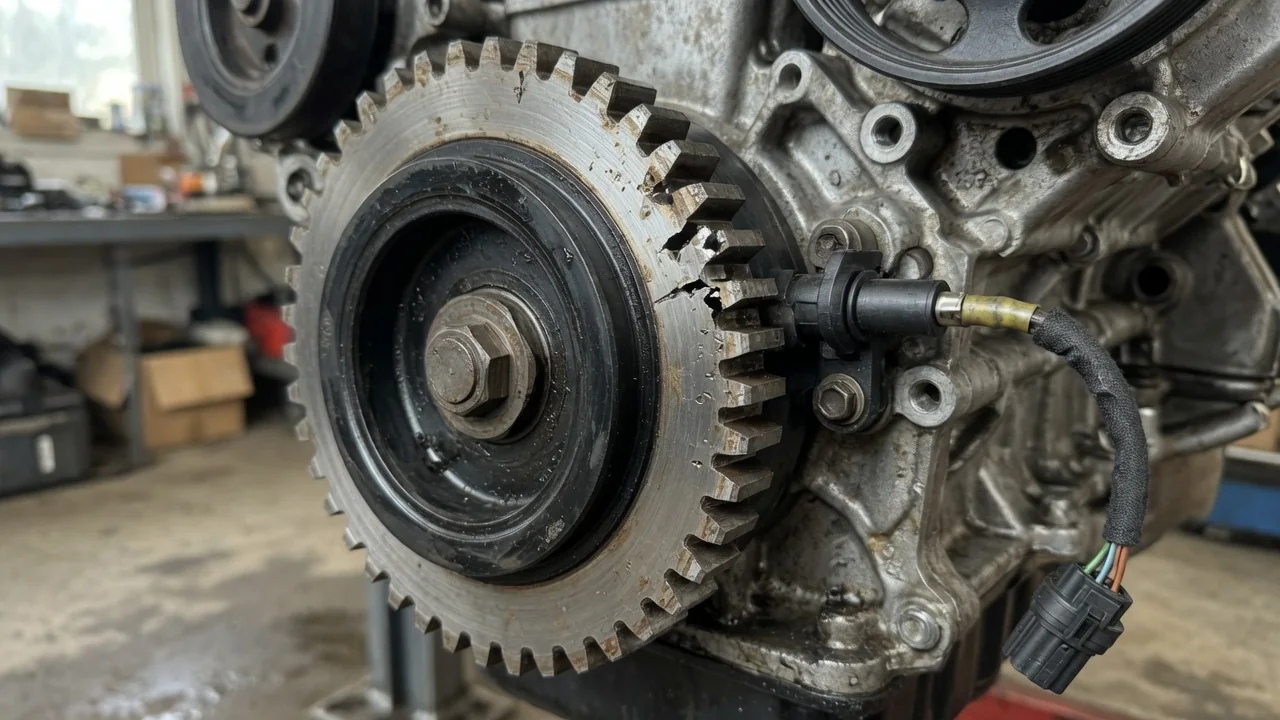
A reluctor wheel is a toothed metal ring that rotates with a shaft so a nearby sensor can track its speed and position. You may also see it called a tone ring, trigger wheel, or timing wheel. Engines use reluctor wheels on the crankshaft and camshaft, and many anti-lock brake systems use similar rings at the wheels. Knowing what a car reluctor wheel does helps explain why some sensor faults are not caused by the sensor itself.
Teeth and gaps
A reluctor wheel's defining feature is its alternating pattern of teeth and gaps. The ring is usually made from a ferrous material such as steel or iron, because the sensor responds to magnetic material passing its tip. Each tooth briefly brings metal close to the sensor, and each gap moves it away. As the shaft spins, this alternation turns rotation into a repeating signal. Depending on the design, the ring may be pressed onto the crankshaft, machined into a flywheel or flexplate, or mounted behind a crankshaft pulley. It can also sit on a camshaft or its sprocket, or be part of a wheel hub, axle shaft, or CV joint housing.
Evenly spaced teeth tell a control module how fast the shaft is turning. They cannot show where the shaft is within its rotation, because every tooth looks the same. To solve this, many crankshaft reluctor wheels include a deliberate irregularity, most often one or two missing teeth. Patterns described as 36-1 or 60-2 are common examples. The first number is the count of evenly spaced tooth positions, and the second is how many teeth are left out. The longer gap creates a recognizable signature once per revolution. Camshaft targets typically use fewer, unevenly spaced teeth or a mix of wide and narrow segments. That lets the module tell which part of the four-stroke cycle the engine is in. Tooth count and arrangement vary by manufacturer and engine, so the pattern on one vehicle should not be assumed for another.
Position sensing
A reluctor wheel does nothing on its own. It serves as a target for a sensor mounted a small distance away. Two sensor approaches are widely used. A variable reluctance sensor, sometimes called a magnetic or inductive pickup, contains a permanent magnet and a coil. Each passing tooth changes the magnetic field through the coil and induces an alternating voltage, and both the frequency and the strength of that signal rise with shaft speed. Hall effect and magnetoresistive sensors are powered by the vehicle and produce a digital on-off signal that keeps its shape even at very low speed. Either way, the sensor converts the tooth-and-gap pattern into a stream of pulses for the control module.
The engine control module counts pulses from the reference gap to calculate crankshaft angle and engine speed. It then compares the crankshaft signal with the camshaft signal to determine which cylinder is nearing top dead center on its compression stroke. That information sets ignition timing and, in fuel-injected engines, injector timing. Combustion events speed the crankshaft up slightly and compression strokes slow it down. Many systems therefore also watch small changes in the time between teeth to help detect misfires. Anti-lock brake modules use wheel speed tone rings more simply. They mainly compare rotation rates between wheels to spot lockup or slip, and the speed data is often shared with traction and stability control. Some wheel bearings use a magnetic encoder built into the seal instead of a visible toothed ring, but the principle is the same: a sensor reading a repeating pattern.
Damage
The sensor depends on a precise, repeatable pattern. Anything that alters the teeth, the gaps, or the position of the ring can corrupt the signal. Common damage includes chipped, bent, or broken teeth and cracks in the ring. Rust can also build up between teeth or swell the ring, and metal debris can cling to a magnetic sensor tip or to the ring itself. Exposed wheel speed tone rings are especially vulnerable to rust, road debris, and impact. Pressed-on rings can crack as corrosion expands beneath them. Damage can also happen during repairs, such as when tools strike the ring or a hub, axle, or flywheel is handled carelessly. A reluctor wheel that loosens or rotates on its mount is a particular concern. The teeth may look intact while the reference point has shifted relative to the shaft.
The symptoms depend on which ring is affected and how badly. A damaged crankshaft reluctor wheel can cause the engine to crank but not start, stall intermittently, run rough, or make the tachometer drop or jump. It can also set misfire codes or crankshaft position sensor codes such as P0335. A camshaft target problem may set crank-to-cam correlation codes, lengthen cranking time, or put the engine into a reduced-power mode. A damaged wheel speed tone ring often turns on the ABS or traction control light. It can also cause the ABS to activate at low speed when the module reads a missing pulse as a locking wheel. None of these symptoms is unique to reluctor wheel damage.
Practical implications and limits
For owners and technicians, the most useful lesson is that a sensor code does not prove the sensor is bad. A new sensor reading a cracked, corroded, or contaminated target will usually set the same fault. The target deserves inspection before or alongside a sensor replacement. Where the ring is visible, a careful look for missing teeth, cracks, rust scale, and debris is a reasonable first step. Where it is hidden, an oscilloscope can show the sensor signal. A distorted or missing pulse that repeats at the same point every revolution points toward the target rather than the wiring. Damaged wiring, corroded connectors, and an incorrect sensor air gap can create similar problems, so they belong in the same check.
Repair difficulty varies widely. Some wheel speed tone rings can be replaced separately, while others are integral to a hub, bearing, axle, or CV joint and come only as part of that assembly. Some crankshaft reluctor wheels sit behind an external pulley, while others are inside the engine and require major disassembly to reach. After replacing a crankshaft sensor, reluctor wheel, flywheel, or related part, some vehicles call for a crankshaft position variation relearn or a similar procedure. Misfire monitoring may not work correctly until it is completed. Tooth patterns, mounting methods, and required procedures are vehicle-specific. The service information for the exact vehicle is the reliable guide for part selection, installation, and any relearn step.