What Is a Regeneration Power Limit? Battery, Inverter and Temperature Explained
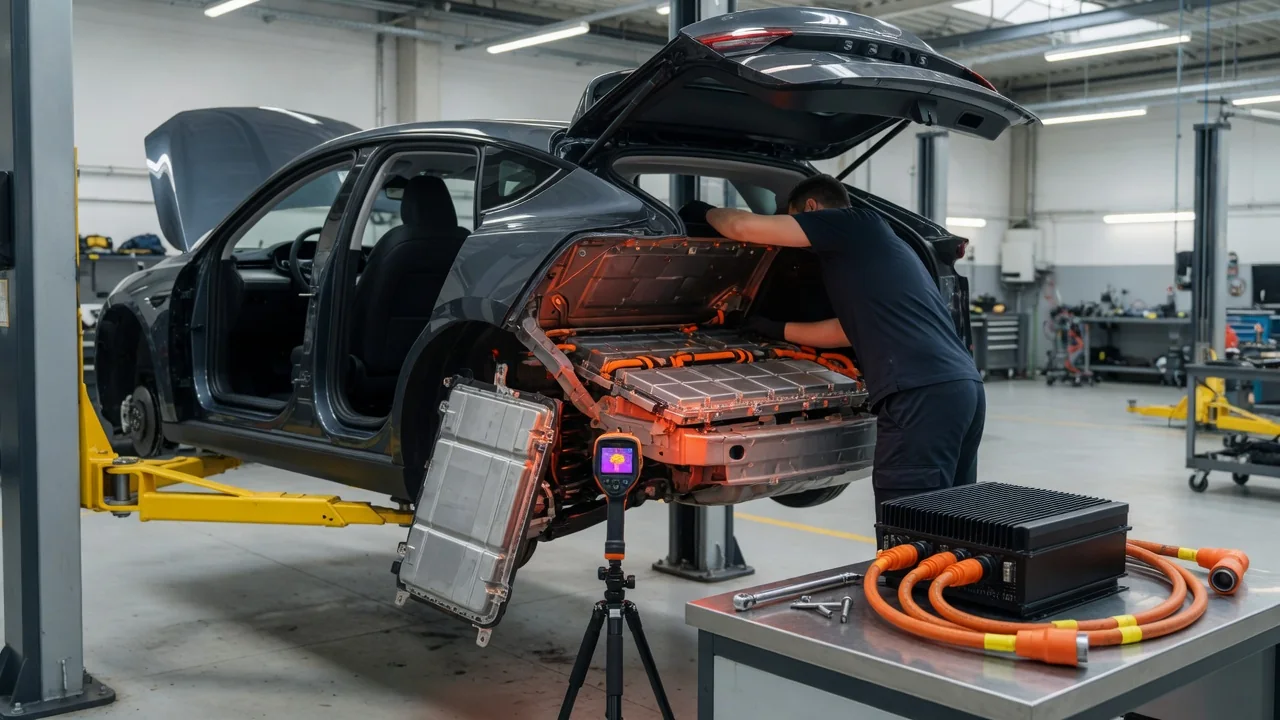
A regeneration power limit is the maximum rate at which an electric or hybrid vehicle can turn its motion back into stored electrical energy while slowing down. It is a limit on power, not a fixed braking force, and the vehicle's control software recalculates it constantly. The limit is the lowest of several ceilings, set by the battery, by the inverter and motor, and by the temperature of each component. Those ceilings explain why regenerative braking feels stronger on some drives than on others.
Battery Acceptance: How Much Charge the Pack Can Take
Regenerative braking is a form of charging. So the first thing the battery management system has to work out is how much charging power the pack can accept at that moment. This value is often called charge acceptance or allowable charge power. It depends on the battery's state of charge, its cell voltages and its internal resistance. Pushing current into a cell raises its terminal voltage, and every lithium-ion chemistry has an upper voltage limit. Going past it speeds up wear and can create safety risks. The closer the cells already are to that ceiling, the less extra current they can absorb before the limit is reached.
This is why regeneration is often reduced or unavailable when the pack is full or nearly full. Two common cases are right after charging to a high level, or at the start of a long downhill drive from a home on a hill. With little room left, the battery management system lowers the permitted charge power, and the regeneration limit drops with it. As the battery discharges during driving, headroom returns and the limit rises again. Pack size also matters. A larger battery spreads the same current across more cells, so for a given chemistry and condition it can generally accept more power than a small hybrid pack. The system also watches cell balance. If one group of cells sits at a higher voltage than the rest, that group can restrict charging for the whole pack.
The Inverter and Motor as a Second Ceiling
Even when the battery can accept plenty of power, the energy still has to pass through the drive system. During regeneration the traction motor works as a generator and produces alternating current. The inverter converts that current into direct current at the battery's voltage. The inverter's power semiconductors have current and voltage ratings, and the motor windings have their own current and heat limits. The motor controller enforces those ratings. As a result, the regeneration power limit can never exceed what the inverter and motor are designed to handle, whether continuously or in short peaks.
Available regenerative power also changes with motor speed. Power is torque multiplied by rotational speed, and torque is capped by the current the hardware can carry. At higher road speeds, the system may therefore hit its power limit rather than its torque limit. At very low speeds, the recoverable power becomes small and losses make recovery inefficient. That is one reason regenerative braking usually fades as a vehicle nears a stop, and the friction brakes or a dedicated low-speed control strategy take over. The controller also applies software limits for drivability and stability. For example, it may reduce regenerative torque on the driven wheels when traction is poor, so regeneration does not cause a wheel to slide on a slippery surface.
Temperature: Why Cold and Heat Reduce Regeneration
Temperature affects every component in the regenerative path, but its effect on the battery is usually the most noticeable. Lithium-ion cells accept charge more slowly when cold. The chemical reactions and ion movement inside the cell slow down, and internal resistance rises. Charging a cold cell too quickly can cause lithium plating, where metallic lithium builds up on the anode surface instead of being stored inside it. This permanently reduces capacity. To prevent it, the battery management system sharply lowers allowable charge power at low cell temperatures. On cold mornings this can weaken or remove regenerative braking until the pack warms up.
High temperatures impose limits from the other direction. A hot battery ages faster under heavy charging, so the management system may reduce charge acceptance once cell temperatures move above its preferred range. The inverter and motor also generate heat during sustained regeneration, such as on a long mountain descent. The controller will reduce output if semiconductor or winding temperatures approach their limits. Thermal management systems help keep components in range, using liquid coolant, heat pumps or resistive heaters depending on the design. On vehicles that offer battery preconditioning, warming the pack before departure can restore regeneration sooner in cold weather.
Practical Implications and Limits
In practice, the regen power limit in an electric car or hybrid keeps changing. Drivers may notice weaker deceleration when lifting off the accelerator, a reduced or capped regeneration gauge, or a message saying regenerative braking is limited. These signals vary by manufacturer. Some vehicles try to keep lift-off deceleration consistent by quietly blending in the friction brakes. On vehicles with blended braking, the brake pedal should still deliver the braking the driver asks for, because the control system adds hydraulic friction braking to make up the difference. What changes is how much energy is recovered and, in one-pedal driving modes, how strongly the car slows without the brake pedal.
A few habits follow from these mechanisms. Where the manufacturer recommends a lower everyday charge level, following it leaves room for energy recovery at the start of a trip. This matters most when the route begins downhill. In cold climates, expect reduced regeneration for the first part of a drive and more use of the friction brakes. On long descents, recovery can taper as the battery fills or components heat up, so the friction brakes may do more work than usual. The owner's manual describes the recommended technique for controlling speed on steep grades.
It also helps to keep the concept in perspective. A regeneration power limit is not a fault in itself. It is a protective boundary calculated from current conditions. The exact thresholds, the order in which constraints apply and the way limits are displayed are specific to each vehicle and are not published consistently. General explanations therefore cannot predict how a particular car will behave at a given temperature or charge level. If regeneration stays limited after the battery has warmed and has room to charge, or if a warning light appears along with the change, check the vehicle's documentation and have a qualified technician inspect it.