What Is a Rear Wing on a Race Car? Downforce, Drag and Setup Explained
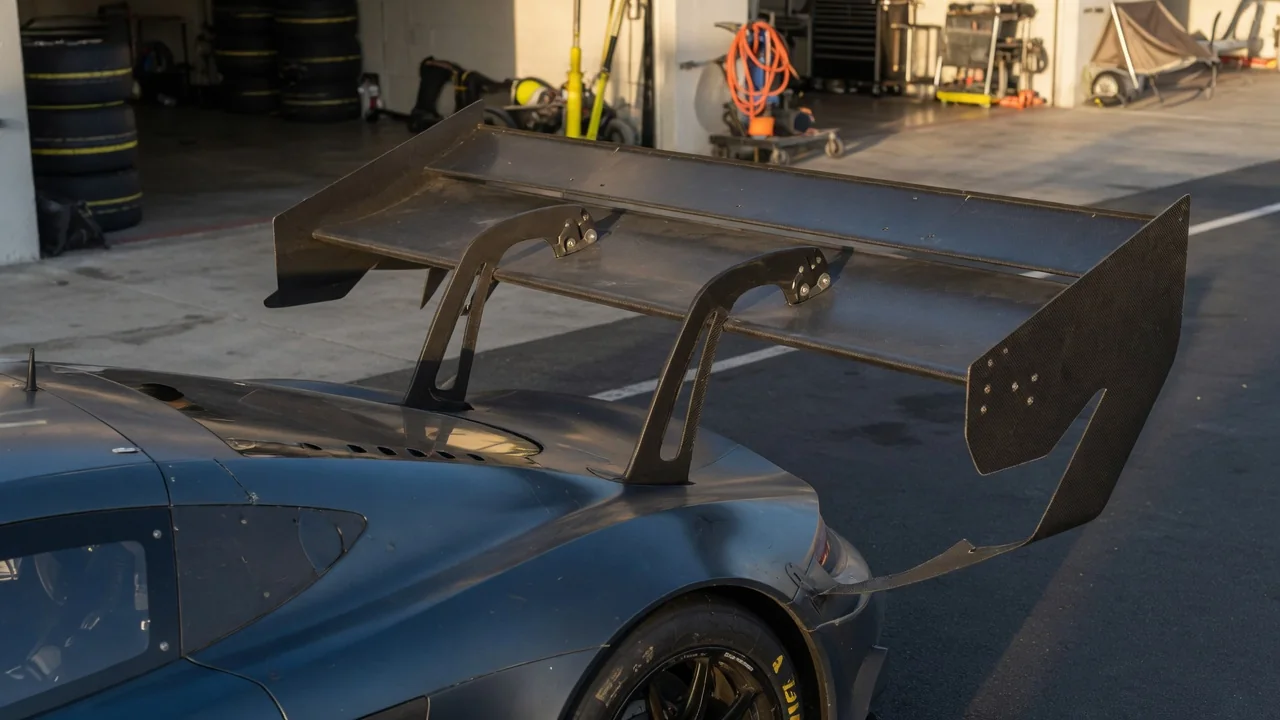
A rear wing on a race car is an aerodynamic device mounted at the back of the car. It uses airflow to press the rear tires harder into the track. Its job is not decoration. It gives up some straight-line speed in exchange for more grip in corners and under braking. Understanding how it works comes down to three topics: how it creates downforce, why it adds drag, and how teams set it up for a given track.
Downforce: How a Rear Wing Generates Grip
A rear wing works on the same basic principle as an aircraft wing, but it is mounted upside down. Its cross-section, called an airfoil, is shaped and angled so that air moving along the lower surface travels faster than the air passing over the upper surface. That faster air is at lower pressure. The pressure difference between the two surfaces produces a net force. On an airplane, that force lifts the wing upward. On a race car, the inverted wing pushes the rear of the car downward instead. This downward aerodynamic force is called downforce.
Downforce matters because a tire's grip depends heavily on how hard it is pressed against the road surface. Adding weight would also press the tires down, but weight comes with costs. Extra mass must be accelerated, slowed and turned, and it loads the tires in every situation. Aerodynamic downforce adds load without adding mass, so the tires can produce more cornering and braking force than the car's weight alone would allow. Because the wing sits at the back, most of its effect lands on the rear axle. On rear-wheel-drive cars, this helps keep the driven tires planted under acceleration. On any car, it helps keep the back end stable through fast corners.
Downforce from a wing grows rapidly with speed. Aerodynamic forces generally increase roughly with the square of airspeed. A wing that does little at low speed can therefore produce a substantial load at high speed. This is why rear wings matter most in fast corners and in heavy braking from high speed. In tight, slow corners, mechanical grip from the tires and suspension does most of the work. Many rear wings use more than one element: a main plane plus one or more flaps. Endplates at each side limit the air spilling around the wing tips, which would otherwise weaken the pressure difference.
Drag: The Cost of Making Downforce
No wing produces downforce for free. Bending the airflow to create a pressure difference also creates drag, the aerodynamic force that resists the car's forward motion. Some of this drag comes from the wing's frontal area and from friction along its surfaces. A significant share is induced drag, which is tied directly to producing the downforce itself. Wing-tip vortices are a major source of it. These swirling flows form at the ends of the wing, where the high- and low-pressure regions meet. Endplates reduce the effect but cannot eliminate it.
Like downforce, drag rises sharply with speed. On a long straight, more drag means the engine must work harder to push the car through the air. That lowers top speed and reduces acceleration at higher speeds. Over a race distance, it can also increase fuel use. The engineering goal is therefore not maximum downforce. It is the best balance between downforce and drag for a particular circuit, often described as aerodynamic efficiency. A wing that delivers useful downforce with comparatively little drag is more efficient than one that simply produces a lot of both.
Some racing series allow mechanisms that temporarily reduce rear wing drag, such as a flap that opens on designated straights. Whether a car has such a system, and when it may be used, depends entirely on the rules of its series. It should not be assumed for any particular car.
Setup: Adjusting the Rear Wing for the Track
The most common rear wing adjustment is the angle of attack: the angle at which the wing, or its upper flap, meets the oncoming air. A steeper angle generally increases downforce and drag together. A flatter angle reduces both. Many wings offer several mounting positions or adjustable flap settings, so teams can change the angle between sessions. The available range depends on the car's design and the regulations it races under. So do the adjustment method and whether changes are permitted during an event.
Track layout largely drives the choice. Circuits with many medium- and high-speed corners tend to reward higher wing settings, because the time gained in corners outweighs the time lost on the straights. Circuits dominated by long straights and slow corners tend to favor lower settings that cut drag. Weather matters as well. In wet conditions, grip is scarce and outright straight-line speed is less decisive, so teams often add wing angle.
The rear wing is never set in isolation. Adding rear downforce shifts the car's aerodynamic balance rearward. That tends to reduce oversteer at speed, but it can create understeer if the front of the car cannot match it. Teams therefore balance the rear wing against front aerodynamic devices such as splitters or front wings. They also consider ride height, springs and dampers, because the platform the car rides on affects how consistently the aerodynamic surfaces work. The aim is a predictable balance that the driver can trust across the whole speed range.
Practical Implications and Limits
For anyone watching or working on race cars, the key point is that a rear wing's value depends on context. Its benefit depends on speed. On a car that rarely corners quickly, a wing may add drag and weight while contributing relatively little grip. A wing also needs reasonably clean airflow. Following closely behind another car puts it in disturbed, slower air, which can reduce the downforce it makes. Bodywork ahead of the wing shapes the air reaching it too. The same wing can therefore behave differently on different cars.
Structural and safety limits matter just as much. Downforce loads pass through the wing supports into the chassis, so the mounts must be strong enough for the highest speeds the car will reach. A failed wing can cause a sudden loss of rear grip. Wings and spoilers on road cars are a separate case. Many are designed mainly for appearance or modest stability, and their real effect cannot be judged by looks alone. Any change to a race car's wing should follow the manufacturer's guidance, the series rulebook and advice from qualified engineers.