What Is a Radiator Cap Pressure Rating?
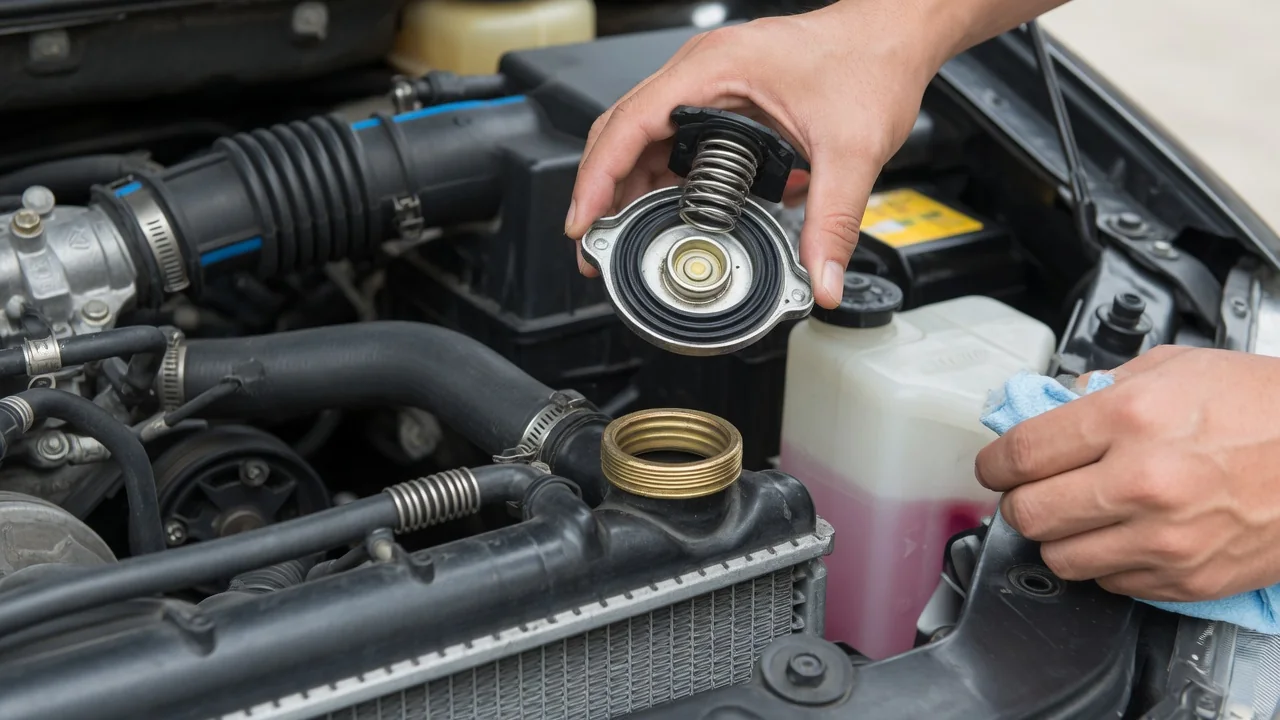
A radiator cap pressure rating is the pressure at which the cap's valve opens and lets coolant escape to the overflow reservoir. It is usually stamped on the cap in psi, kPa, or bar. The number is a design limit. It sets how much pressure the cooling system can hold, and that pressure raises the coolant's boiling point. Knowing what the rating means helps you choose the correct cap and service the system safely.
System pressure: what the rating controls
A modern cooling system is sealed. As the engine warms, coolant expands. With nowhere to go, it raises the pressure inside the radiator, hoses, engine passages, and heater core. The radiator cap contains a spring-loaded valve pressed against a rubber seal. On many vehicles this cap sits on a pressurized coolant reservoir instead of the radiator. The pressure rating is the point where the spring is overcome. Below that pressure, the valve stays shut and the system holds pressure. When internal pressure reaches the rating, the valve lifts and excess coolant flows into the overflow or expansion tank, which keeps pressure from climbing further. In other words, the cap works as a calibrated relief valve. It lets the system run pressurized while protecting components from excessive pressure.
Ratings are usually printed on the cap. In the US they are often shown in pounds per square inch, and many caps show kilopascals or bar as well or instead. One bar is about 14.5 psi, or 100 kPa. Many passenger vehicles use caps rated in the low to middle teens of psi. The correct value is whatever the vehicle manufacturer specifies, and it varies by design. The number is a gauge pressure, meaning pressure above the surrounding air. It is also a release threshold, not the pressure the system holds all the time. A cold engine has little or no system pressure, and a warm one often runs below the cap's limit.
Most caps also contain a second, smaller vacuum valve. As the engine cools, coolant contracts and system pressure can drop below atmospheric. The vacuum valve then opens and draws coolant back from the reservoir. This keeps the radiator full and stops hoses from being pulled inward. A cap with a good pressure valve but a stuck vacuum valve can still cause problems, so both functions matter.
Boiling point: why pressure keeps coolant liquid
The main reason a cooling system runs under pressure is to raise the boiling point. A liquid boils when its vapor pressure equals the pressure around it, so higher system pressure means coolant must get hotter before it turns to vapor. A common rule of thumb is that each psi raises the boiling point of water-based coolant by roughly 3°F. Pure water boils at about 212°F at sea level. Under a cap rated in the mid-teens of psi, its boiling point rises to roughly the 250°F range, before antifreeze is even counted.
Antifreeze adds its own margin. A properly mixed ethylene glycol or propylene glycol coolant boils at a higher temperature than plain water at the same pressure, and cap pressure adds to that increase. Together, these let engines run at normal operating temperatures that may be above water's atmospheric boiling point without the coolant flashing to steam. This matters because vapor carries heat poorly. If coolant boils around hot spots such as the cylinder head, steam displaces the liquid that should be carrying heat to the radiator, and local temperatures can rise quickly. A cap that leaks below its rating shrinks this margin. That can lead to boil-over, coolant loss, and overheating even when the rest of the system is healthy.
Safe service: opening, testing, and replacing the cap
The most important rule is to never open a hot, pressurized cooling system. Removing the cap releases pressure suddenly. Coolant that stayed liquid only because it was under pressure can flash to steam and spray out, causing serious burns. Let the engine cool until the upper hose and reservoir are no longer hot to the touch. Even then, cover the cap with a thick cloth and turn it slowly to the first stop, if it has one, so any remaining pressure can vent before you remove it fully. Also confirm which cap is the pressure cap. On some vehicles it is on the radiator and on others it is on the coolant reservoir. A plain, unpressurized overflow bottle cap is a different part.
You can check a cap with a cooling system pressure tester and a cap adapter. The tester pumps air against the cap to show whether it holds pressure up to its rating and releases near it. Inspect the rubber seals for cracking, hardening, or deformation, and make sure the spring and vacuum valve move freely. Signs that may point to a weak cap include coolant loss with no visible leak, a reservoir that overfills when hot but does not return coolant when cold, hoses that collapse after cooldown, and steam or coolant odor near the cap. Other faults can cause the same symptoms, so test the cap before assuming it has failed.
When replacing a cap, match the rating and physical design the manufacturer specifies, including the filler neck style and seal depth. A higher-rated cap is not automatically an upgrade. It makes the system hold more pressure than the hoses, radiator, heater core, and seals were designed for, which can cause leaks or failures. A lower-rated cap releases coolant too early and lowers the boiling point. Confirm the correct value in the owner's manual, a service manual, or the parts specification for your vehicle.
Practical implications and limits
In everyday driving, the pressure rating works in the background, but other conditions affect it. Atmospheric pressure drops at high altitude. Because the cap rating is measured relative to outside air, total system pressure is lower there, and so is the boiling point. That leaves less margin when climbing grades under load or towing. A correct cap also cannot make up for low coolant, old or wrongly mixed coolant, a clogged radiator, a failing water pump, a stuck thermostat, or a fan that does not run. The cap only sets the pressure ceiling. It does not move heat by itself.
Pressure behavior can also point to problems the cap is not responsible for. Combustion gases entering the coolant through a failed head gasket or a cracked component can raise pressure quickly and force coolant out past the cap, making a good cap look faulty. On the other hand, a system that never builds pressure may have an external leak rather than a cap fault. Finally, the rating on a cap is its design value, not a prediction of how a particular vehicle behaves. Thermostat opening points, temperature gauge behavior, and fan control differ between designs. Read the cap rating together with vehicle-specific service information, not as a diagnosis on its own.