What Is a Racing Roll Cage? Structure, Safety Role and Road-Car Limits
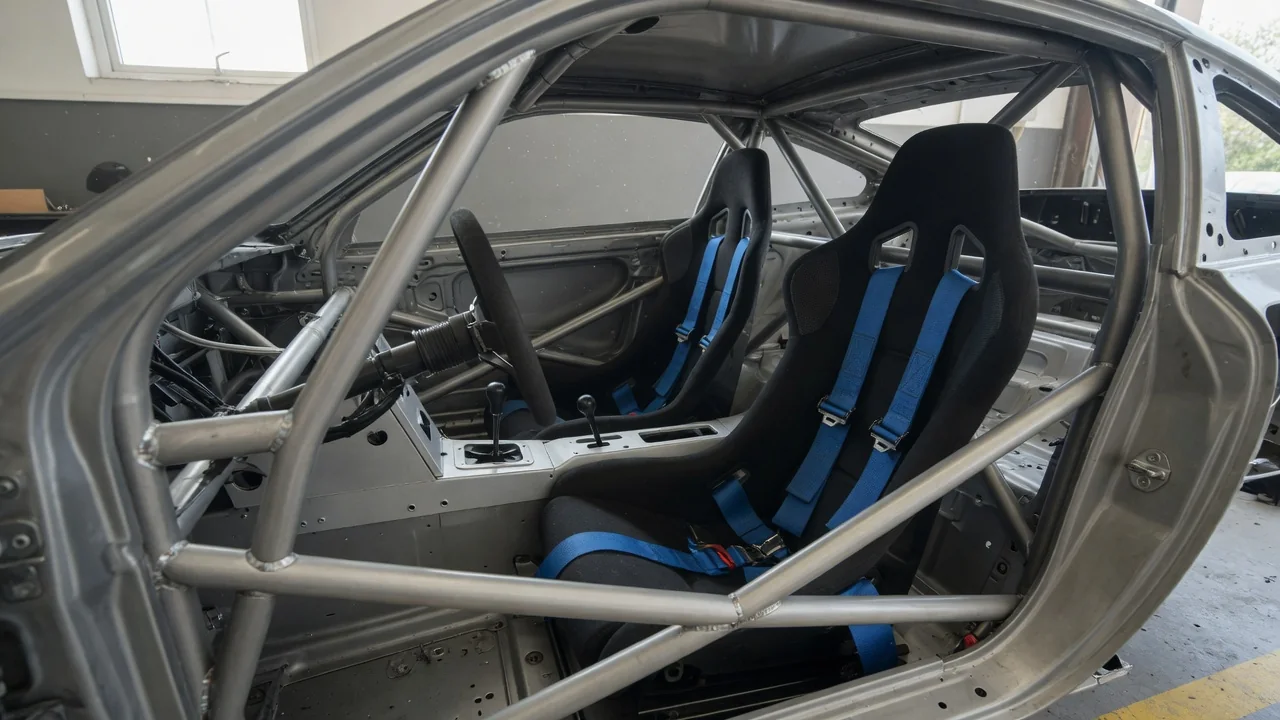
What is a racing roll cage? It is a framework of steel tubes built inside a car's passenger compartment to protect occupants if the vehicle rolls over or suffers a severe impact. The factory body shell is designed around crumple zones and everyday use. A cage instead creates a rigid survival space around the driver. Knowing how its tubes work together, and why it suits the track better than the street, helps owners judge whether one belongs in their car.
Tube structure: how a roll cage is built
The core of most cages is the main hoop, a single bent tube that runs up behind the front seats, across the roof line and down to the floor on the opposite side. It is the primary roll structure and carries load if the car lands on its roof. A front hoop or a pair of tubes follows the windshield pillars and connects to the main hoop through roof bars, so the cabin is enclosed by a continuous frame rather than isolated arches. Rear stays run from the top of the main hoop toward the back of the chassis to keep the hoop from folding forward or backward.
Bracing turns these hoops into a working structure. Diagonal tubes across the main hoop, and sometimes across the roof, form triangles, which resist distortion far better than open rectangles. Door bars run along the sides to add protection against side intrusion. Each tube ends at a mounting point, usually a steel plate welded or bolted to the floor, sills or pillars, which spreads load into the bodyshell instead of letting the tube punch through thin sheet metal. Joints between tubes are typically welded, and gussets are often added at highly stressed corners.
Cages are commonly made from seamless steel tubing, either mild steel or a chromium-molybdenum alloy, chosen for a balance of strength, ductility and weldability. Tube diameter, wall thickness and the required layout are set by the rules of the sanctioning body for a given series, not by general preference. Bolt-in cages attach through flanged joints and can be removed, while weld-in cages are fused to the body and tied more closely into its structure. The right type depends on the intended class, its rules and how the car will be used.
Safety role: what a motorsport roll cage does
The central motorsport roll cage function is preserving survival space. In a rollover, a production roof can deform toward the occupants, and in a hard side impact the door and pillar can intrude into the cabin. A cage places a stiff frame inside that space so the structure around the driver keeps its shape while outer panels absorb and deflect damage. The aim is not an undamaged car but an intact area around the seat.
A cage works as part of a system. It provides support and anchorage for a fixed racing seat and a multi-point harness, and in many classes it is paired with a window net and padding on tubes near the helmet. The harness holds the driver in place relative to the cage, while a helmet and head-and-neck restraint manage forces on the head. Without these companions, a rigid cage alone offers much less protection and can introduce new hazards.
Cages also stiffen the chassis. Tying the front and rear of the body together through triangulated tubes reduces flexing under cornering loads, which can make suspension behavior more consistent. For competition cars this is a side benefit; safety rules, not stiffness gains, define what a legal cage must include.
Road-car limits: why a cage is not a street upgrade
A road car's safety design assumes occupants wear standard three-point belts without helmets and are protected by airbags, crumple zones and interior trim intended for head contact. A roll cage changes that environment. Tubes near the head, especially door bars and pillar bars, can be struck in a crash by an occupant without a helmet. Padding helps, but it does not make bare steel equivalent to factory interior surfaces engineered for that purpose.
Compatibility problems follow. A cage can sit close to airbag deployment paths or curtain airbag zones and can interfere with factory seat belt geometry, reducing the effectiveness of a standard belt if the occupant shifts in the seat. Harnesses used with a cage generally require a fixed seat and correct mounting, which do not combine well with the casual use and passenger seating of a daily driver. Rear seats are often lost, and door bars slow entry and exit, which matters in an emergency.
Legal and administrative factors also vary. Rules on cabin modifications, vehicle inspections and insurance differ by jurisdiction and policy, so a cage acceptable for a track event may raise questions for road registration or coverage. Owners should check local requirements rather than assume a cage is acceptable on public roads.
Practical implications and limits for owners
For anyone considering a cage, the starting point is the rulebook of the specific series or event. Requirements differ between organizations and classes, and a cage built to one standard may not be accepted under another. Many sanctioning bodies require technical inspection, and some require documentation or certification for certain designs. Building first and checking the rules later risks an expensive rebuild.
Fabrication quality matters as much as design. Weld integrity, fit against the body, the size and placement of mounting plates and the condition of the floor or pillars they attach to all influence how a cage behaves in a crash. Rust or thin sheet metal at mounting points weakens the whole structure. For this reason, installation by an experienced fabricator familiar with the relevant rules is the usual recommendation, and any cage involved in an impact should be checked for bent tubes or cracked welds before further use.
There are trade-offs to accept. A cage adds weight, reduces interior space and usually removes much of the practicality a road car offers. For occasional track days in a mostly street-driven car, owners often look at alternatives the event organizer permits, such as a bolt-in roll bar, while recognizing that a bar provides less coverage than a full cage. The deciding factors are the applicable rules, the type of driving and whether the rest of the safety system, including seat, harness and helmet, will be used together every time the car is driven hard.