What Is a Racing Brake Duct? Air Routing, Heat, and Packaging Explained
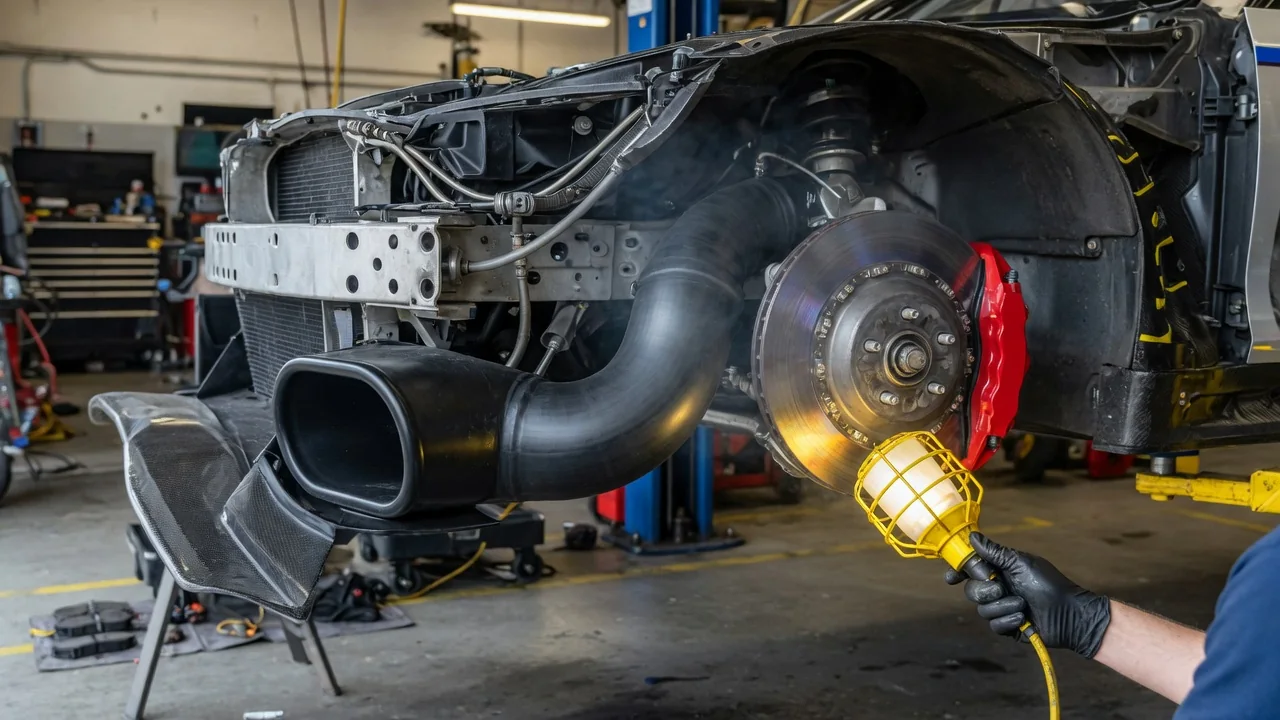
A racing brake duct is a channel that collects air from a high-pressure area of the car, usually at the front, and delivers it to the brake assembly so heat can be carried away from the rotor, pads, and caliper. In motorsport, where brakes are used hard and repeatedly, a brake cooling duct helps keep these parts within their working temperature range. Understanding how the air is routed, what heat it manages, and how the duct fits on the car explains why it matters.
Air routing
Every brake duct starts with an inlet. It is usually placed where moving air naturally builds pressure, such as an opening in the front bumper, a cutout near the front fascia, or a scoop under a splitter. From there, air travels through a hose or molded channel toward the wheel. Flow is driven by a pressure difference: air at the inlet is at higher pressure than the air around the spinning brake assembly, so it moves through the duct toward the lower-pressure area. Because that pressure comes from the car's motion, the duct delivers more air at higher speeds and less at lower speeds.
Where the air is aimed matters as much as how much is collected. Many racing rotors are vented, with internal vanes between the two friction faces. As the rotor spins, those vanes act somewhat like a centrifugal pump, drawing air in near the center and throwing it outward through the rim. For this reason, many ducts feed air toward the center of the rotor so the vanes can pull it through the hottest part of the disc. Other designs aim part of the flow at the caliper body or the area around the pads. The best target depends on the specific brake layout and where heat tends to build up.
The path between inlet and outlet affects how well the system works. Tight bends, long runs, kinks, sudden changes in cross-section, and leaking joints all cost airflow. Smooth, gradual curves and sealed connections help preserve the pressure that the inlet captures. A larger inlet can move more air, but it is not automatically better, because every opening also has aerodynamic consequences for the rest of the car.
Heat
Brakes slow a car by turning its kinetic energy into heat through friction between pads and rotors. Most of that heat goes into the rotor first, then spreads into the pads, caliper, brake fluid, hub, wheel bearings, and wheel. On a road car, stops are usually spaced out enough that the brakes cool naturally between uses. On a racetrack, the driver may brake hard from high speed several times per lap, lap after lap, leaving only a short interval for heat to escape. If more heat goes in than comes out, temperatures keep rising.
Excess heat causes several familiar problems. Pad compounds are designed for a particular temperature window, and beyond it they can lose friction, which drivers feel as fade. Brake fluid that gets too hot can boil, creating vapor in the system and a soft or sinking pedal. Prolonged high temperatures can also stress caliper seals, accelerate pad and rotor wear, cause uneven pad material deposits on the rotor, and contribute to rotor cracking. Heat that soaks into the hub can affect wheel bearings and their grease. A brake duct increases convective cooling by continually replacing hot air around these parts with cooler outside air.
Cooling is a balance rather than a goal to maximize. Many racing pads need to reach a minimum temperature before they grip consistently, so a brake that runs too cold can feel weak or inconsistent. For this reason, teams may partially restrict duct openings in cool weather or on circuits with fewer heavy braking zones. Brake heat also travels into the wheel and can influence tire temperatures, so in some forms of racing brake cooling is managed with tire behavior in mind as well.
Packaging
Packaging means fitting the duct into the limited space around the front of the car and the wheel. The route from the bumper to the brake passes close to suspension arms, tie rods, the steering rack area, the inner wheel well, and the tire itself. Unlike the body, the wheel moves: it travels up and down with the suspension and turns with the steering. A duct that connects the fixed body to the moving brake assembly must allow for that motion, which is why flexible hose with some slack is commonly used for the final section.
At the brake end, the outlet is typically held by a backing plate or bracket attached to the upright or spindle, positioning the air outlet near the rotor center or caliper. This mounting has to clear the rotor, caliper, and the inside of the wheel while surviving vibration, impacts, and high temperatures. Materials are chosen with that environment in mind, using heat-resistant hose and ducting near the hottest components so the duct does not soften, melt, or crack over time.
Packaging also involves aerodynamic and cooling trade-offs. Openings in the front bodywork add drag and can alter the airflow that the front of the car depends on for downforce or stability. Brake inlets may compete for space and air with radiators, intercoolers, and oil coolers. In organized racing, series regulations may also limit where openings can be placed and how ducts are built, so the final design is often a compromise between brake temperature, aerodynamics, and the rulebook.
Practical implications and limits
Whether a brake duct makes a meaningful difference depends on how the car is used. Normal street driving rarely produces the sustained, repeated heat load that ducts are designed to handle. Track days, time attack, and endurance racing are where cooling becomes a limiting factor. Symptoms such as fading under repeated stops, a lengthening pedal, or discoloration on brake hardware suggest heat may be a problem, but they can also point to pad choice, fluid condition, or brake sizing. A duct is one tool among several; it does not compensate for brakes that are undersized for the job, a pad compound unsuited to the conditions, or old fluid.
Results also vary from one vehicle to another. The same duct design may perform differently depending on inlet location, wheel design, rotor type, and the speeds typical of a given circuit, so any claim of improvement should be treated as specific to a particular setup. Ducts need routine attention: hoses can chafe, collapse, tear, or become clogged with debris, rubber, or dirt, and an outlet that has shifted may no longer aim where intended. Checking clearance at full steering lock and full suspension compression after installation, and inspecting the system between sessions, helps catch problems early. For road-registered cars, owners should also consider ground clearance changes, local regulations, and the vehicle manufacturer's service information before modifying bodywork or brake components.