What Is a Race-Car Telemetry System? Live Data, Radio Link and Analysis
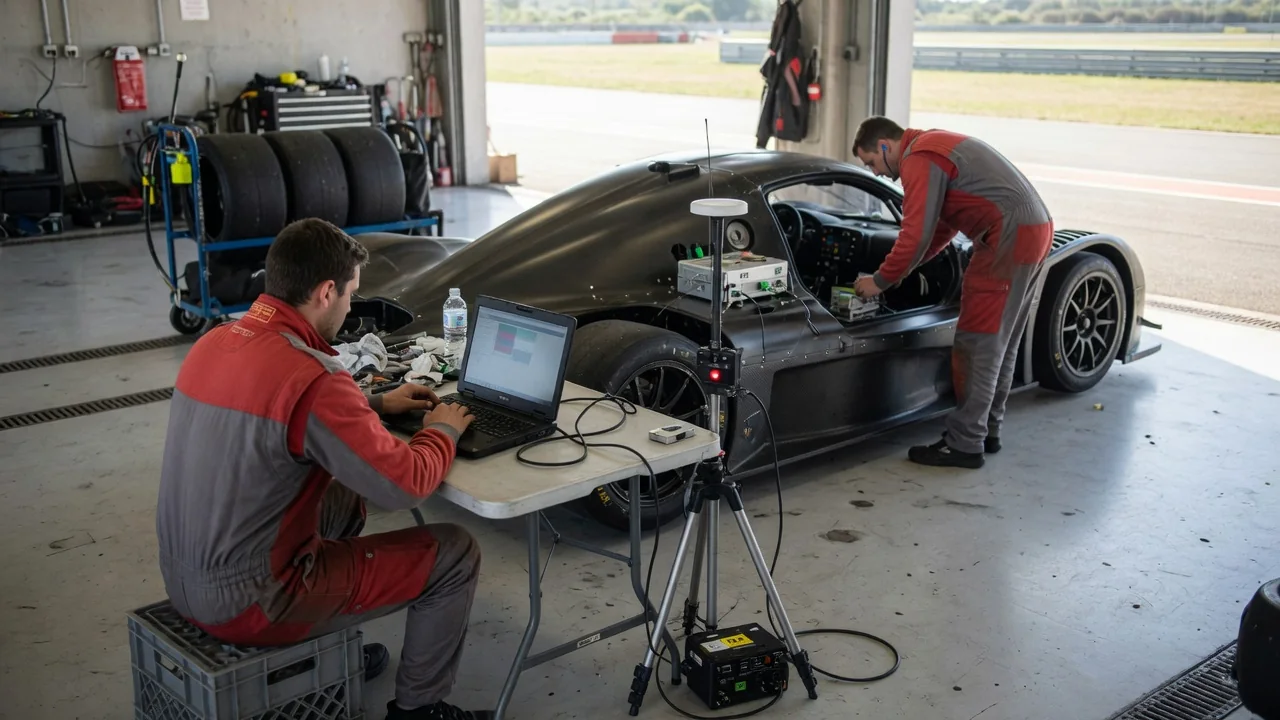
A race-car telemetry system combines sensors, onboard electronics, a wireless link, and trackside software so a team can see what a car is doing while it is on track. Engineers don't have to rely only on the driver's description after a session. They can watch measured values such as speed, engine condition, and driver inputs as they happen, then study the recorded data in detail. Motorsport telemetry has three parts: live data, the radio link, and analysis.
Live data
Live data starts with sensors that turn physical quantities into electrical signals. Common measurements include wheel speed, engine speed, throttle position, brake pressure, steering angle, and gear position. Systems also often record coolant and oil temperatures, oil and fuel pressures, suspension travel, and accelerations from accelerometers. Many systems add GPS position as well. Each measured quantity is usually called a channel. The channels a given car carries depend on its design, its budget, and the rules of the series it races in, so no single list applies to every race car.
The sensors feed an engine control unit, a dedicated data logger, or both. In many modern installations the control units share information over a vehicle network such as a CAN bus, which lets several electronic modules exchange messages over shared wiring. The logger timestamps every channel so values can be lined up later. Sampling rates are chosen to match how quickly each quantity changes. Fast-moving signals such as suspension movement need frequent samples, while slowly changing values such as fluid temperatures can be recorded less often.
Strictly speaking, telemetry means measuring at a distance and sending the results to a remote receiver. A logger that only stores data onboard is not telemetry in that sense. Many amateur and club-level cars have logging but no live transmission, and the data is downloaded in the pits after the session. Where live data is available, it serves mainly for monitoring. The pit crew can spot a rising temperature, falling oil pressure, an unexpected tire pressure change, or higher-than-planned fuel use before it becomes a failure or costs the race.
Radio link
The radio link carries data from the car to the team. An onboard telemetry unit packages selected channels into data frames and transmits them through an antenna on the car. A receiver at the pit wall or in the garage collects them and passes them to a computer running display software. Depending on the series, the venue, and local radio regulations, a system may use dedicated radio frequencies or a cellular data network. Licensing rules for radio transmitters differ between countries, so the hardware and frequencies a team can use are not universal.
A wireless link has limited bandwidth, so teams usually transmit only the channels that matter most during a session and keep the full data set onboard. Range and line of sight also matter. Hills, grandstands, bridges, buildings, and distance from the receiver can all cause dropouts on parts of a circuit. Some installations place extra receiving points around the track. Others buffer data in the car and resend it when the signal returns. Error-checking methods help the receiver detect corrupted packets. Because live radio data can have gaps, the onboard log is usually treated as the complete, authoritative record.
Telemetry normally flows in one direction, from car to pits. Sending commands from the pits to change settings on the car is often called bidirectional telemetry, and many racing series restrict or prohibit it. Voice communication between driver and engineer typically runs on a separate radio system with its own rules. The exact limits come from each series' regulations, which should be checked before anyone assumes a feature is permitted.
Analysis
Analysis software plots channels against time or against distance around the lap, which makes it easier to compare one lap with another. Engineers often overlay laps to see where time is gained or lost. Typical points of comparison are braking points, minimum corner speeds, how early the throttle is applied, and how smoothly the steering is used. A driver can be compared with their own best lap or with a teammate in the same car. Software can also create math channels, which are values calculated from measured data. Comparing wheel speeds to estimate wheel slip is one example.
Beyond driver coaching, the same data supports engineering decisions. Suspension travel data can show how a setup behaves over curbs and bumps. Temperature and pressure trends can reveal engine or brake health over a run. Fuel and tire information helps with strategy. When a team tests a setup change, comparing runs before and after the change under similar conditions gives a measured view of its effect instead of relying only on impressions.
Data shows what happened, but not always why. Track temperature, traffic, wind, fuel load, and tire wear all influence the numbers, so engineers usually combine data with the driver's feedback before drawing conclusions. Sensor calibration matters too. A sensor that is poorly zeroed or incorrectly scaled produces values that look precise but are wrong. Checking calibration is part of routine data work.
Practical implications and limits
Enthusiasts who do track days can get a subset of these capabilities without a full professional system. Common options are GPS-based lap timers, standalone data loggers, and readers that connect to a road car's OBD-II diagnostic port. The engine parameters available through that port, and how often they update, depend on the manufacturer and model. Diagnostic data may refresh more slowly than a dedicated logger can record. Adding sensors means wiring, secure mounting, and care not to interfere with the car's existing electronics or safety systems. The vehicle's service manual is the right reference for any connection points.
Telemetry does not make a car faster on its own. Its value comes from asking specific questions and changing one variable at a time so the effect can be seen clearly. Beginners often collect more channels than they can interpret, so starting with a few well-understood measurements tends to be more useful. Rules also set boundaries. A competition series may limit which sensors, logging features, or transmissions are allowed, and any radio equipment must comply with local regulations. Knowing these limits before installing hardware avoids wasted money and eligibility problems.