What Is a Race-Car Kill Switch? Isolation, Access and Testing
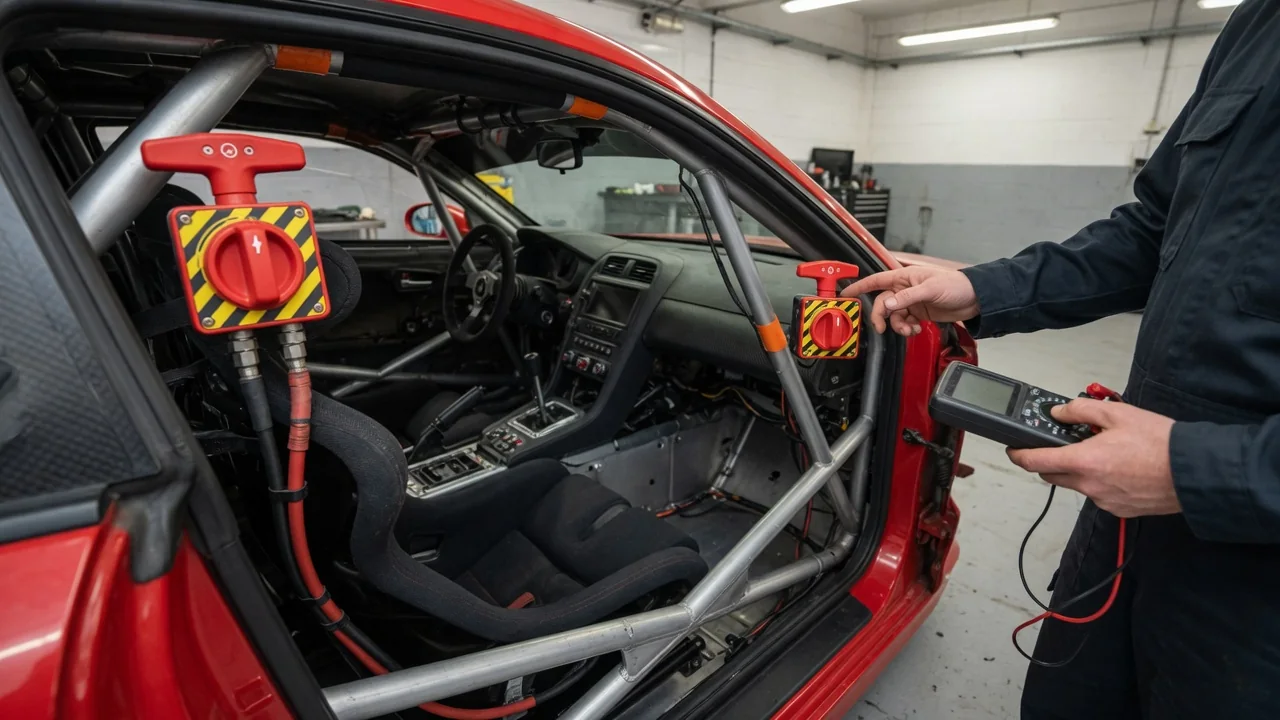
A race-car kill switch, often called a master cutoff switch or battery isolator, is a single control that shuts down the car's electrical system and stops the engine. In motorsport it gives the driver, marshals and rescue crews one fast way to remove power after a crash, fire or fuel leak. Knowing what it disconnects, where it must be reachable, and how to confirm it works answers the core question of what a race car kill switch actually does.
Electrical isolation: what the switch actually cuts
In its simplest form the kill switch is a heavy-duty switch placed in the main battery cable, usually on the positive side, so that opening it separates the battery from everything downstream: starter, ignition, fuel pump, engine control unit, lights and accessories. Because the main cable carries starter current, the switch must be rated for high current and mounted securely, with terminals that stay tight under vibration. Some installations use a remote electronic master switch instead, where a low-current control circuit operates a high-current solenoid or solid-state relay so the thick battery cable does not have to be routed through the cockpit.
Disconnecting the battery alone is not always enough. Once an engine is running, the alternator can keep supplying voltage to the ignition and fuel system, so the engine may continue to run even with the battery isolated. For this reason, a motorsport master cutoff switch typically has auxiliary contacts that interrupt the ignition or engine-management power feed at the same moment the main contacts open. Many switch designs also provide a way to connect a resistor across the alternator output when the switch is turned off, giving that output somewhere to go and reducing the risk of a voltage spike that could damage charging-system components or electronics. Exact wiring depends on the switch, the charging system and the car's electronics, so the switch maker's diagram is the reference for any given installation.
The goal is that, after the switch is operated, no circuit capable of keeping the engine running or feeding a fire remains live. Some rulebooks allow specific exceptions, such as separately powered safety equipment, but those exceptions are defined by the sanctioning body, not by the builder.
Access: reaching the switch inside and outside the car
A kill switch only helps if someone can use it quickly. Racing rules commonly require that the driver be able to operate it while seated and fully belted, and that a separate control be reachable from outside the car. The outside control is often a pull handle or push button linked to the switch by cable or wiring, positioned where marshals expect to find it, frequently near the base of the windshield on closed cars or at a specified point on open cars, depending on the class. Location requirements vary between series, so the current rulebook for the event is the authority.
Marking matters as much as placement. The widely used identifier is a red spark symbol on a blue triangle with a white border, placed at or next to the external control, and many rules also require the off position or pull direction to be indicated. Clear labeling lets a marshal who has never seen the car find and use the switch without hesitation. Builders also consider how body damage could affect access: a cable routed through a crush zone or a handle hidden behind a removable panel may be unusable after an impact. Placing the control in a protected, unobstructed spot and keeping the operating path short reduces that risk.
Testing: confirming the cutoff works
A kill switch should be tested with the engine running, not just by checking that the dash goes dark with the ignition on. The basic check is simple: start the engine, operate the internal control and confirm the engine stops promptly; restart, then repeat with the external control. If the engine keeps running or stumbles before dying, something is still powered, often through the alternator or an ignition feed that bypasses the auxiliary contacts. Checking at idle and at a moderately raised engine speed can reveal problems that only appear when the charging system is producing more output.
After the engine stops, confirm that the fuel pump, fans and other powered equipment are also off and that nothing stays energized while the switch is in the off position. A multimeter check of circuits downstream of the switch can confirm zero voltage where none is expected. Physical inspection belongs in the same routine: look for loose or corroded terminals, heat discoloration near the switch body, frayed or binding external cables, and cracked mounts. Pre-event technical inspection often includes a kill-switch check, but regular testing in the garage or paddock helps catch faults before they matter.
Practical implications and limits
A kill switch removes electrical power; it does not stop fuel that is already leaking, cool hot components, or replace a fire suppression system. Stored fuel pressure, mechanically driven pumps and hot exhaust parts can still sustain a fire after the electrics are off, which is why the switch is one element of a wider safety setup rather than a complete answer. High-voltage systems in hybrid or electric race cars normally have their own dedicated isolation procedures and indicators, and a conventional low-voltage master switch should not be assumed to make them safe.
Using the switch also has side effects in everyday operation. Cutting power can clear volatile memory in some electronics, such as clocks, presets or learned idle settings, depending on how each unit stores data, and some data loggers need an orderly shutdown to save their files. An undersized switch or long main cable run can add resistance that shows up as slow cranking. On a car that is also driven on public roads, a master switch may serve as a security or storage measure, but correct fusing must stay in place, since the switch protects people in an emergency rather than protecting wiring against a short circuit. Installation quality, the current rulebook wording and the switch maker's instructions remain the deciding factors for any particular car.