What Is a Propeller Shaft in a Car? Torque Path, Joints and Inspection
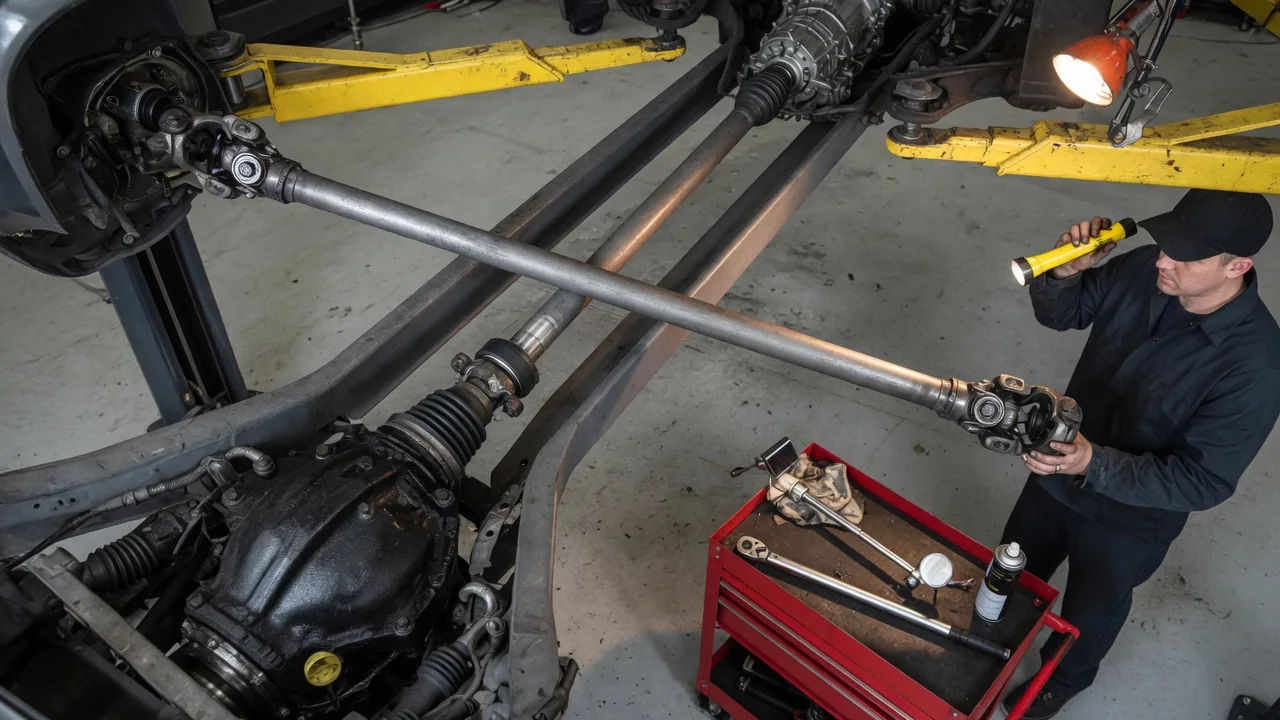
A propeller shaft, often shortened to prop shaft and also called a driveshaft, is the rotating tube that carries engine torque along the length of a vehicle. In rear-wheel-drive cars and many four-wheel-drive and all-wheel-drive layouts, it connects the transmission or transfer case to a differential mounted some distance away. In vehicle terms, a prop shaft is the link that lets torque travel from front to back. This guide explains how it works, why its joints matter, and what an inspection can reveal.
Longitudinal torque path
In a vehicle with a longitudinally mounted engine, the transmission sits behind the engine, and its output shaft points toward the rear of the car. The drive axle and its differential are mounted farther back, and the propeller shaft bridges that gap. Engine torque leaves the transmission, travels along the shaft, and enters the differential through a flange or yoke. The differential turns the drive through roughly a right angle, applies the final gear reduction, and splits torque between the left and right axle shafts. Because that final reduction happens after the prop shaft, the shaft usually spins faster than the wheels and carries less torque than the axle shafts downstream of it.
Most propeller shafts are hollow tubes, typically made of steel or aluminum, and some vehicles use composite materials. A tube provides good stiffness for its weight. That matters because a long, spinning shaft can bow and vibrate as it approaches what engineers call its critical speed. Designers manage this through the tube's diameter, material, and length. On longer spans, the shaft is often split into two or more sections, with a center bearing mounted to the body or frame supporting the middle. Shafts are balanced during manufacture, and the small weights attached to the tube are part of that balance.
The layout is not universal. Front-wheel-drive cars with transversely mounted engines usually send power directly to the front wheels through short half shafts and have no propeller shaft. Many all-wheel-drive vehicles built on transverse platforms add a prop shaft that runs from a power take-off unit at the front to a rear drive unit. Traditional four-wheel-drive trucks may use separate front and rear shafts leaving a transfer case. The exact arrangement depends on the specific vehicle.
Joints
A propeller shaft cannot be a rigid link. The axle moves up and down with the suspension, while the transmission stays fixed to the body through its mounts. That movement changes both the angle between the components and the distance between them. Joints accommodate the angle, and a slip joint accommodates the change in length. The most common angle joint is the universal joint, also known as a Cardan or Hooke joint. It is a cross-shaped trunnion with four needle-bearing caps, held between two yokes. It transmits torque well at modest angles, but it is not a constant-velocity joint: when it runs at an angle, its output speeds up and slows down twice per revolution. Drivelines cancel this effect by phasing the yokes correctly and keeping the operating angles at the two ends of the shaft close to equal and opposite. That way, the fluctuation introduced at one joint is undone at the other.
The slip joint is usually a splined yoke that slides in and out of the transmission or transfer case output, or a splined section built into the shaft itself. Some propeller shafts use constant-velocity joints instead of, or alongside, universal joints, which helps where angles are larger or smoothness is a priority. Others use flexible rubber couplings, sometimes called flex discs, which absorb small misalignments and damp driveline vibration. Two-piece shafts add a center support bearing, held in a rubber mount that isolates noise and allows slight movement.
Lubrication varies by design. Some universal joints have grease fittings for periodic service, while many are sealed for life. Constant-velocity joints rely on grease held in by flexible boots, so the condition of those boots directly affects how long the joint lasts.
Inspection
Propeller shaft problems often show up in a few recognizable ways: a clunk when shifting into drive or reverse, or when getting on and off the throttle; a vibration that grows with road speed; a rhythmic squeak at low speed; or a shudder when pulling away from a stop. None of these symptoms is unique to the shaft. Tires, wheel balance, wheel bearings, engine and transmission mounts, and differential wear can cause similar complaints. Symptoms are a reason to inspect, not a diagnosis on their own.
A basic inspection is done with the vehicle securely supported, following the procedure for that vehicle. The inspector grips the shaft near each joint and tries to twist and lift it, feeling for free play or a rough, notchy action in the universal joints. Reddish rust dust around the bearing caps can indicate a dry, worn joint. Other things to check include torn or leaking CV boots and grease flung onto nearby surfaces, cracked or swollen rubber in flex couplings and the center bearing mount, loose flange bolts, dents or bends in the tube, missing balance weights, and fluid leaking from the seal where a slip yoke enters the transmission or transfer case.
If the shaft is removed, marking the orientation of each flange and yoke before disassembly helps preserve balance and joint phasing when it goes back together. Fastener torque values and any angle or runout specifications should come from the manufacturer's service information, not general rules.
Practical implications and limits
In everyday driving, a healthy propeller shaft goes unnoticed. Wear tends to develop gradually, and an ignored vibration or clunk can progress to a joint that binds or comes apart. A shaft that separates at one end can drop, strike nearby components or the road surface, and leave the vehicle without drive. For that reason, persistent driveline noises call for prompt attention rather than waiting to see if they get worse.
Changes to ride height also matter. Lift kits, lowering springs, and worn or replaced transmission mounts can change the angles at each joint, so a driveline that was smooth before may start to vibrate afterward. In those cases, the fix may be correcting the angles rather than replacing parts. Repair options also depend on design. Some universal joints can be replaced individually, while some shafts use joints that are not meant to be serviced separately; there, the assembly is replaced or rebuilt by a driveline specialist who can rebalance it.
This explanation covers general principles. Joint types, service intervals, acceptable play, operating angles, and repair procedures differ between vehicles. The owner's manual or factory service information remains the authority for any specific car, truck, or SUV. When a vibration is hard to pin down, a methodical road test and inspection by a qualified technician is more reliable than replacing driveline parts on a guess.