What Is a Power Door Lock Actuator and What Does It Do
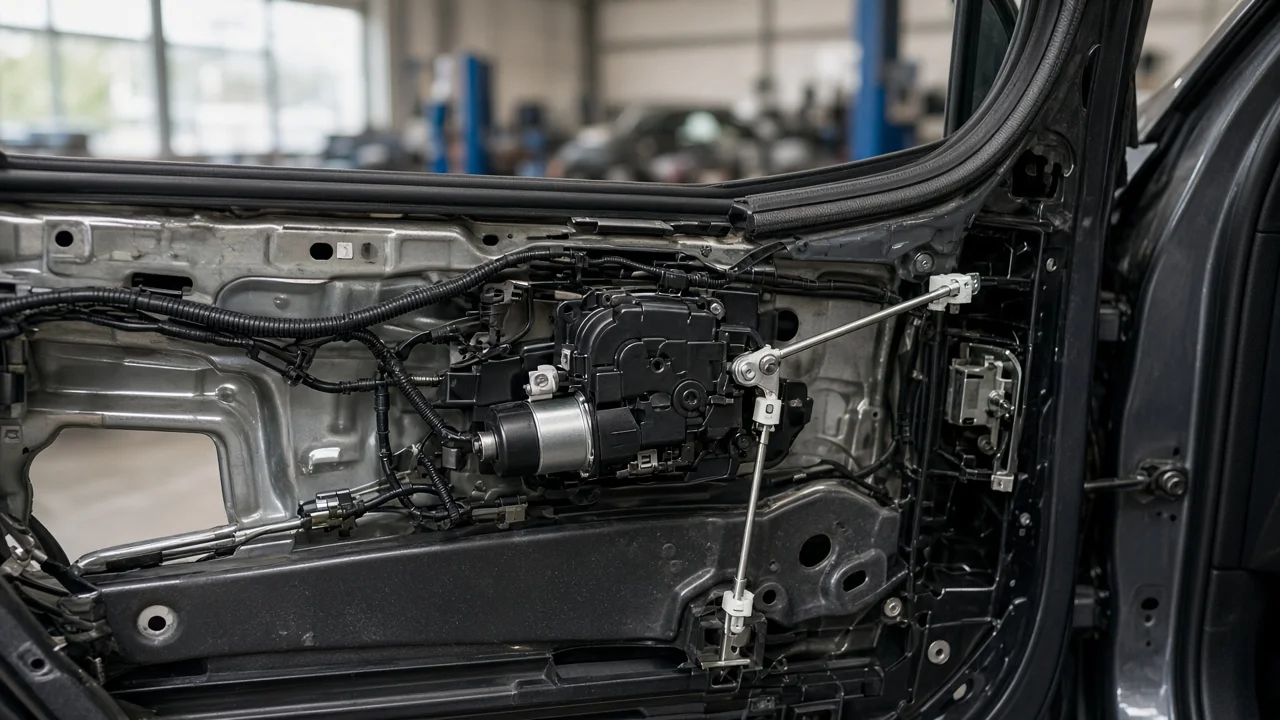
When you press the lock button on a key fob or door panel, something inside each door has to physically move the lock. That part is the power door lock actuator. Knowing what it is and what it does helps you make sense of a lock that buzzes, works only sometimes, or ignores one door. It also helps you tell an electrical fault apart from a door that no longer lines up with its striker.
What a power door lock actuator is and does
A power door lock actuator is the device that converts an electrical command into the mechanical movement that locks or unlocks a door. On most vehicles it is a small reversible electric motor driving a gear set, which moves a lever or rod connected to the locking mechanism of the door latch. When the motor turns one way, the latch is set to locked. When it turns the other way, the latch is set to unlocked. On most doors the actuator does not hold the door closed and does not open it. The latch holds the door shut by engaging the striker on the body, and the inside and outside handles open it. The actuator only changes the latch's locked state, so a door can usually still latch normally even when its actuator has failed.
On many current vehicles the actuator is not a separate part. It is built into the door latch assembly, so the motor, gears, latch and often a position switch are sold and replaced as one unit. Older designs and some trucks use a stand-alone actuator mounted inside the door and linked to the latch by a rod. Liftgates, tailgates, trunk lids and fuel doors may use their own actuators that work on a similar principle.
How the actuator locks and unlocks the door
The command usually starts at a door lock switch, the key fob, the key cylinder, or an automatic feature such as locking when the vehicle starts moving. On most modern vehicles a body control module or similar module receives that input and sends power to the actuators. To lock, current flows through the motor in one direction. To unlock, the polarity is reversed and the motor runs the opposite way. Older systems do the same job with relays. Many latches also contain a switch that reports whether the door is locked, ajar or open. The module uses that information for alarm arming, interior lighting and warning messages.
Inside the actuator, the motor spins quickly but with little force. A gear reduction trades that speed for the force needed to move the lock lever. These gears are commonly plastic. Worn or broken teeth are a frequent cause of the clicking, buzzing or grinding owners hear when a lock no longer moves. Power reaches the door through a wiring harness that crosses the gap between the body and the door near the hinge, usually inside a flexible rubber boot. That harness bends every time the door opens, and broken wires at this point can mimic a failed actuator.
What changes the answer on your vehicle
The details depend heavily on design and vehicle fitment. With an integrated latch, a failed motor usually means replacing the full latch assembly. A separate actuator can often be replaced on its own. Some vehicles have a second locking stage, often called double locking or deadlocking, which disables the inside handle and may involve an additional motor or position. Certain older European models used vacuum or pneumatic central locking, where a pump drives diaphragm-type actuators instead of electric motors. Some newer vehicles use electronic door releases, where a motor also opens the latch and a mechanical backup release is provided. Diagnosing those systems follows different procedures.
Operating conditions matter too. Cold weather can thicken lubricants and slow a weak actuator, and ice or water inside the door can stop a lock from moving. A door that has dropped on worn hinges, a striker that has shifted, or a weather seal that pushes the door outward can load the latch. When that happens, the actuator may not be able to overcome the friction. The motor itself may be healthy, and replacing it will not cure the problem. Power liftgates add their own motors, latches and struts, so a liftgate lock or release complaint should be diagnosed as part of that whole system.
How to tell an actuator fault from a mechanical problem
Start by noting which doors are affected and which inputs fail. If every door fails from every switch and the fob, the cause is more likely shared, such as a fuse, a switch or a module. If only the remote fails, check the fob battery first. If only one door fails while the others respond, that door's actuator, latch or wiring is the more likely suspect. Try the fob, the driver's switch and, if fitted, the key in the door cylinder. Note whether the door locks but will not unlock, or the reverse. A motor that works in only one direction, works intermittently, or makes noise without moving the lock points toward the actuator or its gears.
Next, separate electrical from mechanical causes. With the door open, operate the lock and watch the interior lock knob or indicator. If it moves normally with the door open but struggles or fails once the door is closed, alignment or latch loading is a strong candidate rather than a dead motor. Press firmly on the door near the latch while operating the lock. If the lock then works, the door, striker or weather seal is likely pushing against the latch. Also move the manual lock by hand. A knob that feels stiff or binds suggests a mechanical problem in the latch or linkage. A knob that moves freely by hand but never moves electrically suggests an electrical or motor fault.
Look for clues before ordering parts. Check the rubber boot between the door and body for cracked or broken wires. Look for wear marks around the striker that show the door contacting it unevenly. Check for door sag by gently lifting the open door and feeling for play at the hinges. If you adjust a striker, mark its original position first so you can return to it. When buying a replacement, match the part to your exact vehicle, door position and options, ideally by VIN. Left and right, front and rear, and trim-level differences are common.
Limits of home diagnosis and the next step
Symptoms alone cannot always confirm the cause. A failing actuator, a broken wire in the door jamb and a module output problem can look identical from the outside. Confirming the fault normally requires checking for power and ground at the actuator connector during lock and unlock commands, or reading fault codes with a scan tool that supports body systems. Removing a door panel also varies widely by model. It may involve hidden fasteners, clips that break easily, window and mirror wiring, and, in some doors, side-impact sensors or other safety components.
Before taking a door apart, check the model-specific service procedure for panel removal, latch replacement and any relearn or initialization steps required after battery disconnection or part replacement. Treat it as a safety issue and have a qualified technician inspect it if the door is hard to close, will not stay latched, or cannot be opened from inside. The same applies if the problem involves child locks or electronic releases. For a single slow or noisy lock that passes the mechanical checks, the actuator or integrated latch is a reasonable next focus once the wiring has been ruled out.