What Is a Planetary Gearset? Sun Gears, Ring Gears and Ratios Explained
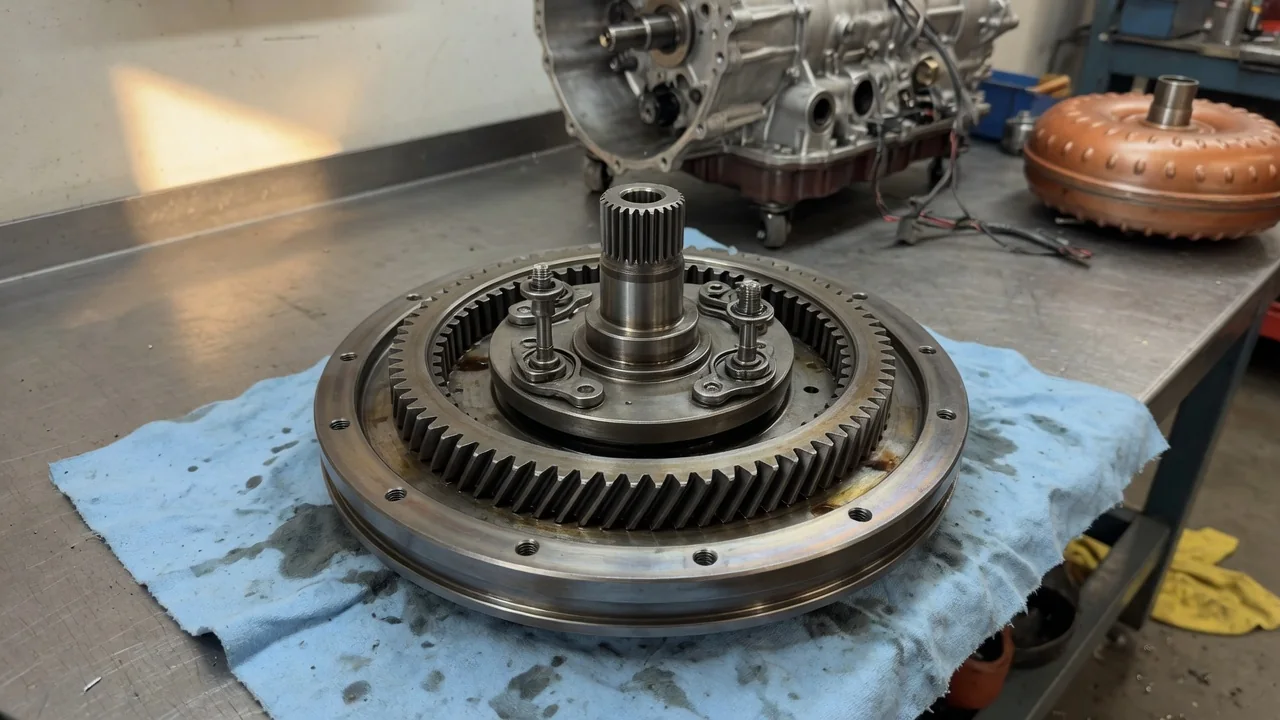
A planetary gearset is a compact arrangement of gears found at the heart of most conventional automatic transmissions. Instead of sliding gears in and out of mesh, it keeps every gear permanently engaged. It produces different ratios by changing which part is driven, which part is held still, and which part delivers power. Knowing how automatic transmission planetary gears work explains how a gearbox can shift under load, provide reverse, and still stay small enough to fit between the engine and the driveline.
Sun and ring gears
Every simple planetary gearset has three main members. The sun gear sits in the center and has teeth on its outside. The ring gear, also called the annulus or internal gear, surrounds the assembly and has teeth cut on its inner surface. Between them run several small planet gears, sometimes called pinions, that mesh with the sun and the ring at the same time. The planets turn on pins mounted in a planet carrier. The carrier is the third member, because it can rotate as a unit around the same center line as the sun and the ring.
Because the sun, carrier and ring share a common axis, power can enter and leave the gearset along the same line. This is one reason the design suits automatic transmissions, where the input from the torque converter and the output toward the driveline are often arranged in line with each other. Using several planets also spreads the load across multiple tooth contacts instead of concentrating it on a single pair of gears. That load sharing lets a relatively small assembly handle substantial torque.
The ring gear always has more teeth than the sun gear, and the planet size is set by the space between them. In a simple gearset, the tooth counts of the sun and ring determine the available ratios. The planets work as intermediate gears that carry motion between the sun and ring while letting the carrier move relative to both.
Ratio changes
To transmit power, a planetary gearset needs one member as the input, one held stationary, and one as the output. If no member is held, the parts spin freely and nothing is transmitted, which is effectively neutral. If any two members are locked together, the entire set turns as one solid unit and gives direct drive at 1:1. Inside an automatic transmission, members are held or connected by multi-plate clutches, brake bands, and one-way clutches. In most modern units these are applied through hydraulic pressure controlled by the transmission's control system.
Each combination of input, held member and output gives a different result. With the ring held, sun as input and carrier as output, the carrier turns slower than the sun in the same direction, giving the largest forward reduction. With the sun held, ring as input and carrier as output, the reduction is smaller. With the sun held, carrier as input and ring as output, the ring turns faster than the input, creating an overdrive. With the carrier held, the planets act only as idlers, so driving the sun turns the ring in the opposite direction at a reduced speed. That is a reverse gear.
For a simple gearset, the reduction from sun to carrier with the ring held equals one plus the ring tooth count divided by the sun tooth count. As an illustrative calculation only, a sun with 30 teeth and a ring with 72 teeth would give about 3.4:1 in that mode. Holding the carrier would give roughly 2.4:1 in reverse. Holding the sun and driving the ring would give about 1.42:1, and reversing that path with the carrier as input would give an overdrive near 0.70:1. Real transmissions use their own tooth counts and often combine several sets, so actual ratios come from the specific design.
Applications
A single simple gearset offers only a few practical ratios, so automatic transmissions usually combine two or more sets. Common compound arrangements include the Simpson layout, in which two gearsets share a common sun gear. Another is the Ravigneaux layout, which uses two sun gears, short and long planets, and a single ring gear in one compact assembly. Other designs stack several simple sets and connect their members in different ways. The number of forward gears depends on how many sets are used, how they are linked, and how many clutches and brakes control them.
Planetary gearing also appears in other parts of vehicles. Some four-wheel-drive transfer cases use a planetary set to provide a low range. Some belt-type continuously variable transmissions use one to switch between forward and reverse. Many gear-reduction starter motors use a small planetary set to multiply motor torque. Some hybrid drivetrains use a planetary set as a power-split device, connecting the engine, a generator and an electric motor to different members so that power can be blended. Hub reduction units on some heavy commercial vehicles and some electric drive units also rely on the same principle.
Practical implications and limits
For drivers, the main practical effect is that a planetary automatic shifts by releasing one holding element and applying another, without disengaging power the way a manual gearbox does. Shift smoothness therefore depends largely on how precisely that handover is timed and how much pressure is applied. Fluid condition, friction material wear and control calibration often affect shift feel more than the gear teeth themselves. When problems develop, they frequently involve clutches, bands, seals, bushings, thrust washers or planet pinion bearings rather than broken gear teeth, although the exact failure pattern varies by design and use.
The gearset also has clear limits. Its ratios are fixed by tooth counts, so they cannot be adjusted without different hardware. Adding more gears requires more sets, more holding elements or both, which increases complexity and service difficulty. Because each transmission engages its members in its own sequence, diagnosis depends on the clutch and band application chart in the relevant service manual. A noise or slip that appears only in certain gears can point toward particular components, but confirming the cause requires proper testing. Fluid type and service intervals should follow the vehicle manufacturer's specifications, since friction elements and their controls are matched to the intended fluid.