What Is a Parking Pawl? How Park Locks an Automatic Transmission
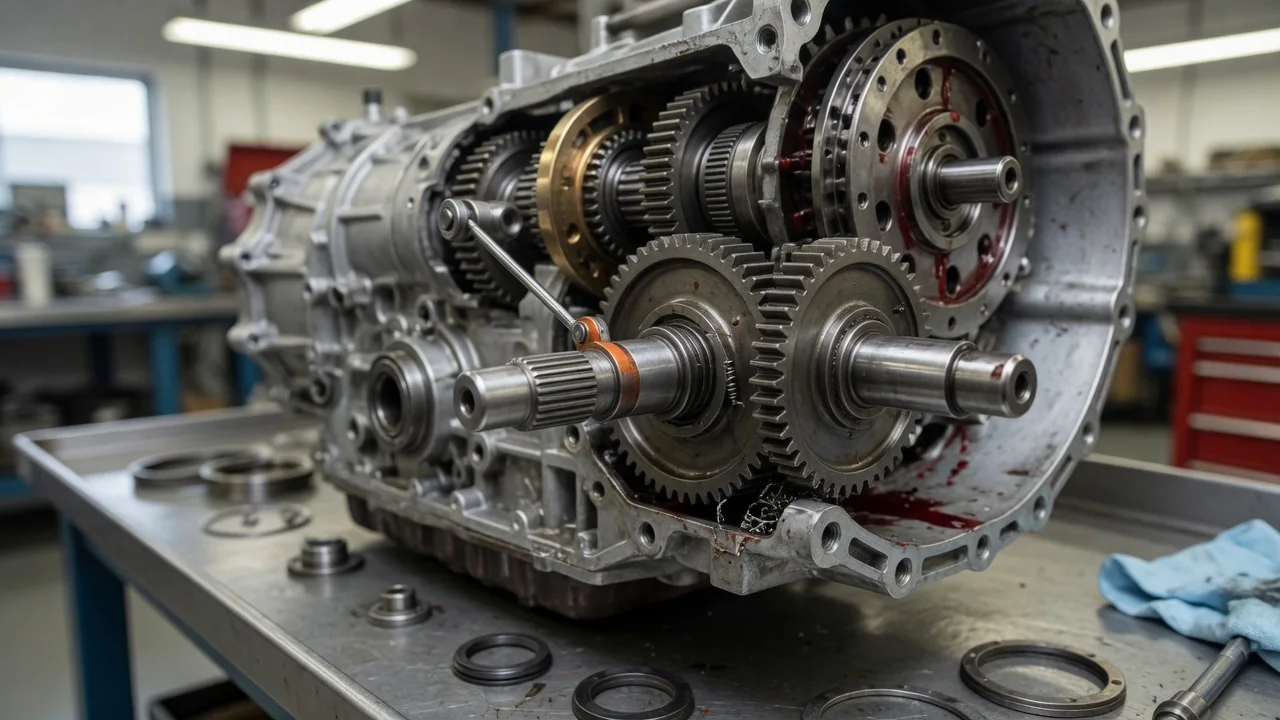
A parking pawl is the small mechanical lock inside an automatic transmission that holds the vehicle still when the selector is placed in Park. It is not a brake in the usual sense. It does not clamp a disc or drum but physically blocks the transmission output from turning. Knowing how this automatic parking pawl mechanism works explains why Park feels solid on level ground, why it can clunk on a hill, and why the parking brake still matters.
Gear locking
The system has two main parts. The first is a parking gear, a notched ring fixed to the transmission output shaft or to a component that turns with it. The second is the pawl itself, a pivoting steel lever with a single tooth on one side. When the driver selects Park, the shift linkage moves an actuating rod, typically with a cam or tapered end, that pushes the pawl into one of the notches. With the pawl seated, the output shaft cannot rotate, and the drive wheels connected to it are held. When the selector leaves Park, the rod withdraws and a return spring lifts the pawl clear.
The pawl does not always line up with a notch at the moment Park is selected. If its tooth lands on top of a gear tooth, a spring in the actuating mechanism keeps it pressed against the gear. Once the vehicle rolls a short distance, the pawl drops into the next notch. This is why a car may move slightly after being put in Park before settling. The shapes of the pawl and the gear teeth are generally designed so that the pawl tends to bounce off, or ratchet, if the output is turning faster than a crawl, which helps prevent violent engagement at speed. In shift-by-wire designs, an electric actuator moves the pawl instead of a cable or rod, but the locking principle is the same.
Because the pawl locks the transmission output rather than the wheels directly, it holds only the driven wheels, and it does so through the differential. A differential allows its two output sides to turn in opposite directions even when its input is locked. If one driven wheel is lifted or sits on a very slippery surface, the vehicle may not be held as securely as expected. Non-driven wheels are not restrained by the pawl at all.
Load on slope
On level ground the pawl carries very little force. On a grade, gravity pulls the vehicle downhill, and that force travels from the tires through the axles, differential and final drive to the parking gear. All of it is resisted at the small contact area between the pawl tooth and the side of the notch. The driveline also has a little slack and elasticity, so when the brake pedal is released the vehicle can shift slightly as that slack is taken up and the components twist under load.
That load creates friction between the pawl and the notch, which makes the pawl harder to withdraw. Drivers may notice a stiff selector that needs extra effort to move out of Park, followed by a clunk or jolt as the pawl releases and the stored twist in the driveline unwinds. An electric actuator in a shift-by-wire system has to overcome the same friction. On its own, this behavior on a slope is a normal consequence of how the mechanism works rather than a sign of failure.
The usual way to reduce that load is to let the parking brake carry the vehicle's weight. Stop with the service brake held, apply the parking brake, select Park, then release the service brake so the parking brake takes the force first. When leaving, keep the service brake applied, shift out of Park, and only then release the parking brake. Following this order keeps the pawl from being the primary element holding the vehicle on the hill.
Care
The most important habit is to bring the vehicle to a complete stop before selecting Park. Shifting into Park while rolling can make the pawl ratchet against the gear teeth with a grinding sound, wearing the edges of both parts. If the pawl does catch while the vehicle is moving, the sudden stop can put a shock load through the pawl, the gear and the rest of the driveline. Some vehicles include interlocks that limit this, but the driver should not rely on them.
Avoid situations that load the pawl beyond normal parking. Do not rock a parked vehicle against it, and do not leave it as the only restraint on a steep grade. Towing also matters. In Park the drive wheels are locked, so moving the vehicle with those wheels on the ground can damage the mechanism. The owner's manual describes the approved towing method for each vehicle, including any requirement to use Neutral, a dolly or a flatbed.
The parking pawl is not usually a scheduled maintenance item, so attention is driven by symptoms. Warning signs include a vehicle that creeps or rolls while in Park, grinding or ratcheting noises when parking, unusual difficulty moving out of Park, or a selector position that does not match the gear indicator. Possible causes include a shift cable or linkage out of adjustment, worn pawl or gear teeth, a weak or broken spring, or an actuator fault. Diagnosis belongs with a qualified technician, and a vehicle showing these signs should be secured with the parking brake until it is inspected.
Practical implications and limits
The pawl is a holding device intended for a stationary vehicle, not a means of stopping one. That defines its role in daily driving. It provides a positive lock that keeps the car from rolling when the engine is off and the driver has stepped away, while the parking brake provides a second, independent restraint that acts at the wheels instead of inside the transmission. Using both gives redundancy. If either system is worn or misadjusted, the other still contributes to holding the vehicle.
Many details vary from one design to another and should be checked in the owner's manual rather than assumed. These include whether Park is engaged by a cable or an electric actuator, whether the vehicle selects Park automatically when the engine is switched off or a door is opened, what interlocks apply, and how to move the vehicle when the battery is discharged. Some shift-by-wire vehicles need electrical power to leave Park and provide a specific procedure for that situation. Transmissions other than conventional automatics, such as many CVTs, dual-clutch units and electric drive units with a P position, also use a parking lock, though their layout can differ.
For an owner, the answer to what is a parking pawl comes down to a simple point: it is a small, strong but finite part that does its job best when it is spared unnecessary stress. Treating Park as the final step after the vehicle has stopped and the parking brake is set, rather than as a brake in its own right, aligns everyday habits with what the mechanism was designed to do.