What Is a Parallel Hybrid? Engine, Motor, Coupling and Control Explained
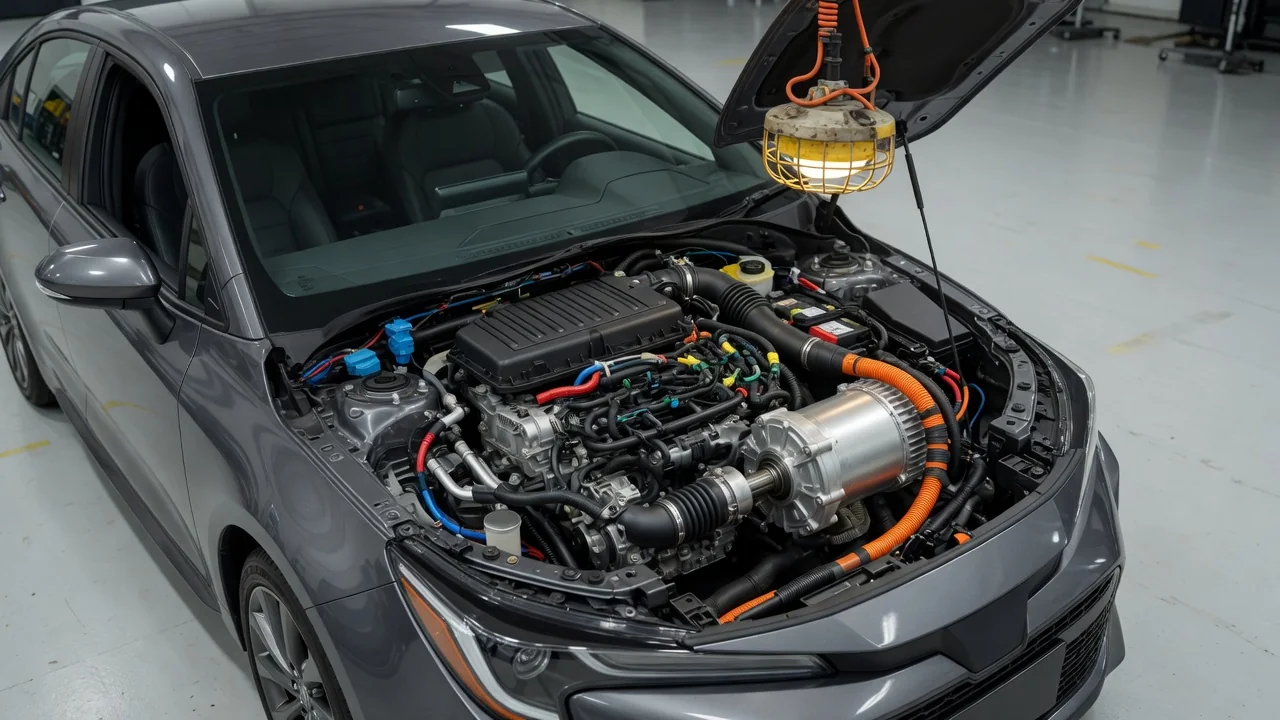
A parallel hybrid is a vehicle in which a combustion engine and an electric motor can both send torque to the wheels through a shared mechanical path. Either source can work alone or both can work together, depending on the design and the driving situation. This guide explains how a parallel hybrid car powertrain is arranged, how the two power sources are coupled, and how the control system decides which one does the work.
Engine and motor drive
In a parallel layout, the engine keeps a direct mechanical link to the driven wheels, much as it does in a conventional car. The electric motor is added to the same driveline rather than replacing it. That is the key difference from a series hybrid, where the engine only turns a generator and the wheels are driven electrically. Because both machines can push the vehicle, the system can add their torque when strong acceleration is requested, let the engine run alone at steady cruising loads, or, in designs that allow it, let the motor move the car while the engine is stopped. The motor can also act as a generator, recovering energy during deceleration and charging the high-voltage battery.
Engineers often describe parallel hybrids by where the motor sits, using labels from P0 to P4. A P0 motor is a belt-driven starter-generator on the front of the engine, a layout common in mild hybrids. P1 places the motor directly on the crankshaft. P2 puts it between the engine and the transmission, usually with a clutch that can separate the engine. P3 connects the motor at the transmission output, and P4 drives a separate axle. The position strongly affects what the system can do. A belt-driven unit, for example, generally assists the engine and restarts it but is not designed to drive the car by itself, while a P2 or P4 motor can often provide electric-only driving.
Coupling
Coupling describes how the output of the engine and the motor is combined. Most parallel hybrids use torque coupling: both machines connect to a common shaft or gear set, so their torques add together while their speeds are fixed relative to each other by the gear ratio between them. This differs from the speed coupling found in power-split systems, where a planetary gear set allows engine speed to vary independently of vehicle speed. In a parallel hybrid, engine speed is still tied to road speed through the selected gear, which is why these designs usually keep a multi-ratio transmission such as a conventional automatic, a dual-clutch unit or an automated manual.
Clutches decide when the engine participates. In a P2 arrangement, a disconnect clutch between the engine and the motor can open so the motor drives the transmission alone without dragging the stationary engine. When more power is needed, the clutch closes and the engine joins in; the motor can also spin the engine up to restart it. A P4 layout takes a different approach known as through-the-road coupling: the engine drives one axle, the motor drives the other, and the two power flows meet only at the road surface. That arrangement also provides a form of all-wheel drive without a mechanical connection between the axles.
Control
A supervisory controller, often called the hybrid control unit, translates the driver's pedal input into a total torque request and then splits that request between the engine and the motor. Its decisions depend on inputs such as vehicle speed, battery state of charge, battery and motor temperature, engine temperature and the selected drive mode. In a typical charge-sustaining hybrid, the controller tries to keep the battery within a target band over time rather than draining it, using the engine to recharge when charge falls and relying more on the motor when charge is high.
Control strategies range from rule-based logic, which uses thresholds such as speed and load limits for electric driving, to optimization methods like the equivalent consumption minimization strategy, which treats battery energy as an equivalent fuel cost and chooses the split with the lowest overall consumption. A frequently used tactic is load-point shifting: the motor either absorbs extra engine output as charging power or adds its own torque, so the engine operates in a more efficient region of its map. The exact strategy a manufacturer uses is generally not published in detail.
The controller also manages transitions. It coordinates clutch slip during engine starts so the car does not jerk, can fill torque gaps during gear changes, and blends regenerative braking with the friction brakes so the pedal feels consistent while the motor recovers as much energy as conditions allow. When the battery is full or cold, regenerative capacity may be reduced and the friction brakes take a larger share of the stopping work.
Practical implications and limits
For drivers, a parallel hybrid usually feels closer to a conventional car than a series or power-split hybrid does, because engine speed rises and falls with road speed and the transmission shifts through gears. The most noticeable differences are automatic engine stops and restarts, electric assistance during acceleration, and braking that recovers energy. Fuel savings tend to be largest in stop-and-go driving, where braking energy can be recaptured and the engine can avoid inefficient light loads. During sustained highway cruising the engine carries most of the load, so the advantage is usually smaller.
The term parallel hybrid covers a wide range of systems, from a mild hybrid with a small belt-driven motor to, for example, a plug-in hybrid with a larger battery and a motor mounted ahead of the transmission. Whether a particular vehicle can drive on electric power alone, at what speeds and for how long depends on its motor size, battery capacity and calibration, so the owner's manual is the reliable source for those details. Ownership also combines two sets of hardware: the engine and transmission still need their usual maintenance, and the high-voltage battery, inverter and cabling should be serviced only by qualified technicians following the manufacturer's procedures.