What Is a Multilink Rear Suspension? Links, Alignment and Service
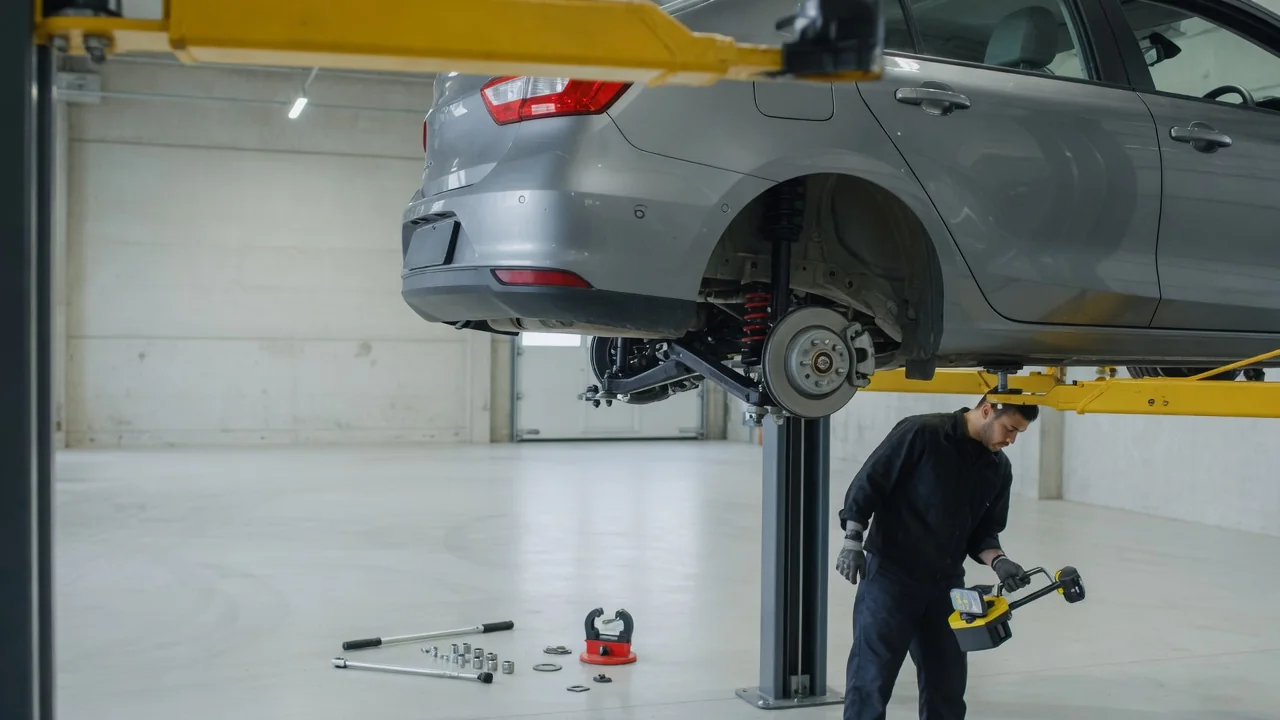
A multilink rear suspension locates each rear wheel with several separate arms, or links, instead of one or two large control arms or a solid beam. Because several members share the job of holding the wheel, engineers can tune how it moves over bumps, under braking and in corners. This article explains how multilink rear suspension design works, how it affects wheel alignment, and what it means when the suspension needs inspection or repair.
Separate links and what each one controls
At the center of a multilink rear suspension is the wheel carrier, sometimes called the knuckle, upright or hub carrier. It holds the wheel bearing and hub. Instead of bolting that carrier to a single large control arm, the design connects it to the subframe or body through several relatively slim links. A typical layout includes upper and lower lateral links that run roughly across the car, a toe link that controls the steering angle of the rear wheel, and a trailing link or arm that handles fore-and-aft forces. Each link usually has a rubber bushing or a ball joint at each end. The spring and shock absorber mount to one of the lower links or directly to the carrier.
The kinematic logic is easiest to see by counting freedoms. A rigid wheel carrier floating in space could move in six ways: three translations and three rotations. An ideal link with a pivot at each end resists motion only along its own length, so it removes one of those freedoms. Five well-placed links remove five freedoms and leave the one motion the suspension needs, which is vertical travel. Layouts with three or four links reach the same result by using an arm that is shaped or mounted to resist more than one direction. The term is not standardized, so manufacturers apply the multilink name to several different arrangements.
Separating the links is what gives engineers control. The length, angle and mounting points of each link determine three things: how camber and toe change as the wheel moves up and down, where the roll center sits, and how much the rear resists squatting under acceleration or lifting under braking. Bushing stiffness adds another tuning layer. A bushing can be relatively soft in one direction to absorb impacts and firm in another to keep the wheel precisely located in corners. Cornering forces can even be used to nudge rear toe in a stabilizing direction, an effect known as compliance steer.
Alignment: how the links set the rear wheel angles
The main rear alignment angles are camber and toe. Camber is the inward or outward tilt of the wheel seen from the front or rear. Toe describes whether the front of the wheel points toward or away from the car's centerline. Together, the toe settings of the two rear wheels define the thrust angle, which is the direction in which the rear axle pushes the car. On a multilink rear suspension, these angles come directly from the link lengths and pivot locations. Many designs therefore provide adjustment through an eccentric cam bolt or a threaded sleeve on the toe link, and sometimes on a camber link as well. Which angles can be adjusted, and how, depends on the specific vehicle.
Because each angle depends on a particular link, small changes have direct effects. A toe link bent by a curb strike changes toe even when nothing looks obviously damaged. So does a bushing that has softened and lets the link shift under load. Ride height also matters, because the links swing through arcs and camber and toe change as the suspension compresses. Alignment specifications are therefore published for a defined ride height and load condition. Lowering springs, sagging springs or heavy loads can move the rear wheels outside the intended range.
Rear adjustments are often coupled, so a technician typically sets camber before toe and then checks the result again. Rear toe also matters for the front of the car. On a four-wheel alignment, front toe is normally set relative to the rear thrust line, so a rear error can show up as an off-center steering wheel. For that reason, a car with a multilink rear generally calls for a four-wheel alignment rather than a front-only adjustment.
Service: bushings, joints and inspection
The parts that wear in a multilink rear suspension are mainly the joints between the links and their mounting points. Rubber bushings crack, separate or soften with age, heat and road contaminants. Ball joints used in some links can develop play. Wheel bearings, shock absorbers and springs are also part of the assembly. Common signs of wear include clunking over bumps, a vague or shifting feel from the rear during lane changes or turns, irregular wear on the inner or outer shoulder of the rear tires, and a car that no longer tracks straight.
Inspection usually involves checking each link for bending and each bushing for cracks, tearing or excessive movement. This is often done by carefully prying near the joint with the car safely supported. When links are replaced, many service procedures specify that the bushing bolts receive their final tightening with the suspension at normal ride height. Tightening them with the wheel hanging can preload the rubber, which may shorten bushing life. Corroded eccentric bolts and mounting hardware are a frequent complication. The vehicle's service manual should guide the sequence, torque values and any one-time-use fasteners.
Any replacement of a link, knuckle, subframe mount or adjustment bolt should be followed by an alignment check. This applies even if the new part matches the old one and the adjustment positions were marked beforehand. The same applies after a significant impact, because a link can bend slightly without visible damage.
Practical implications and limits
For drivers, the main benefit of the design is that ride comfort and wheel control can be tuned more independently than with simpler layouts. The label alone, however, does not guarantee a particular feel. Two cars with multilink rear suspensions can behave very differently depending on link geometry, bushing choices, spring and damper rates and tire selection. The design also has trade-offs: more parts, more pivot points that can eventually wear, more space taken up beneath the vehicle, and more steps when diagnosing a noise or tire wear problem. That complexity is one reason some vehicles use a torsion beam or another simpler rear layout instead.
General kinematic principles explain why the links are arranged as they are, but they cannot replace vehicle-specific information. The number of links, which angles are adjustable, alignment ranges, fastener torque values and replacement procedures vary between vehicles, and sometimes between versions of the same vehicle. When a multilink rear suspension needs repair or alignment, the manufacturer's service information and a properly equipped alignment shop remain the authoritative references for that car.