What Is a Midrange Car Speaker? Vocal Range, Placement and Balance
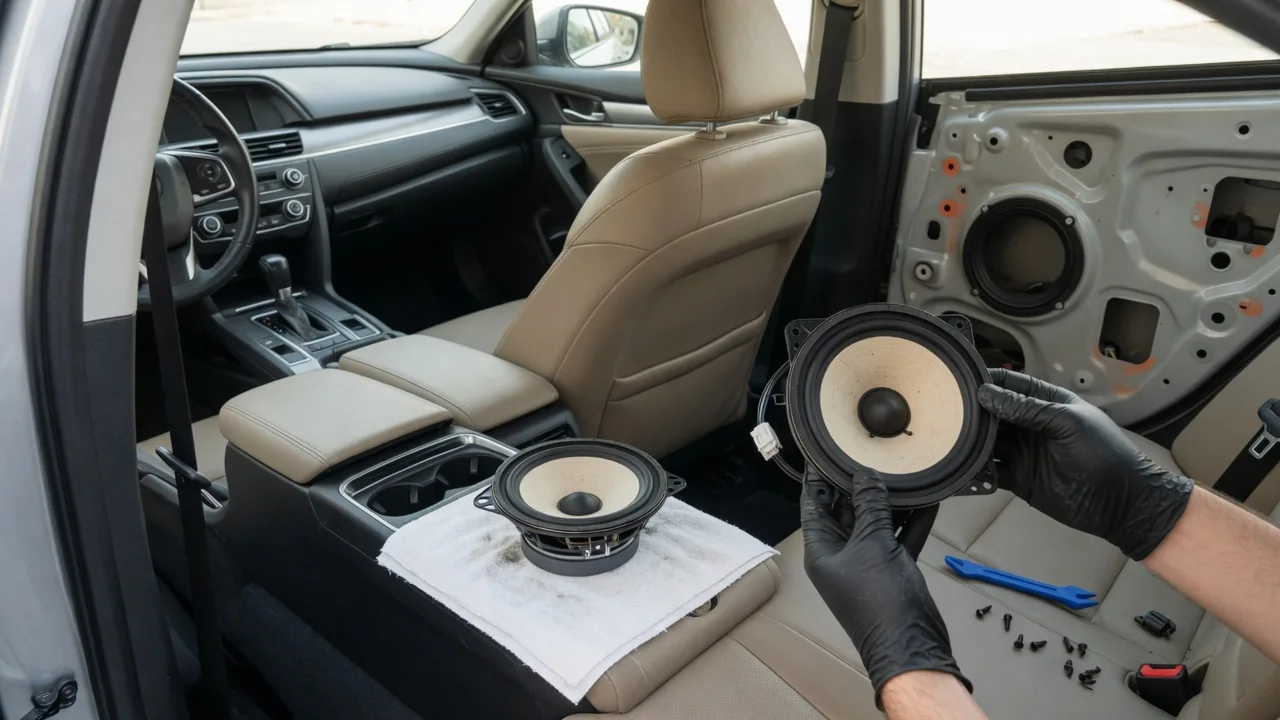
A midrange car speaker is a driver designed to reproduce the middle band of the audio spectrum, the region that carries most of the human voice and the body of many instruments. In a car audio system it sits between the woofer or midbass driver, which handles low notes, and the tweeter, which handles the highest ones. Understanding the car midrange speaker role helps explain why vocals sound clear or muffled, where these drivers are mounted, and how they fit into a tuned system.
Vocal range
The midrange band is where hearing is most sensitive and where much of the musical information lives. The fundamental pitches of speaking and singing voices fall largely in the low hundreds of hertz, while the harmonics, vowel shapes and consonant details that make words intelligible extend into the low kilohertz range. Guitars, pianos, horns and snare drums also place much of their character here. Because the ear is especially sensitive across this region, small errors in level or added distortion are easy to notice, which is why the midrange is often described as the part of a system that makes or breaks realism.
A dedicated midrange driver is built for this job. Its cone is typically smaller and lighter than a woofer's, so it can move quickly and stay controlled at frequencies where a large cone tends to struggle, yet it is larger than a tweeter dome, so it can play lower and produce more output in the vocal band. Common forms include small cone drivers and wider dome designs. Exact operating limits depend on the individual design and on how the system's crossover is set, so there is no single universal frequency range that defines every midrange speaker. In a two-way setup the woofer and tweeter split this territory between them; a three-way system gives the middle band its own driver.
Door placement
Doors are the most common mounting location for car speakers because they offer space, an enclosed volume behind the trim panel and existing factory openings. In many component systems the larger midbass driver or woofer occupies the lower door, while the midrange is placed higher, in the upper door panel, the sail panel near the mirror or nearby trim. Some installations use the dashboard or A-pillars instead. Which positions are available depends entirely on the vehicle, so the owner's or service manual for the specific car is the right reference for panel removal, mounting depth and wiring.
Height and aim matter more for midrange than for bass. Low frequencies behave as largely non-directional in a small cabin, but sound becomes more directional as frequency rises, and midrange output is easily absorbed or blocked by legs, seats and door pockets. A driver mounted low in the door and pointed at the floor can make vocals seem to come from the listener's knees. Raising the midrange and angling it toward the listening area generally helps place voices closer to ear level and in front of the listener, which is the goal of a convincing soundstage.
The door itself also affects performance. A thin, unsealed door skin can flex, rattle and let the rear sound wave leak around the driver, which muddies the midrange. Damping material, a solid mounting baffle and sealed gaps are common general measures. Doors also collect moisture that runs down inside the window channel, so drivers and connections there should tolerate damp conditions, and any added parts must clear the window mechanism.
Balance
A midrange speaker only sounds right when it blends with the drivers around it. Crossovers divide the signal so each speaker receives the frequencies it handles best: the woofer below, the midrange in the middle and the tweeter above. Where those handoffs occur, and how steeply the filters roll off, determine whether the transitions are seamless or whether some notes jump out or seem to vanish. Passive crossovers are fixed networks supplied with many component sets, while active crossovers in an amplifier or digital signal processor allow the points to be adjusted.
Level matching is just as important. If the midrange plays too loudly relative to the other drivers, the sound tends to become harsh, shouty or nasal, and long listening becomes tiring. If it is too quiet, voices recede and music sounds hollow, as if the middle has been scooped out. Because each driver in a car usually sits at a different distance from each seat, timing plays a role as well: sound from the nearer speaker arrives first and can pull the image toward that side. Time alignment and equalization in a processor can compensate for some of this, usually optimized for one primary seat.
Practical implications and limits
For many owners, the real question is whether a separate midrange is needed at all. A well-implemented two-way component or coaxial system can reproduce vocals clearly, and adding a third driver increases complexity: another mounting location, more wiring, additional crossover sections and often more amplifier channels. A three-way layout tends to pay off when the goal is more precise vocal imaging and less strain on the other drivers in the middle band, and when the vehicle offers a practical place to mount the extra driver with good aim.
There are also limits that hardware alone cannot overcome. Every cabin has its own reflections from glass, dashboards and upholstery, so the same speakers can sound different in two vehicles. Equalization can reduce peaks but cannot fully correct a driver that is blocked, poorly aimed or mounted in a resonant panel. Some factory systems use their own amplifiers, built-in equalization or nonstandard connectors, which can complicate replacing or adding a midrange, so the vehicle's documentation and wiring information should be checked before buying parts. Finally, tuning usually favors one seat, and a setup that images precisely for the driver will rarely be ideal for every passenger at the same time.