What Is a Mechanical Fuel Pump?
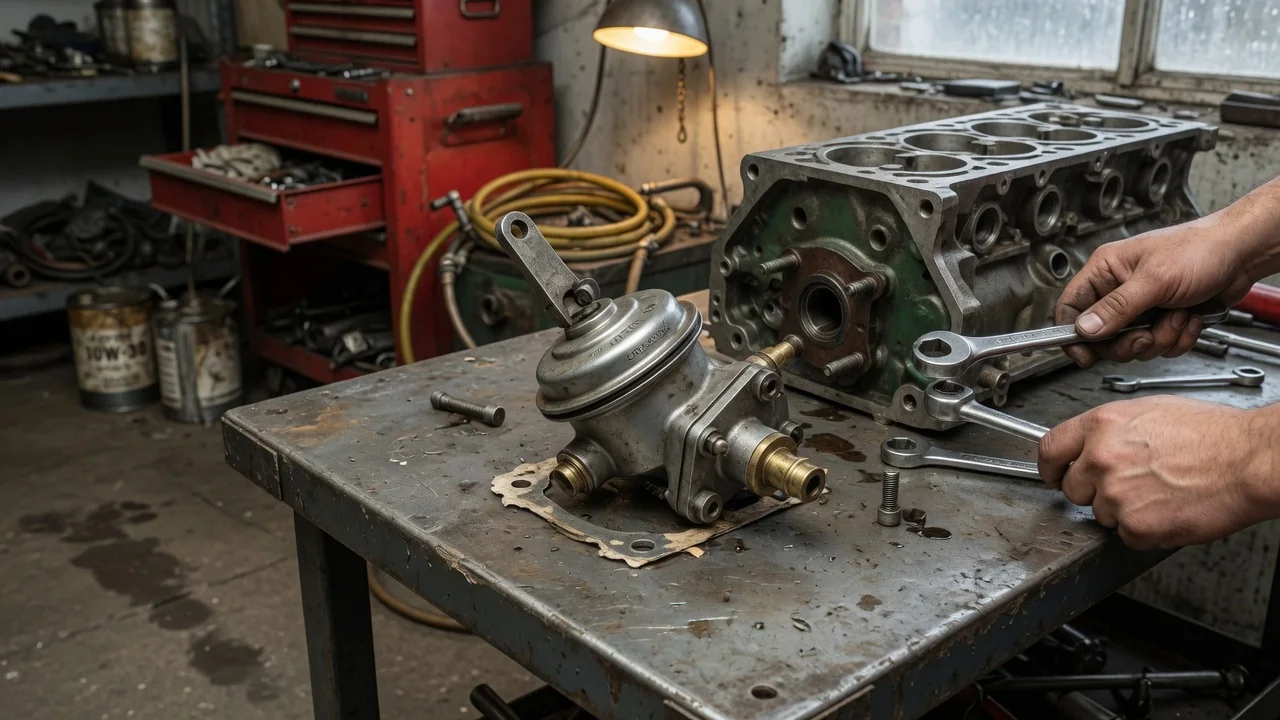
A mechanical fuel pump is an engine-driven pump that moves gasoline from the tank to the carburetor using a lever, a flexible diaphragm, and a pair of one-way valves. It was the standard arrangement on most carbureted engines for decades, so classic car owners often ask what a mechanical fuel pump is and how it works. Knowing how the pump is driven, how the diaphragm works, and how to service it makes fuel delivery problems much easier to diagnose.
Cam drive
The pump gets its motion from the engine itself. A classic car mechanical fuel pump typically bolts to the side of the engine block, the timing cover, or the cylinder head. A lever arm, often called the rocker arm, extends through the mounting flange into the engine. Inside, that lever rests against an eccentric, which is an off-center lobe on the camshaft or on a part that turns with it. Some engines place a short pushrod between the eccentric and the pump lever, so the lobe pushes the rod and the rod pushes the lever. Either way, every revolution of the camshaft produces one stroke of the lever. In a four-stroke engine the camshaft turns at half crankshaft speed, so the pump strokes once for every two crankshaft revolutions.
A return spring keeps the lever in contact with the eccentric, so the lever follows the lobe on its way down as well as up. The lever does not drive the diaphragm rigidly in both directions. In most designs it pulls the diaphragm through a link that can only pull, not push, which creates a deliberate lost-motion connection. As a result, the cam sets how far the lever moves, but the cam does not force fuel out. That job belongs to the diaphragm spring, described below. Mounting location, eccentric design, and whether a pushrod is used all vary by engine. The shop manual for the specific vehicle is the reference for those details.
Diaphragm
The diaphragm is a flexible membrane, usually made of fabric-reinforced rubber or a synthetic material. It is clamped between the upper and lower halves of the pump body and divides the pump into a fuel chamber on one side and a dry chamber on the lever side. The fuel chamber contains two check valves. The inlet valve lets fuel in from the tank line, and the outlet valve lets fuel out toward the carburetor. Each valve opens in only one direction.
On the intake stroke, the lever pulls the diaphragm away from the fuel chamber. The chamber's volume increases and its pressure drops, so the inlet valve opens and fuel is drawn up from the tank. On the return stroke, the lever backs off and the diaphragm spring pushes the diaphragm back. The inlet valve closes, the outlet valve opens, and fuel is pushed toward the carburetor. The pump's output pressure is set largely by the force of that spring rather than by engine speed. This is why a mechanical pump delivers the relatively low, steady pressure that a carburetor float valve is designed to handle.
When the carburetor float bowl is full, its needle valve closes and fuel has nowhere to go. Pressure on the outlet side then holds the diaphragm against its spring. The lever keeps moving back and forth through its lost motion but no longer pulls the diaphragm a full stroke. As the engine uses fuel and the needle valve opens, the diaphragm starts moving again. This lets the pump deliver roughly what the engine consumes instead of forcing a fixed volume on every stroke.
Service
Many original-equipment pumps can be disassembled and rebuilt with a kit that contains a diaphragm, valves, and gaskets. Others are crimped or sealed units that are meant to be replaced as an assembly. Which type a car has depends on the pump actually fitted, not on a general rule. Common service checks include looking for fuel weeping from the body seams or from a small vent hole in the lower housing. They also include inspecting the inlet and outlet fittings and hoses, and cleaning any built-in screen or sediment bowl on pumps that have one. Fuel at the vent hole usually points to a torn or porous diaphragm.
A failing diaphragm can also leak inward. On pumps where the lever side opens into the engine, fuel that gets past the diaphragm can drain into the crankcase and thin the oil. A gasoline smell on the dipstick or a rising oil level is a reason to inspect the pump. Pump performance is normally confirmed with a pressure test and a volume test at the pump outlet, and the results are compared against the figures in the service manual for that engine. Low readings may come from the pump itself. They may also come from a clogged filter, a kinked or collapsed line, an air leak on the suction side, or a worn eccentric or pushrod that shortens the lever stroke.
Installation also deserves care. The lever must sit on the correct side of the eccentric. Turning the engine so the lobe is at its low point reduces the load on the lever while the bolts are tightened. On engines that use a pushrod, holding the rod up during installation keeps it from dropping out of place. Gasket or spacer thickness can affect lever travel, so use the parts specified for the engine. Replacement diaphragms should be made of materials suited to the fuel in use, including ethanol blends.
Practical implications and limits
Because the camshaft drives the pump, it only moves fuel while the engine is turning. That can be an advantage: if the engine stops, the pump stops instead of continuing to push fuel through a damaged line. The trade-off appears after a car has been parked long enough for the fuel in the carburetor to evaporate. The engine then has to crank for a while before the pump refills the float bowl. The pump also works by suction on the tank side, and gasoline at reduced pressure boils more easily. Heat from the engine, the exhaust, or hot weather can produce vapor in the inlet line or the pump. This condition, known as vapor lock, can cause stalling or hard starting when the engine is hot.
A mechanical pump is matched to the low pressure needs of a carburetor. It is generally not suitable for fuel injection systems, which need much higher and more tightly regulated pressure. On a carbureted engine, it should not be swapped for a pump of unknown output. Excessive pressure can push the float needle off its seat and cause flooding. Hesitation, stalling, or hard starting are not always the pump's fault, because ignition, carburetor, and fuel-supply problems can produce similar symptoms. A pressure and volume check is a sensible early step before replacing parts. Pressure ranges, flow rates, and mounting arrangements differ between engines, so take them from the documentation for the particular vehicle.