What Is a MacPherson Strut Layout? Design, Packaging and Service
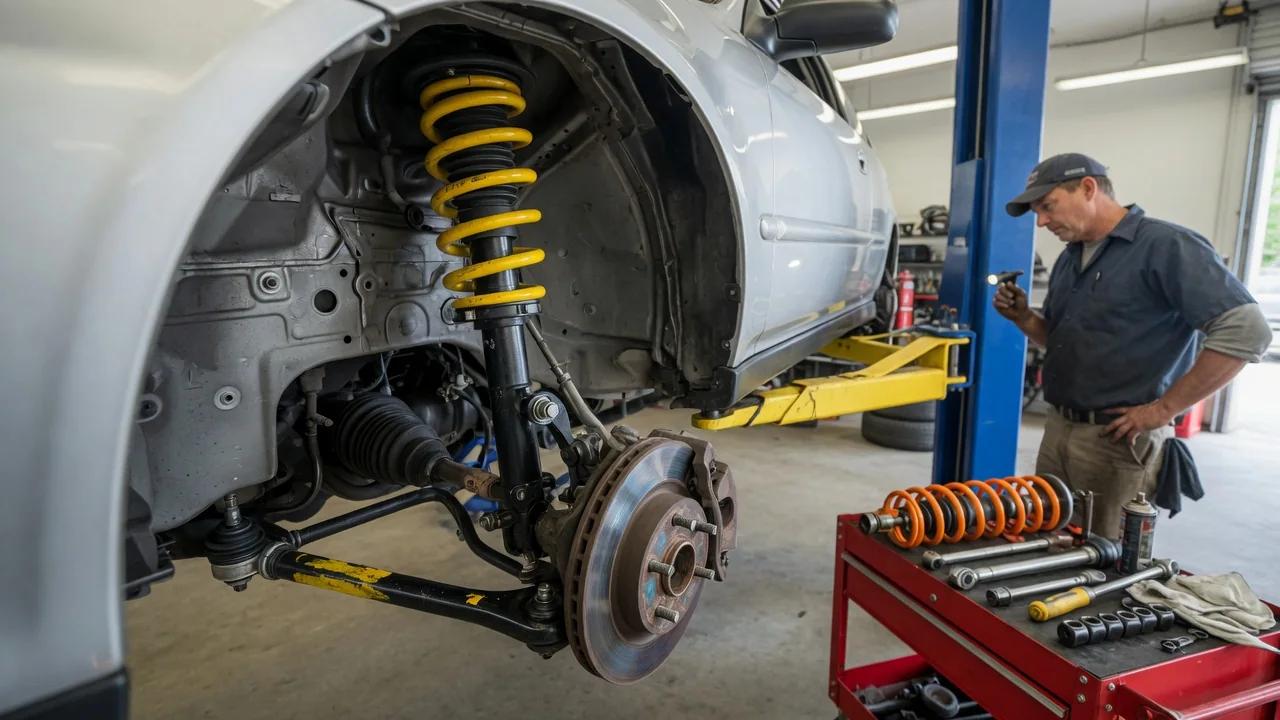
A MacPherson strut layout is an independent suspension design in which a telescopic strut, combining the shock absorber with a coil spring in most applications, also acts as a structural member that locates the wheel. A single lower control arm handles the bottom of the wheel carrier. The result is a compact, relatively simple arrangement used on the front axle of a great many passenger cars. Below is how the parts work, why the layout packages so well, and what it means for service.
Strut and control arm
The defining feature of the layout is that the strut does two jobs at once. Its lower end is bolted or clamped to the steering knuckle, and its upper end is fastened to the body through a top mount in the strut tower. The damper inside the strut controls motion, while the strut body itself holds the top of the knuckle in place. Because there is no upper control arm, the strut carries side and fore-aft loads that a standalone shock absorber would never see, so the piston rod, its guide and the strut tube are built to resist bending. On a steered axle, the top mount usually includes a bearing or a flexible element that lets the whole strut rotate as the wheels turn.
The lower control arm locates the bottom of the knuckle. It is commonly an A-shaped arm or a transverse link paired with a separate tension or compression rod, attached to the subframe or body through rubber bushings and to the knuckle through a ball joint. The arm keeps the wheel from moving forward, backward or sideways while allowing it to rise and fall. On a front axle, a tie rod connects the steering rack to an arm on the knuckle and sets toe, and an anti-roll bar link typically attaches either to the strut body or to the control arm.
MacPherson strut geometry follows from these two attachment points. The steering axis runs from the center of the top mount down through the lower ball joint, so caster and steering axis inclination are largely fixed by where the designers place those points. As the suspension compresses, the strut shortens and the control arm swings through an arc, producing a relatively modest change in camber compared with a double wishbone design. The angle of the lower arm also influences roll center height and, together with tie rod position, how much toe changes over bump travel. Many designs offset or angle the spring relative to the damper axis to reduce the bending load and internal friction the strut would otherwise carry.
Packaging
The main reason engineers choose a strut layout is space. Without an upper arm, the area between the front strut towers stays open, leaving room for a transversely mounted engine and transmission. That makes the design a natural fit for front-wheel-drive cars, where driveshafts pass below the spring and connect to the hub through the knuckle. Fewer components also mean fewer pivot points and bushings, and generally lower manufacturing cost and assembly effort, which helps explain how widespread the layout has become in mainstream vehicles.
The tradeoff is height. A strut is a tall assembly, and its top mount must sit high enough to provide useful travel and geometry, which affects how low the hood line and fenders can be. Loads reaching the top of the strut are fed into a single area of the body, so the strut tower must be a stiff, reinforced part of the structure, and some vehicles add a brace between the towers. The layout can also be used at the rear, where the towers may intrude into the cargo area or rear passenger space depending on the body design.
Service
Wear in a strut system tends to appear in a few predictable places. The damper can lose effectiveness or leak oil, which may show up as excessive bouncing, floaty body motion or uneven tire wear. Top mounts and their bearings can wear, producing clunks over bumps or a creaking, binding or notchy feel when steering. The lower ball joint and control arm bushings degrade with age and mileage, coil springs can sag or break, and anti-roll bar links are another common source of knocking. Because several parts share the same loads, a noise or handling change usually calls for checking the whole corner rather than assuming a single cause.
Strut replacement is commonly done in one of two ways. A technician can disassemble the old assembly with a spring compressor, transfer the spring and top mount to a new damper and reinstall it, or fit a complete pre-assembled strut that already includes a new spring, seat and mount. A compressed coil spring stores a large amount of energy, so disassembly requires a proper compressor and careful procedure; damaged or improvised tools are a serious injury risk. Fastener torque values, tightening order and whether bushings must be torqued with the suspension at ride height vary by vehicle, so the applicable service manual should be followed.
Because the strut is bolted directly to the knuckle, removing it or replacing a control arm can disturb wheel alignment, and an alignment check after this kind of work is widely recommended. Adjustment range depends on the design: many strut suspensions offer toe adjustment at the tie rods as standard, while camber adjustment may be limited, provided through eccentric bolts or slotted holes on some vehicles, or absent unless aftermarket parts are installed.
Practical implications and limits
For most drivers, the strut layout delivers predictable handling, reasonable ride comfort and straightforward maintenance, which is why it remains common on everyday cars. Its limits show up mainly near the edges of performance. Since camber does not increase much as the body rolls, the outside front tire can lean with the body in hard cornering, reducing its effective contact patch. Manufacturers compensate with static camber settings, bushing tuning, spring and damper rates and anti-roll bar sizing, so the outcome on any given vehicle depends on the whole package rather than the layout alone.
Modifications deserve caution. Lowering a strut-equipped car changes the angle of the control arm and tie rod, which can move the roll center, increase toe change over bumps and reduce travel before the suspension reaches its bump stops. Adjustable top mounts and camber plates exist for owners who want more alignment range, but they also change how loads enter the strut tower. Any general description of the layout is only a starting point: geometry, alignment specifications, part designs and repair procedures differ between vehicles, and the manufacturer's documentation for the exact car remains the authoritative reference.