What Is a Longitudinal Engine?
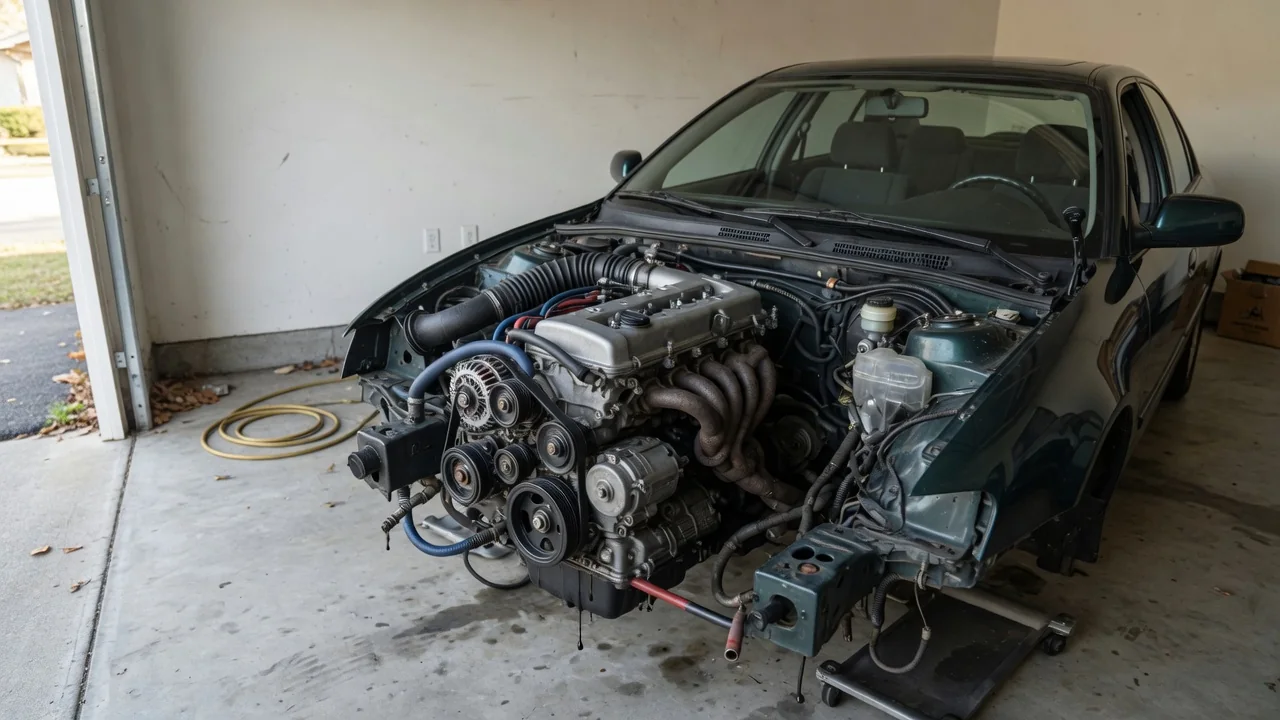
What is a longitudinal engine? It is an engine mounted so its crankshaft runs front to back, parallel to the vehicle's length, rather than across it. That single choice shapes where the transmission sits, how power reaches the wheels, and how the whole car is laid out. Understanding it makes drivetrain layouts far easier to read.
Orientation
A longitudinal engine is defined by the direction of its crankshaft. The shaft's axis points along the length of the vehicle, so the cylinders line up one behind another from the radiator toward the firewall. In an inline engine this produces a long, narrow block running nose to tail; in a V engine, the two cylinder banks sit to the left and right of that centerline. A transverse engine, by contrast, is turned ninety degrees so the crankshaft points toward the front wheels.
Opening the hood usually reveals the layout quickly. With a longitudinal installation, the accessory drive belt and pulleys typically face the radiator at the front of the car, and the back of the engine meets the transmission near the firewall. Many rear-wheel-drive sedans, pickup trucks and sports cars are built this way. Plastic engine covers can hide the clues, though, and some mid-engine or rear-engine cars also mount the engine lengthwise behind the cabin, so the belt position is a more reliable hint than the cover's shape.
Transmission path
Because the crankshaft already points toward the rear, power can flow in a nearly straight line. The transmission bolts to the back of the engine and extends under the floor, usually inside a central tunnel. From its output, a driveshaft, sometimes called a propeller shaft, carries torque to a differential at the rear axle, which turns the flow ninety degrees and splits it between the rear wheels. That single right-angle turn at the axle is the classic rear-wheel-drive routing.
The same orientation supports other drive arrangements. Four-wheel-drive trucks commonly add a transfer case behind the transmission, sending a second shaft forward to a front differential. Some all-wheel-drive cars use a longitudinal engine with a transaxle that drives the front wheels directly and passes power rearward as well. A few front-wheel-drive designs have also placed the engine lengthwise. Orientation alone therefore does not reveal which wheels are driven; the vehicle's documentation or a look underneath settles that question.
Packaging
Mounting an engine lengthwise uses the car's length rather than its width. That suits long engines, such as inline sixes and large V configurations, which could be difficult to fit sideways between the front wheels. It also leaves space on either side of the block, which can benefit steering geometry, exhaust routing and access to components along the engine's flanks. Designers can push the engine rearward toward the firewall to shift mass closer to the middle of the car, helping weight distribution.
The trade-off appears in the cabin. The transmission and driveshaft need room, so the floor often has a raised tunnel running between the seats and through the rear footwell, which can crowd a middle passenger. The engine bay tends to be longer, leading to a longer hood relative to overall length. A transverse layout packs the engine and transaxle into a compact unit over the front axle, which is why it dominates small, space-efficient cars. How pronounced these effects are differs from one vehicle platform to another.
Everyday Use and Observations
Behind the wheel, the engine's orientation is less noticeable than the drive layout it enables. Rear-wheel-drive vehicles with longitudinal engines separate steering from propulsion, so the front tires steer while the rear tires push, and many drivers describe the steering as free of the tugging that can occur when powerful front-drive cars accelerate hard. In slippery conditions, though, traction depends on tires, weight over the driven wheels and electronic stability systems far more than on which way the crankshaft points.
Owners may notice the layout during routine checks. The belt drive sits up front, behind the radiator and cooling fans, while components at the rear of the engine can be tucked close to the firewall and harder to see. Underneath, a driveshaft and rear differential add fluid-filled components and joints that a front-drive transaxle car does not have in the same form. Vibrations felt through the floor at speed sometimes relate to that rotating shaft, though wheels, tires and mounts are equally plausible sources and need proper inspection.
Limits and Next Steps
Knowing the engine runs front to back explains the general architecture, but it does not describe everything. It says nothing certain about cylinder count, whether the vehicle is rear-, four- or all-wheel drive, or how the transmission is built. Hybrid vehicles may place an electric motor within the transmission housing or on a separate axle, and battery electric vehicles have no crankshaft at all, so the term applies loosely or not at all there. Treat orientation as one clue among several.
To confirm how a particular vehicle is laid out, the owner's manual and manufacturer service information are the dependable references, since they identify the drive type, fluid requirements and maintenance schedule specific to that model. A visual check under the hood and beneath the car can support what the documentation says. If the goal is diagnosing a noise, leak or vibration, a qualified technician can inspect the driveline on a lift safely. With the basics understood, comparing transverse, mid-engine and rear-engine layouts becomes a natural next topic.