What Is a Locking Differential? How It Works, When to Use It, and Its Limits
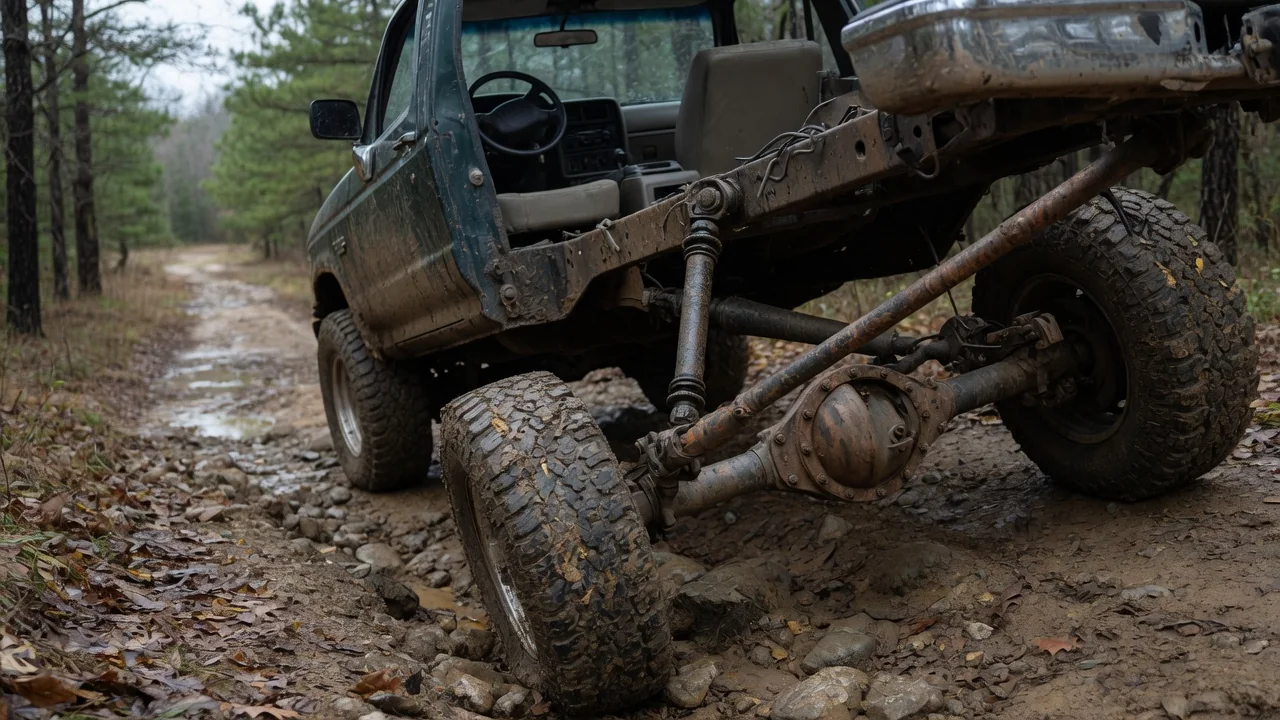
A locking differential is a differential that can mechanically join the two wheels on an axle so they turn at the same speed, sending usable torque to whichever wheel still has grip. That simple idea solves a common traction problem, but it also changes how the vehicle steers and how the driveline is loaded. This guide explains the locking differential concept, how it connects the axle shafts, when locking makes sense, and where its limits are.
Axle Connection: How a Locker Ties the Wheels Together
To understand a locker, start with an ordinary open differential. Inside the axle housing, the ring gear turns a carrier that holds small spider gears, which mesh with side gears splined to each axle shaft. This arrangement lets the left and right wheels rotate at different speeds, which they must do in every turn because the outside wheel travels a longer path than the inside wheel. The trade-off is that an open differential splits torque roughly evenly between the two sides, so the total torque available is limited by the wheel with the least traction. If one tire is on ice, in mud, or lifted in the air, it spins freely and the other wheel receives little driving force.
A locking differential removes that weak link by preventing differentiation when engaged. Depending on the design, a sliding collar, a dog clutch, or a set of engaging teeth locks a side gear to the carrier or locks the two axle shafts to each other. Once locked, both shafts rotate as a single unit, much like a solid shaft running across the axle. The wheel with grip can now receive torque even if the other wheel has none, up to the limit of its own traction and the strength of the driveline parts.
Lockers come in a few general forms. Selectable lockers stay open in normal driving and are engaged by the driver through an electric, pneumatic, or cable actuator. Automatic lockers stay locked under drive torque and let a wheel unlock and overrun when the vehicle turns or coasts, often with audible clicking or ratcheting. A spool is a permanently locked carrier with no differentiation at all and is generally reserved for dedicated off-road or competition use. A limited-slip differential is a separate category: it biases torque toward the wheel with more grip but still allows speed differences, so it does not fully lock the axle.
Appropriate Use: When Locking the Differential Helps
A locking differential is designed for low-traction, low-speed situations where one wheel on an axle is likely to lose grip or contact with the ground. Typical examples include rock crawling, crossing ruts or ditches that cause heavy axle articulation, climbing loose or wet slopes, driving through deep mud or snow, and pulling a trailer up a slippery ramp. In these conditions, keeping both wheels turning together lets the vehicle keep moving instead of stalling while one tire spins.
With a selectable locker, good practice is to engage it before it is needed rather than after a wheel is already spinning. Many systems need the gear teeth to align or the vehicle to roll slightly before the mechanism fully engages, and engaging while one wheel spins quickly can shock the gears and shafts. Drivers commonly approach the obstacle slowly, lock the axle, use steady throttle, and unlock once back on firmer ground. The owner's manual for a specific vehicle describes its own engagement conditions, speed restrictions, and indicator behavior, and those instructions take priority over general advice.
On vehicles with lockers on both axles, the rear is usually locked first because it has the least effect on steering. Locking the front axle as well adds traction at the front wheels but makes the vehicle much harder to turn, so it is generally saved for the most difficult obstacles.
Limits of a Locked Axle
The same rigidity that adds traction creates problems on surfaces with good grip. In a turn, a locked axle forces the inside and outside wheels to rotate at the same speed even though they need to travel different distances. Something has to give, so the tires scrub against the surface, the driveline winds up with stored tension, and the vehicle tends to push straight ahead instead of following the steering. On dry pavement this can cause tire hop, extra tire wear, unpredictable handling, and added load on axle shafts, joints, and gears. For these reasons, selectable lockers are meant to be disengaged on paved roads and at higher speeds.
A locker also cannot create traction that is not there. If both wheels on the locked axle sit on slick surfaces, they will simply spin together. Locking shifts the question from one spinning wheel to whether the axle as a whole has enough grip, and from there to tire choice, tire pressure, weight distribution, and driving technique. It also does not replace four-wheel drive: locking one axle of a two-wheel-drive vehicle helps only that axle.
Mechanical stress is the other important limit. When a locked axle sends most of the torque to one wheel, that axle shaft, its joint, and the ring and pinion carry loads they might not see with an open differential. Larger tires, high engine torque, and wheel hop add to this stress. Automatic lockers have their own behaviors, such as abrupt unlocking and relocking in turns and a tendency to pull during throttle changes, which can make them demanding to drive on slippery roads.
Practical Implications and Limits for Everyday Ownership
For owners, the first practical step is knowing which type of differential the vehicle actually has. A trim name or a dashboard switch does not always tell the whole story, since some vehicles use brake-based traction control that imitates a locker by braking a spinning wheel, while others have a true mechanical locker, a limited-slip unit, or an open differential. These systems behave differently, follow different operating rules, and may interact with stability control in vehicle-specific ways. The owner's manual and the vehicle's axle or build information are the reliable places to confirm what is installed.
Maintenance and modification also deserve attention. Lockers depend on correct gear oil and service intervals, and some designs or actuators carry specific fluid or inspection requirements from the manufacturer. Selectable lockers that are rarely used are often worth engaging occasionally so a sticking actuator is found before it matters on the trail. Matching tire sizes on the same axle matters more when it is locked, because mismatched diameters fight each other. Anyone considering an aftermarket locker should weigh installation complexity, the strength of the existing axle shafts and joints, and how the vehicle is driven day to day; a locker that suits occasional off-road use may be a poor fit for a vehicle that mostly sees wet highways.