What Is a LIN Bus in a Car? Low-Speed Vehicle Networking Explained
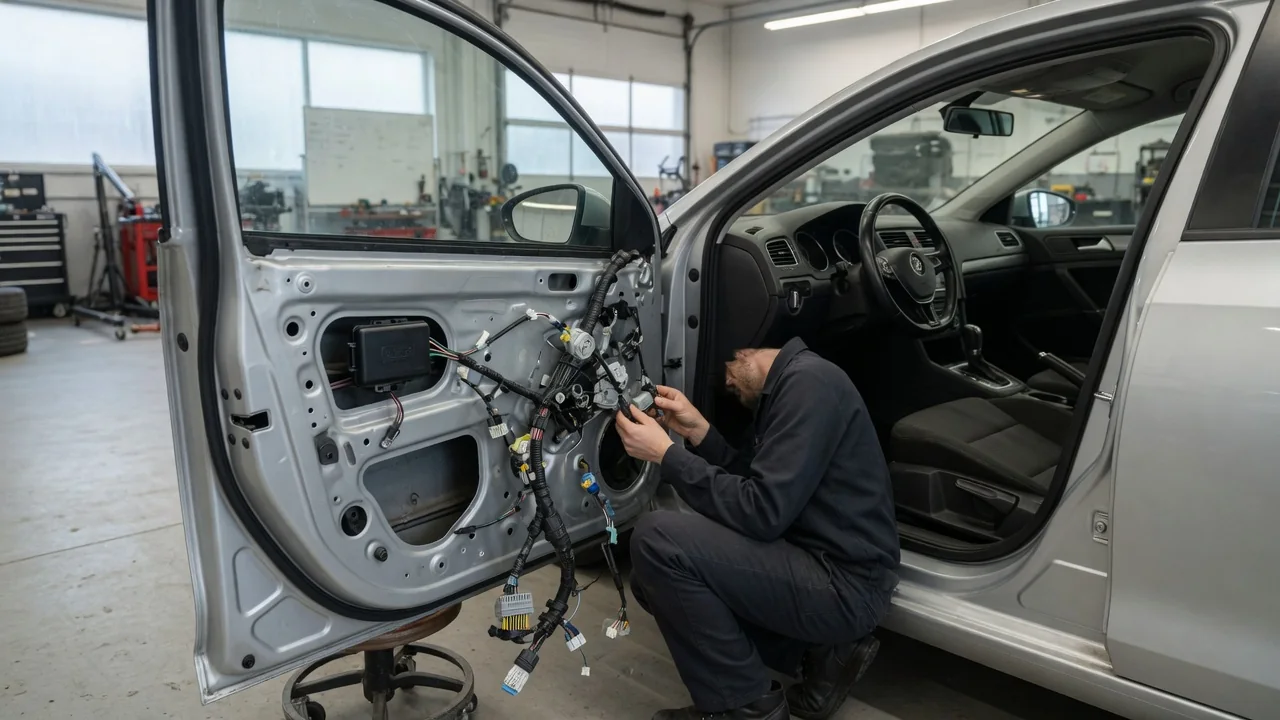
A LIN bus in a car is a simple, low-cost data network that connects small electronic devices to a controlling module. LIN stands for Local Interconnect Network. Faster networks such as CAN carry engine, braking and other time-critical data. The automotive LIN network handles modest jobs like moving a mirror, reading a switch or positioning a climate control flap. Knowing how it works helps explain why some comfort features fail together and how technicians approach those faults.
Low-speed devices: what LIN was built for
Modern vehicles contain dozens of small motors, switches and sensors that only need to exchange a few bytes of information now and then. A window switch reports a button press, a mirror motor receives a direction command, and a rain sensor reports how wet the windshield is. Giving each of these parts a full CAN interface would add cost and complexity that their simple tasks do not justify. LIN was developed by a group of automakers and suppliers as an inexpensive complement to CAN, and it was later standardized internationally as ISO 17987. Its purpose is to network low-speed devices cheaply while still replacing many individual wires with shared digital communication.
The physical layer is deliberately minimal. A LIN connection typically uses one signal wire plus the module's ground and battery supply, and it operates at the vehicle's normal system voltage. The maximum data rate is about 20 kilobits per second, far below what CAN offers. LIN uses the ordinary serial interface built into inexpensive microcontrollers. Slave devices can synchronize their timing from a field inside each message, so they do not need a precise quartz crystal. The specification also limits cluster size, commonly described as up to 16 nodes and roughly 40 meters of wire. Many real clusters are much smaller.
The trade-off is intentional. LIN is slow and does not carry functions that require high bandwidth or strict safety integrity. For a seat motor or an interior light, though, a delay of a few milliseconds makes no practical difference, and the lower cost per node matters more.
Master and slave: how a LIN cluster communicates
Every LIN cluster has exactly one master node and one or more slave nodes. Newer versions of the standard use the terms commander and responder, but the roles are the same. The master is usually a larger electronic control unit, such as a body control module, a door module or a climate control unit. That module is often also connected to a CAN network, so it acts as a gateway between the fast backbone and the slow LIN branch. Slave nodes never transmit on their own initiative. They speak only when the master asks them to.
Communication happens in frames. The master starts each frame by sending a header made of a break field, a synchronization byte and a protected identifier. The identifier tells every node which piece of data is being requested or delivered. The one node assigned to that identifier then sends the response, which contains up to eight data bytes followed by a checksum. Sometimes the master answers its own header, which is how it sends commands to slaves. Because the master decides who speaks and when, two nodes do not try to transmit at the same time. LIN therefore needs no arbitration process like the one CAN uses.
The master follows a schedule table, a predefined sequence of frames repeated at fixed intervals. This makes LIN timing predictable, which suits simple control loops. The protocol also supports sleep and wake-up. When the vehicle is idle, the cluster can go quiet to save battery power. Any node can then send a wake-up signal, for example when someone presses a switch, and the master resumes its schedule. LIN also defines diagnostic frames, which allow the master to pass service requests to its slaves and collect their responses.
Applications: where LIN is used in a car
LIN is most closely associated with body and comfort electronics. Common examples include power window motors and switch panels, exterior mirror adjustment and folding, door lock actuators, seat position and seat heating controls, sunroof drives, steering wheel buttons and interior or ambient lighting. Which features actually use LIN varies by manufacturer, model and equipment level, so a given vehicle may handle the same function through LIN, CAN or a direct wired circuit.
Beyond comfort features, LIN often links smart sensors and actuators. Typical uses include rain and light sensors, stepper motors that move heating and air conditioning flaps, blower controls, wiper motors and climate control panels. On some vehicles, battery monitoring sensors and charging system regulators also communicate over LIN. In each case, the device sends status information or receives simple commands, and the decision-making stays in the master module.
These applications reflect a hierarchical design. A high-speed backbone connects the main control units, and short LIN branches hang off individual modules near the parts they control. A door module on the CAN network, for instance, can manage the window, mirror and lock devices inside that door over a single LIN wire. This layout reduces the number of wires passing through areas such as door hinges and lets suppliers build components with their own built-in electronics.
Practical implications and limits
The shared single wire shapes how faults appear. A short to ground or to battery voltage on the LIN line, or a failed slave that holds the line in one state, can disable every device on that cluster at once. Several unrelated-seeming comfort features may stop together. If the master module fails or loses power, its whole LIN branch goes silent as well. A problem inside one slave, on the other hand, usually affects only that slave's function. That pattern is a useful clue when narrowing down where a fault sits.
Diagnosis normally goes through the master. A generic OBD-II scan tool generally cannot talk to LIN devices directly. Instead, the master module stores trouble codes, often lost-communication codes naming a specific LIN node, and a scan tool that can read that module retrieves them. With the electrical basics, an idle LIN line sits near battery voltage and is pulled toward ground to send data. During activity, a multimeter shows only an averaged reading, so an oscilloscope gives a far clearer view of the signal. Pin locations, wire colors and expected readings are vehicle-specific, and the manufacturer's service information is the reliable reference.
Replacement parts deserve care. A LIN slave must match what its master expects, and some vehicles require a replacement node to be configured or coded through the master before it responds. A part that looks identical but carries a different software variant may not work correctly. Finally, LIN has clear limits by design. It is not meant for safety-critical or data-heavy functions, and it supplements CAN, CAN FD and automotive Ethernet rather than replacing them.