What Is a Limited-Slip Differential? Torque Biasing, Types and Care
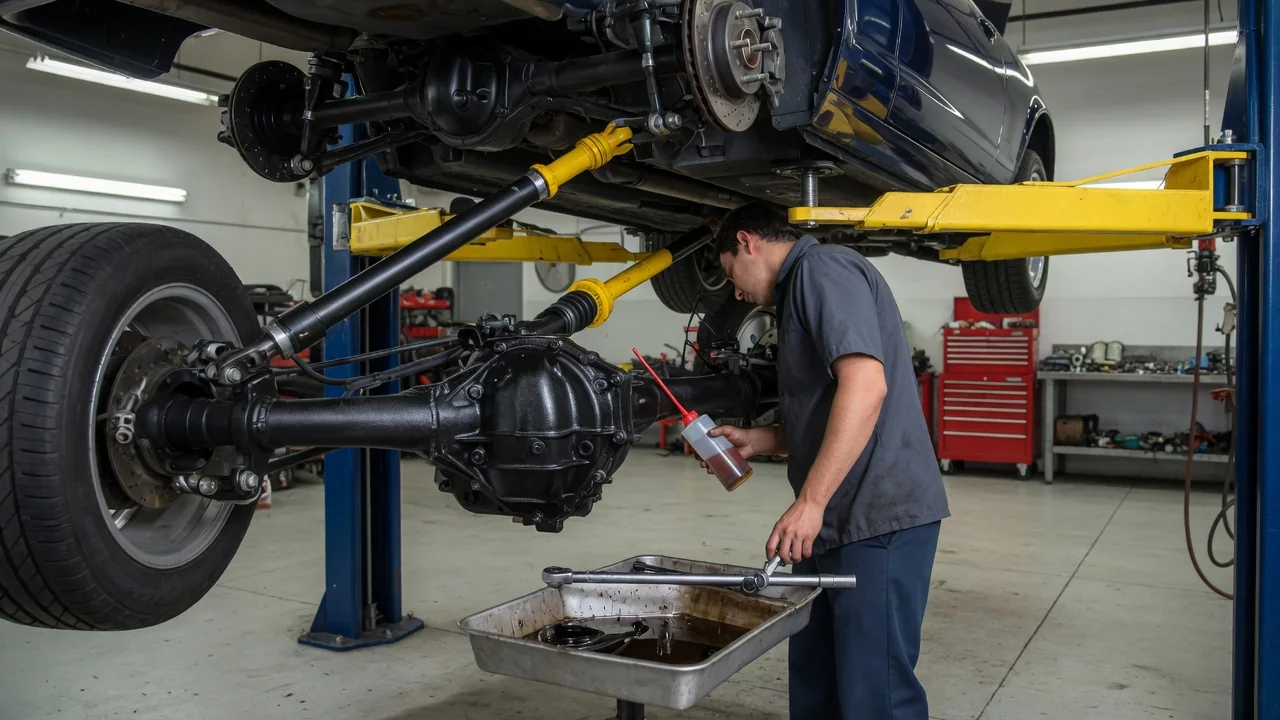
A limited-slip differential is a differential that still lets the driven wheels on an axle turn at different speeds through corners, but resists the large speed difference that develops when one wheel loses grip. A conventional open differential tends to send drive where resistance is lowest, so a single spinning tire can leave the vehicle stuck. Knowing what a limited-slip differential does, and how limited-slip differential operation differs between designs, explains why these units feel different on snow, gravel, or dry pavement and why they need specific care.
Torque biasing
An open differential divides torque roughly equally between its two output shafts while allowing them to rotate at different speeds. That equal split is the weakness. The wheel with less traction sets the ceiling for both sides: if one tire on ice can only accept a small amount of torque before it spins, the tire on dry pavement receives about the same small amount. Additional engine output simply makes the slipping wheel spin faster rather than pushing the vehicle forward.
A limited-slip differential adds controlled internal resistance between the two sides. Because the unit resists relative rotation, it can send more torque to the slower-turning wheel with better grip than to the faster-turning wheel that is slipping. This behavior is called torque biasing, and it is often described with a torque bias ratio: the ratio of torque the high-traction side can receive compared with the low-traction side before the wheels begin to slip relative to each other. A higher ratio means a stronger locking tendency. The ratio multiplies the torque the low-traction wheel can support, so when that wheel has almost no grip, the total torque delivered can still be modest.
Designs differ in what triggers the resistance. Torque-sensitive units increase their bias as input torque rises, speed-sensitive units react once a difference in wheel speed appears, and many clutch-based units add a preload so some resistance exists even with no throttle applied. A limited-slip differential is also distinct from a locking differential, which can force both wheels to turn at the same speed regardless of traction.
Common mechanisms
The clutch-type, or plate-type, limited-slip differential is one of the most widespread designs. Stacks of friction discs and steel plates sit between the side gears and the differential case, and springs or Belleville washers clamp them together with a set preload. In many performance-oriented versions, ramps in the case push the clutch packs harder as torque increases, and the ramp angles determine how strongly the unit locks under acceleration versus deceleration. Units that act only under acceleration are called one-way, those that act equally in both directions are called two-way, and those with reduced action on deceleration are called one-and-a-half-way. Cone-type units work on a similar principle but use cone-shaped friction surfaces instead of flat plates.
Gear-type torque-sensing differentials use helical or worm gears instead of clutch packs. When torque is applied, the gears generate thrust and friction against the case and each other, and that friction produces the bias. Because there are no friction plates designed to wear, these units are generally smooth and quiet in normal driving. Their limitation follows from the bias ratio: if one wheel is lifted off the ground or sits on a surface with almost no grip, a gear-type unit may behave much like an open differential. Some drivers use light brake pressure to create artificial resistance at the spinning wheel in that situation.
A viscous limited-slip differential, or viscous coupling, uses interleaved plates in a sealed housing filled with a thick silicone-based fluid. When the two sides turn at different speeds, the plates shear the fluid, which resists the motion. This makes the design speed-sensitive and somewhat delayed in its response. Electronically controlled limited-slip differentials use a hydraulic or electric actuator to vary clamping force on a clutch pack based on signals from a control module. Brake-based traction systems, sometimes described as electronic limited slip, are a separate approach: they apply the brake at a spinning wheel rather than using a mechanical limited-slip unit.
Maintenance
Lubricant is the most important routine item. Clutch-type units typically depend on gear oil that is formulated or modified for limited-slip use, because the clutch plates must slip smoothly before they grip. Some lubricants already contain the needed friction modifier, while others require a separate additive. Using the wrong fluid can cause chatter or reduce the locking effect. The vehicle or differential manufacturer's specification determines the correct oil and change interval, and severe service such as towing, track driving, or water crossings may call for shorter intervals according to the service manual.
Several symptoms suggest attention is needed. A chatter, groan, or clunk in slow, tight turns is a classic clutch-type complaint and is often linked to fluid condition or the wrong lubricant. A noticeable loss of traction where the unit once helped can indicate worn clutch plates or a degraded viscous coupling. Whining or howling that changes with speed more often points to ring-and-pinion gears or bearings than to the limited-slip mechanism itself, so a proper diagnosis matters. Leaks at the pinion seal, cover, or axle seals reduce fluid level and should be addressed early.
Tire condition affects limited-slip differentials more than many owners expect. Mismatched tire sizes, mixed tread depths, or very different inflation pressures across an axle make the differential work constantly, which can generate heat and wear in clutch packs or viscous couplings. Some service manuals describe a breakaway torque check, in which the torque required to rotate one wheel while the other is held is measured to judge clutch condition. Rebuilding a clutch-type unit, replacing plates, and setting preload require the correct specifications and tools, so that work is usually handled by a qualified shop.
Practical implications and limits
In everyday driving, a limited-slip differential is usually most noticeable when one wheel begins to lose grip: pulling away on wet or snowy pavement, climbing a loose driveway, or accelerating out of a corner. On rear-wheel-drive vehicles it can make the rear of the car respond more directly to throttle, and on front-wheel-drive vehicles it can change steering feel under hard acceleration. How strongly these effects appear depends on the specific design, its setup, and the vehicle's other systems.
A limited-slip differential does not create additional grip. It redistributes available torque, so it does not shorten braking distances or increase the cornering grip of the tires. It is not a substitute for tires suited to the conditions, and in extreme off-road situations with a wheel fully in the air, a locking differential is often more effective. Interaction with stability and traction control varies by vehicle, so the owner's manual is the reliable reference for how those systems work together.
To confirm whether a vehicle has a limited-slip differential, owners can check the build documentation, the axle identification tag or code, or the owner's manual. Lifting one wheel and spinning it is not a dependable test for every design, since gear-type and viscous units can behave differently from clutch-type units. Anyone considering an aftermarket unit should confirm compatibility with the axle, the fluid requirements, and the expected change in driving behavior before installation.