What Is a Limited-Slip Differential Called LSD? Meaning and Types
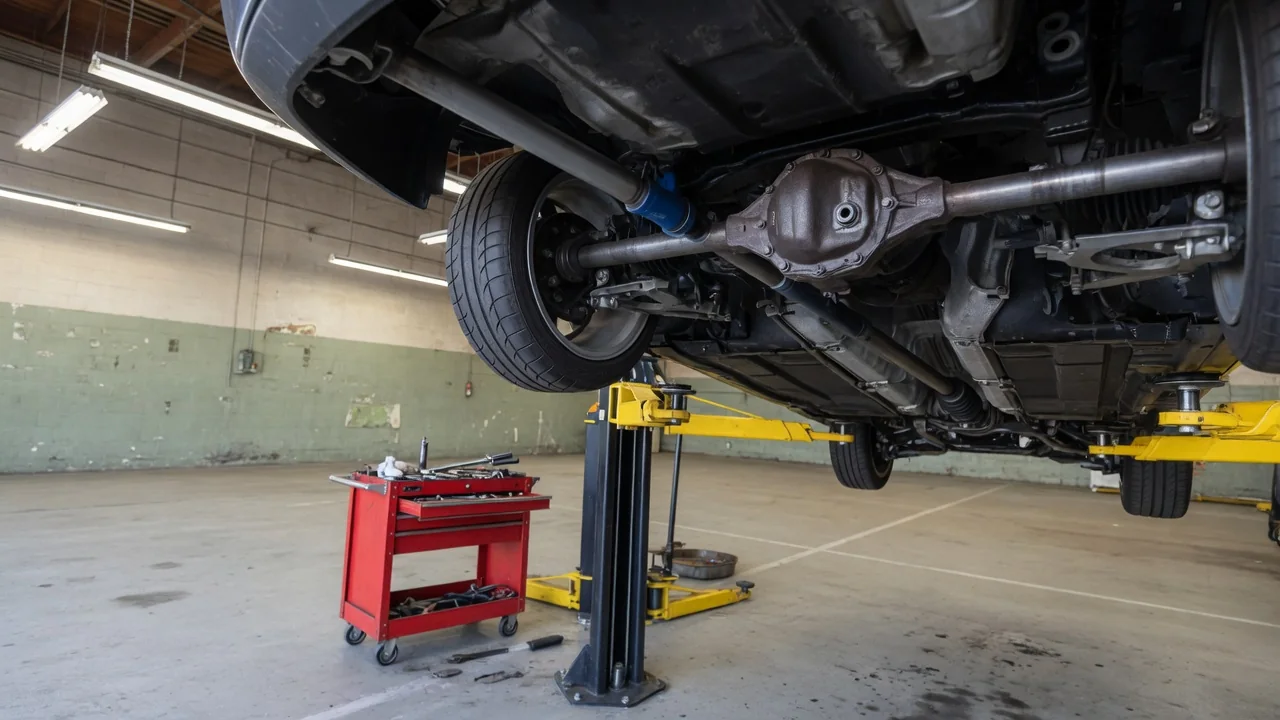
In car enthusiast language, LSD is the abbreviation for limited-slip differential. This type of differential restricts how much the two driven wheels on an axle can spin at different speeds. If you have seen the LSD differential abbreviation on a spec sheet, in a forum thread, or in an owner's manual, it refers to this drivetrain hardware. This guide explains what the term means, how an LSD behaves under torque, and which designs are most common.
Term meaning
Every vehicle with two driven wheels on a shared axle needs a differential. When the car turns, the outside wheel travels a longer path than the inside wheel, so it must rotate faster. A differential splits engine torque between the two wheels while letting them turn at different speeds. Without it, the tires would scrub and the drivetrain would bind in corners. The simplest version is called an open differential. It does this job quietly and cheaply, and it is still widely used in everyday vehicles.
The limited-slip part of the name describes what an LSD adds to that basic function. It still allows the wheels to turn at different speeds, but only up to a point. When one wheel starts spinning much faster than the other, usually because it has lost grip, the LSD resists that difference. It then sends more usable torque to the wheel that still has traction. So the answer to what a limited-slip differential is called is that LSD is the standard shorthand. The term covers a family of designs rather than one specific mechanism. Some manufacturers also use their own names for similar hardware, so the vehicle's documentation is the reliable way to confirm what a particular car has.
Torque behavior
An open differential has a weakness that explains why the LSD exists. In a conventional open design, the torque delivered to the two wheels is essentially equal. That means the total usable torque is limited by the wheel with the least grip. If one tire is on ice or wet grass, or lifts during hard cornering, very little torque is needed to spin it. The opposite wheel receives the same small amount. The result is a spinning tire and a car that barely moves or exits a corner slowly.
A limited-slip differential creates internal resistance to differences in wheel speed. Depending on the design, that resistance comes from friction between clutch plates, from the meshing forces of specially angled gears, or from a fluid that resists shearing as the speed difference rises. In every case, the effect is the same: the wheel with more traction can receive more torque than the wheel that is slipping. Engineers often describe this capability with a torque bias ratio. That ratio expresses how much more torque the gripping wheel can receive than the slipping one. It varies by design and setup, so it cannot be assumed for a given car without its specification.
Two ideas are often blurred here. First, an LSD does not create traction; it redistributes the torque the tires can already use. Second, it does not permanently tie the wheels together the way a locking differential or a solid spool does. That middle ground is the point of the design. The LSD provides enough coupling to put power down, while the wheels can still turn at different speeds in normal cornering.
Common types
Clutch-type, or plate, LSDs use stacks of friction discs between the differential case and the side gears. Springs provide a baseline preload. In many designs, internal ramps press the clutches harder as driving or braking torque increases. Tuners often describe these units as 1-way, 1.5-way, or 2-way. A 1-way unit locks under acceleration only. A 1.5-way unit locks under both acceleration and deceleration, but more strongly under acceleration. A 2-way unit locks similarly in both directions. Clutch-type units can be tuned and are popular in motorsport, but their friction parts wear and they often need specific fluids.
Gear-type, or helical, LSDs are often called torque-sensing or torque-biasing differentials. They use worm or helical gears whose internal friction resists speed differences in proportion to the torque passing through them. Torsen is a well-known trade name for this approach. These units have no clutch packs to wear out and operate smoothly. However, because their action depends on torque, they can be ineffective when one wheel carries almost no load. Viscous LSDs use a sealed chamber of perforated plates and silicone fluid. When one wheel spins faster, shearing the fluid generates resistance. Because they react to speed difference rather than torque, they tend to respond more gradually.
Electronically controlled LSDs use a clutch pack that is actuated hydraulically or by an electric motor. A control unit decides how much lockup to apply based on sensor data. Many modern vehicles also use brake-based traction control, which brakes a spinning wheel so that torque reaches the other wheel through an open differential. This is sometimes marketed as an electronic limited-slip function, but it is a brake control strategy, not a mechanical LSD.
Practical implications and limits
Everyday drivers notice an LSD most when pulling away on mixed surfaces, climbing a slippery driveway, or accelerating out of a corner as weight shifts off the inside wheel. Enthusiasts value it because it lets a car use more of its power on corner exit and makes its behavior near the limit more predictable. In front-wheel-drive cars, an aggressive LSD can increase the tug felt through the steering wheel under hard acceleration. In rear-wheel-drive cars, it can make the car easier to rotate on throttle. That helps on a track but calls for care on a wet road.
Ownership details matter. Many clutch-type units call for a specific gear oil, sometimes with a friction modifier. The wrong fluid can cause chatter or groaning in tight, slow turns such as parking maneuvers. Clutch packs and viscous couplings can lose effectiveness with age and use, so a differential that once worked well may gradually behave more like an open unit. Check the owner's manual or service manual for the specific vehicle to confirm fluid type, service intervals, and any precautions about towing or matching tire sizes. Mismatched tire diameters can keep some differentials working constantly.
An LSD also has clear limits. It cannot overcome tires that lack grip, and it offers little help when both wheels on an axle are on ice. It is not a substitute for a true locker in serious off-road use, and it does not replace stability control. It is best understood as a tool that helps the drivetrain use available traction more effectively. The real-world benefit depends on the differential's type, setup, and condition.