What Is a Laser-Assisted Headlight? How Laser Light Becomes Road Light
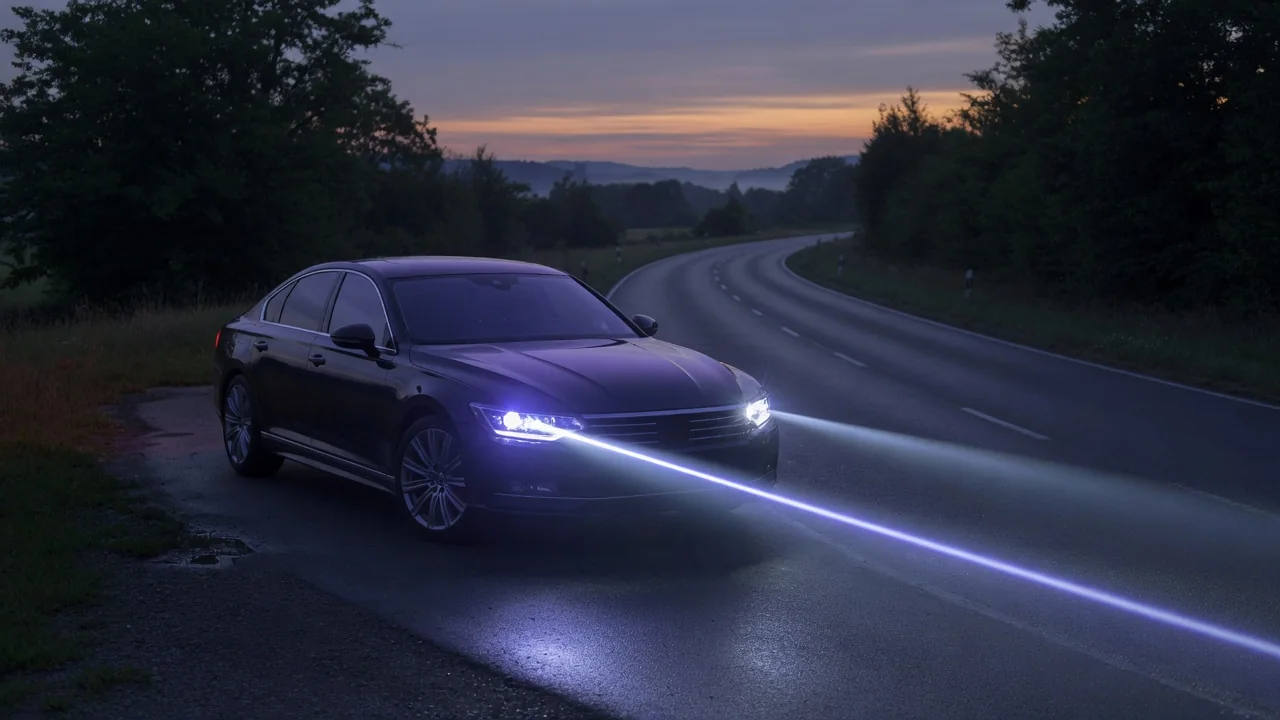
A laser-assisted headlight is a lighting system in which laser diodes supply energy to a phosphor element, and that phosphor produces the white light a driver actually sees. The laser is not aimed at the road. In the typical laser automotive headlight concept, the laser module adds a concentrated high-beam spot to an LED headlight that handles the low beam and the wider high-beam pattern. Understanding how the light is generated, converted and controlled explains both the appeal and the limits of the technology.
Light generation
The light source starts with one or more semiconductor laser diodes. Like an LED, a laser diode is a semiconductor junction that emits photons when current flows through it. The difference is that a laser diode has an optical cavity that reflects light back and forth through its active region, producing stimulated emission. The output is coherent, nearly a single wavelength, and leaves the chip as a tightly confined beam instead of spreading in many directions the way an LED's light does.
Automotive laser modules generally use blue laser diodes, built from the same basic semiconductor family used for blue LEDs. Blue is chosen because each photon carries enough energy to excite a phosphor that emits longer wavelengths, which is the foundation of the next stage. The key property the laser contributes is luminance: a large amount of optical power emerging from a very small area. A small, bright source allows a headlamp designer to use compact optics while still projecting a narrow, intense beam far down the road. The diodes also generate heat, so the module relies on a heat sink and driver electronics that regulate current, because laser output and service life are sensitive to temperature.
Conversion
Raw blue laser light would be unsuitable and unsafe for road illumination, so a laser-assisted headlight converts it before it leaves the lamp. The blue beam is directed, often through small lenses or mirrors, onto a phosphor element. A common choice for white-light conversion is a cerium-doped yttrium aluminum garnet phosphor, made as a ceramic or embedded in a binder. The phosphor absorbs part of the blue light and re-emits it as broad yellowish light. The blue light that is not absorbed mixes with that yellow emission, and the combination appears white to the eye.
Conversion also changes the character of the light in a way that matters for safety. The phosphor scatters the light, breaking up the coherent, collimated laser beam into diffuse emission from a tiny spot. That spot becomes the effective light source for the reflector or projection lens, which shapes it into a usable beam pattern. Designs differ in whether the laser passes through the phosphor or reflects off its surface, and each layout affects efficiency and heat handling. The phosphor itself must shed heat, because conversion is not perfectly efficient and the lost energy becomes heat concentrated in a very small area.
Control
Control in a laser-assisted headlight works at two levels: protecting people from the laser itself, and deciding when the laser-assisted beam should be lit at all. Because an intact phosphor is what makes the output safe, these systems are generally designed to detect faults in the conversion path. Approaches include sensors that monitor the light leaving the converter and beam traps that catch stray laser light. If a cracked or displaced phosphor, impact damage or abnormal readings are detected, the control electronics can switch the laser off while the conventional LED lighting keeps working.
The second level is beam management. Because the laser element usually supplements the high beam, it is typically tied to the high-beam function and often to automatic high-beam or camera-based systems that detect oncoming traffic, vehicles ahead and ambient lighting. Activation logic can also consider vehicle speed, so the long-range spot is used where it helps most, such as on open, unlit roads, rather than in town. The exact conditions, thresholds and integration with other headlight functions vary by manufacturer and by the regulations of each market, so specific behavior should be confirmed in the owner's manual for the vehicle in question.
Practical implications and limits
For drivers, the main benefit of a laser-assisted headlight is a longer, more concentrated high beam that can make distant objects visible sooner on dark roads. It does not change how the low beam behaves, because that job is normally handled by LED modules. Since the laser portion often operates only under certain conditions, a driver may rarely notice it in everyday urban driving, and a blue-tinted element visible inside the headlamp does not mean blue light is reaching the road.
Ownership has its own implications. Laser modules are integrated into sealed headlamp assemblies with dedicated control electronics, so they are not designed to be serviced like replaceable bulbs. A fault in the laser or phosphor section usually calls for dealer or specialist diagnosis and possibly assembly-level replacement, which tends to cost more than swapping a halogen bulb. Headlamp aim also matters: a concentrated long-range spot that is misaligned after a collision or suspension work loses usefulness and can affect other road users, so aiming should follow the vehicle's service procedure.
Some limits are worth keeping in mind. Products sold as laser bulbs or laser upgrades are not necessarily laser-assisted headlights in the sense described here; the word is sometimes used loosely in marketing. Fitting a genuine laser module into a lamp not designed for it raises legal and safety questions, because headlight approval applies to the complete assembly. Finally, the technology adds a component that depends on phosphor integrity, thermal management and safety monitoring, so its value lies in extended high-beam reach rather than in replacing the LED lighting that does most of the everyday work.