What Is a Jack Stand's Role? Load, Placement, and Inspection Explained
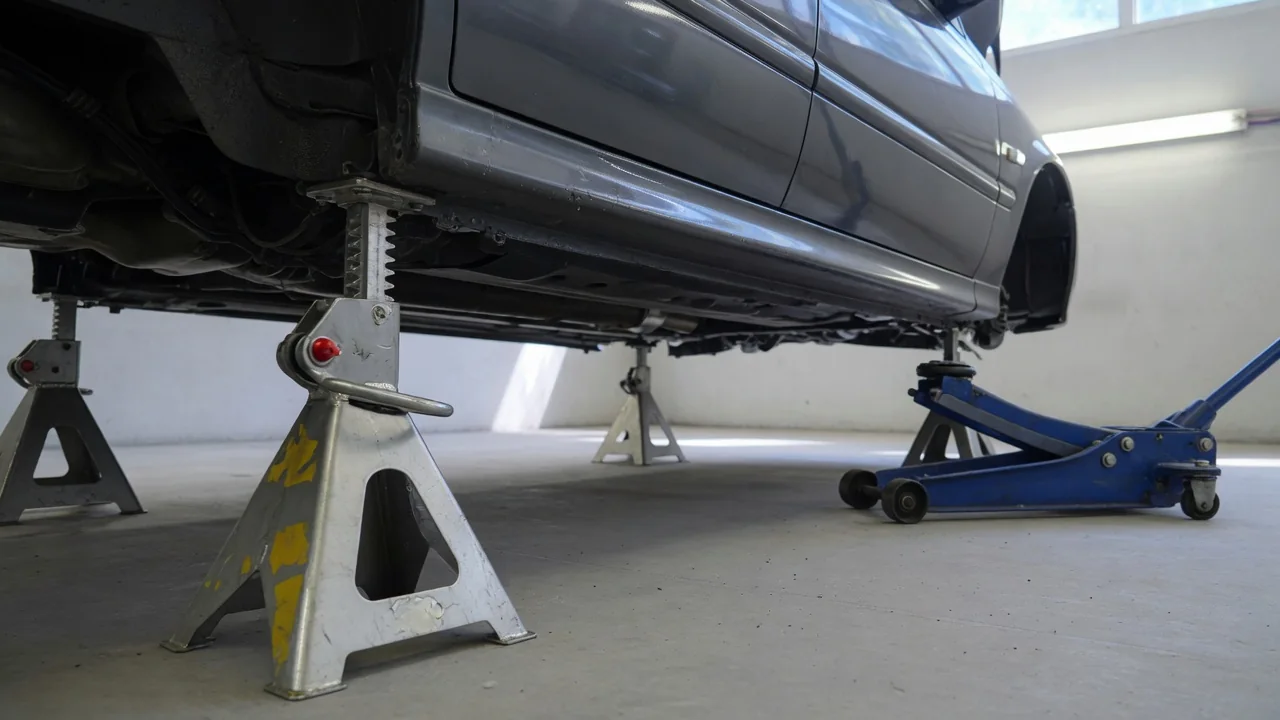
A jack stand has one job: to hold a raised vehicle securely at a fixed height while you work on or under it. A floor jack or scissor jack is built to lift, not to serve as long-term support. Knowing what a jack stand's role is, how it carries vehicle load, where it should be placed, and how to inspect it before use is basic safety knowledge for anyone doing maintenance in a home garage.
Vehicle Load: Why the Stand Holds the Car, Not the Jack
Most floor and bottle jacks hold a vehicle up with hydraulic pressure trapped behind seals and a release valve. That arrangement works well for lifting, but a worn seal, a bumped handle, or an accidentally opened valve can let the load descend with little warning. A jack stand works differently. Once its column is set, a ratchet and pawl or a steel pin locks it mechanically, so its height no longer depends on fluid pressure or on anyone touching a control. That fixed, mechanical support is the core of what jack stand car support means: the jack raises the vehicle, and the stands take over the job of holding it.
Every stand carries a rated capacity, usually marked on its label or body, and some ratings describe a pair of stands rather than a single one, so read the marking carefully. When you raise one end of a vehicle, the stands carry only part of its total weight, but that share depends on the vehicle's layout, engine position, cargo, and how much of the car is lifted. The share can also change during work: removing a heavy component or forcing a stubborn bolt shifts weight and side loads onto the stands. Choosing stands with a comfortable margin above the expected load, and checking the vehicle's weight information in its documentation or on the door-jamb label, keeps that variation within safe limits.
Placement: Ground, Support Points, and Setup
A stand can only be as stable as the surface beneath it. A hard, flat, level floor, such as a sound concrete garage slab, gives the base full contact. Gravel, soil, and asphalt softened by heat can let a base sink or tilt, and any slope encourages the vehicle to roll. Before lifting, set the parking brake, put an automatic transmission in park or a manual in gear, and chock the wheels that will stay on the ground.
Where the saddle meets the vehicle matters just as much. Manufacturers designate lifting and support points, and the owner's manual or service manual is the place to confirm them for a specific vehicle. In general terms, unibody cars are often supported at reinforced pinch-weld areas, body-on-frame trucks at the frame rails, and solid-axle vehicles at the axle housing, but these are broad patterns, not rules that apply to every model. Avoid oil pans, floor pans, exhaust parts, plastic trim, and suspension components not intended to carry the vehicle. A rubber or slotted saddle pad can help prevent a pinch weld from bending under a flat saddle.
Lift at a designated jacking point, slide the stand into position, and raise its column to the needed height. Confirm the lock is fully engaged, ideally with both stands on the same notch so the vehicle sits level. Then lower the jack slowly until the weight settles onto the stands, watching that each saddle stays centered. Many technicians leave the jack lightly in contact as a secondary backup where it does not interfere. Finally, give the vehicle a firm but careful push to confirm it is stable before any part of your body goes underneath.
Inspection: Checking a Jack Stand Before Each Use
Because a stand is passive, its condition decides whether it can do its job. Start with the structure: look for bent legs, cracked welds, deep corrosion, or a base that rocks instead of sitting flat on the floor. The column should be straight and should slide smoothly without binding, and the saddle should not be cracked, spread, or distorted from previous loads.
Next, examine the locking mechanism, since that is what actually holds the height. On ratchet-style stands, check that the teeth are crisp rather than rounded or chipped and that the pawl snaps fully into engagement and stays there. On pin-style stands, make sure the pin is straight and the holes are not elongated or cracked. If the capacity label is missing or illegible, you no longer know what the stand is rated to carry.
A stand that fails any of these checks should be retired, not repaired with improvised welding or shims. Jack stands, like other tools, can be the subject of manufacturer recalls, so keeping track of the brand and model you own and watching for safety notices is worthwhile. Storing stands dry and off the floor helps slow corrosion between uses.
Practical Implications and Limits
Understanding the stand's role clarifies what it cannot do. It is not a lifting tool, and it cannot compensate for soft ground, a poorly chosen support point, or a vehicle left free to roll. When only one end is raised, the wheels still on the ground are part of the support system, which is why chocks and the parking brake remain essential. Lifting an entire vehicle onto four stands is possible, but it removes that grounding and calls for careful sequencing and level placement.
Improvised supports are a common source of risk. Concrete blocks and bricks can crack suddenly under concentrated load, and stacked wood can split or shift. Ramps are a separate option for some tasks but serve a different purpose. Vehicle-specific factors also matter: some vehicles with air suspension may need a service or jacking mode before being lifted, and electrified vehicles may have battery packs that restrict where support is allowed. The vehicle's manual is the right reference for these details.
Good habits extend the safety margin further. Keep someone nearby when you work under a vehicle, stay out of the space beneath it when you do not need to be there, and recheck stability after any forceful work. If you are unsure about support points, or the task requires removing major components, a shop with a proper lift may be the safer choice.