What Is a Hybrid Power Split Device? How It Splits Engine and Motor Power
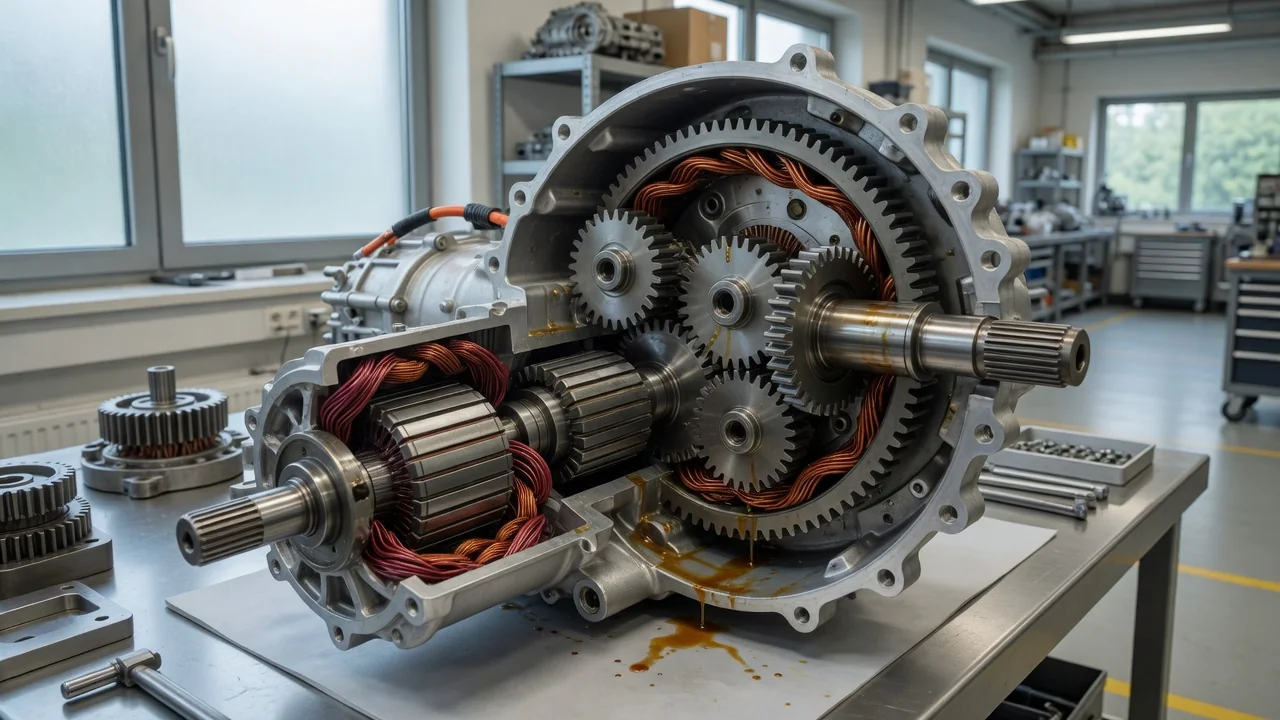
A hybrid power split device is the mechanical core of many full hybrid transmissions. It replaces a conventional stepped gearbox with a planetary gearset that connects a gasoline engine and two electric motor-generators to the drive wheels at the same time. This guide explains what a hybrid power split device is, how power travels through it, how its gears interact, and which operating modes it makes possible, without relying on the details of any single vehicle.
Engine and motor paths
A typical power split hybrid combines an internal combustion engine, two motor-generators, a high-voltage battery, an inverter and a hybrid control unit. Service literature often labels the motor-generators MG1 and MG2, although naming varies between manufacturers. MG1 mainly works as a generator and engine starter, while MG2 mainly works as the traction motor that drives the wheels and recovers energy during braking. The power split device is the gear assembly that ties the engine, MG1 and the output shaft together.
When the engine runs, its output is divided into two paths. In the mechanical path, part of the engine torque goes through the gears directly to the wheels. In the electrical path, the remaining power turns MG1, which produces electricity. That electricity is routed through the inverter either to MG2, which adds torque at the wheels, or into the battery for later use. Because power can flow both mechanically and electrically at once, this layout is commonly described as a series-parallel hybrid.
The reason for splitting power is control. By adjusting how much load the generator places on the system, the control unit can keep the engine near an efficient speed and load while road speed changes independently. The battery acts as a buffer, absorbing surplus energy or supplying extra when demand rises. The electrical path does involve conversion losses in the generator, inverter and motor, so during steady driving the control strategy generally favors sending most engine power through the more direct mechanical path.
Gearset
The power split device is built around a planetary gearset, the same basic arrangement found in many automatic transmissions. It has a central sun gear, several planet gears mounted on a carrier, and an outer ring gear with internal teeth that mesh with the planets. In the most common textbook layout, the engine drives the carrier, MG1 is connected to the sun gear, and the ring gear is linked to the output shaft and MG2, either directly or through additional reduction gearing. Some designs use extra planetary sets or different connections, so this description is a general model rather than a universal blueprint.
The three members of a planetary set are kinematically linked: if the speeds of any two are known, the speed of the third is fixed. Engineers often illustrate this with a lever or nomograph diagram in which the three speeds always fall on a straight line. In a hybrid, the ring gear speed is set by vehicle speed, so changing the speed of MG1 changes engine speed. This is why the system behaves as an electronically controlled continuously variable transmission, even though it contains no belts, pulleys or shifting clutches in its basic form.
Torque behaves differently from speed. The torque shares among the sun, carrier and ring are fixed by the gear tooth counts, so the engine can only push against the wheels if MG1 supplies a reaction torque at the sun gear. That reaction is exactly what makes MG1 generate electricity. If MG1 is allowed to spin freely with no load, engine torque cannot reach the output, which is how the system creates an effective neutral without a mechanical clutch.
Operating modes
At low speeds and light loads, many power split hybrids can drive on electricity alone. The engine is stopped, so the carrier is stationary, while MG2 turns the ring gear and the wheels. With the carrier held still, the sun gear and MG1 simply spin in reverse without doing work. When the engine is needed, MG1 applies torque to the sun gear and cranks the engine through the carrier. In typical designs this replaces a separate starter motor, which allows quick and smooth engine starts.
Once the engine is running, the system blends engine and electric power. During moderate cruising, engine output is split between the mechanical path and MG1, and surplus electricity may recharge the battery. Under hard acceleration, the battery supplies additional current to MG2 so that combined output exceeds what the engine provides alone. At some higher speeds, MG1 may need to act as a motor rather than a generator, which can cause power to circulate inside the system. Control strategies try to limit this state because it reduces efficiency.
When the driver lifts off or brakes, MG2 operates as a generator and converts kinetic energy into electricity, while the brake system blends regenerative and friction braking. Reverse is usually handled by running MG2 backward rather than by a dedicated reverse gear. The exact switching points between these modes are vehicle-specific and depend on battery state of charge, temperature, accessory load and driver demand, so two power split hybrids may behave differently in the same situation.
Practical implications and limits
For drivers, the most noticeable effect is that engine speed is not tied to road speed through fixed gears. Under firm acceleration the engine may rise to a high, steady rpm while the car gathers speed, a sensation some owners describe as droning. The engine may also start or stop at moments that seem unrelated to driving, for example to warm the cabin, heat the catalytic converter or restore battery charge. These behaviors are normal results of the control logic rather than signs of slipping or a fault.
Electric-only driving has built-in limits. With the engine stopped, MG1 spins faster as vehicle speed increases, so above a certain speed the system may need to turn the engine to keep components within safe limits. Battery capacity and power output further restrict how far and how hard the car can move without the engine. Towing also requires care: because the drive wheels are connected to the gearset and motors, moving the vehicle with drive wheels on the ground can turn internal parts and generate voltage, so the owner's manual towing instructions should always be followed.
From a maintenance standpoint, the planetary gearset avoids the clutch packs and shift hardware of a conventional automatic, but the transaxle still requires the fluid specified by the manufacturer, and the inverter and motors often depend on a dedicated cooling circuit. Warning lights or abnormal behavior usually call for diagnosis with a scan tool that can read hybrid system data. The high-voltage components are not suitable for casual do-it-yourself repair, and work on them should follow the factory repair manual and appropriate safety procedures.