What Is a Hybrid Power-Control Unit? Inverter, Converter and Cooling Explained
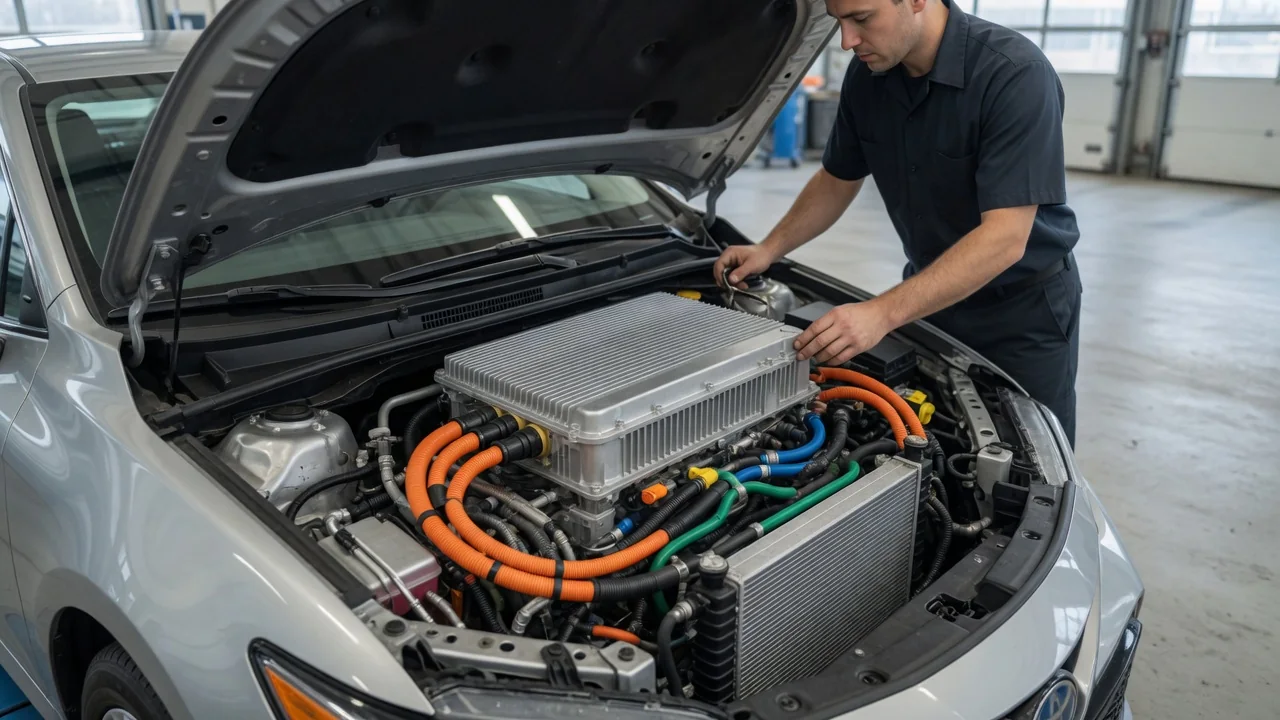
A hybrid power-control unit is the electronic module that manages energy flow between a hybrid's high-voltage battery, its electric motor-generators, and the vehicle's low-voltage electrical system. The short answer to what is a hybrid power control unit is this: it is a power-conversion hub. It changes the type and level of electrical energy, switches large currents very quickly, and has to get rid of the heat that work produces. Three topics explain how it works: the inverter, the converter, and the cooling system.
Inverter: Turning Battery DC Into Motor AC
A hybrid's high-voltage battery stores and delivers direct current (DC), but the traction motors used in most hybrids are three-phase alternating current (AC) machines. The inverter bridges that gap. Inside it, power semiconductors, commonly insulated-gate bipolar transistors (IGBTs) and in some newer designs silicon carbide devices, switch on and off thousands of times per second. Through a technique called pulse-width modulation, this rapid switching produces a current that approximates a smooth AC waveform. By changing the frequency and effective amplitude of that output, the inverter controls the motor's speed and torque, which is how the car delivers electric drive power on demand.
The inverter also works in reverse. During regenerative braking, or when the engine turns a generator, the motor-generator produces AC, and the inverter converts it back to DC so the battery can be recharged. Many hybrids use two motor-generators, and the power-control unit may contain a separate inverter stage for each in a single housing. Supporting parts typically include gate-driver circuits that operate the transistors, current sensors that report what the motors are doing, and a large capacitor that smooths the DC supply. It helps to separate roles: the hybrid control computer decides how much power should flow and in which direction, while the power-control unit carries out those commands electrically.
Converter: Boost and DC-DC Stages
Many hybrid power-control units include one or more converters that change DC voltage levels. In some hybrid designs, a boost converter raises the battery's voltage to a higher system voltage before it reaches the inverter. A higher operating voltage allows the motors to deliver the same power with less current, which reduces resistive losses and can help the motors perform well at higher speeds. A boost converter of this type is usually bidirectional, stepping voltage back down when energy flows toward the battery during regeneration. Not every hybrid uses this approach; some systems run the inverter directly at battery voltage, so the presence of a boost stage is a design choice rather than a universal feature.
The second common converter is the DC-DC converter, which steps high voltage down to the roughly 12-volt level used by lights, infotainment, control modules, and other accessories. It also keeps the conventional 12-volt battery charged. In many hybrids, this converter takes over the job a belt-driven alternator performs in a conventional car, which is why some hybrids do not have an alternator at all. Depending on the manufacturer, the DC-DC converter may sit inside the main power-control unit housing or be packaged as a separate module elsewhere in the vehicle.
Cooling: Managing Heat From Power Electronics
No power conversion is perfectly efficient. Every time the semiconductors switch, and whenever current passes through them, a portion of the energy becomes heat. Power semiconductors have firm temperature limits, and components such as capacitors and solder joints tend to age faster when they run hot. For that reason, most hybrid power-control units are liquid-cooled. Many hybrids use a dedicated coolant circuit for the power electronics that is separate from the engine's cooling system, because the electronics need to stay considerably cooler than the temperature an engine normally runs at. Such a circuit typically includes an electric pump, its own reservoir, and a radiator or radiator section, often mounted near the front of the vehicle.
Because the engine in a hybrid may be off while the electronics are working hard, the coolant pump for the power-control unit is usually electric and controlled independently of engine speed. Temperature sensors report to the control system, which can reduce the available electric power if temperatures climb beyond safe limits. This protective strategy, often called derating, sacrifices some performance to prevent damage. Cooling arrangements still vary: some smaller components may be air-cooled, and some designs integrate the electronics cooling with other thermal systems in the vehicle.
Practical Implications and Limits
For owners, the most visible consequence is maintenance. Where a separate electronics coolant loop exists, it is often its own service item with a specified coolant type and, in some cases, a specific filling and air-bleeding procedure. The owner's manual or official service information is the right reference for coolant type and intervals; assuming engine coolant guidance applies can lead to mistakes. Low coolant or a failed electric pump in this circuit can trigger warning messages and reduced power, so dashboard alerts related to the hybrid system deserve prompt attention rather than continued driving to see if they clear.
Safety is the other major consideration. The hybrid power control unit handles voltages capable of causing serious injury, and its internal capacitors can retain a charge for a period after the system is switched off. High-voltage cables are typically marked in orange. Manufacturer procedures for working near these parts generally involve disabling the high-voltage system and waiting a specified time before any work begins. Opening the unit or disconnecting high-voltage connectors is a job for technicians trained in hybrid systems and equipped with appropriate insulated tools and protective equipment.
A general explanation also has limits. Manufacturers use different names, such as inverter assembly, power electronics module, or power-control unit, and they package the inverter, converters, and controls in different combinations. Symptoms like a hybrid system warning or a car that will not enter ready mode can have many causes, including a weak 12-volt battery, since the low-voltage system powers the controllers that switch on the high-voltage circuit. Accurate diagnosis relies on a scan tool that can read hybrid-specific fault codes and live data, and repair options range from replacing the complete assembly to servicing individual components, depending on what the manufacturer supports.