What Is a Hybrid Inverter?
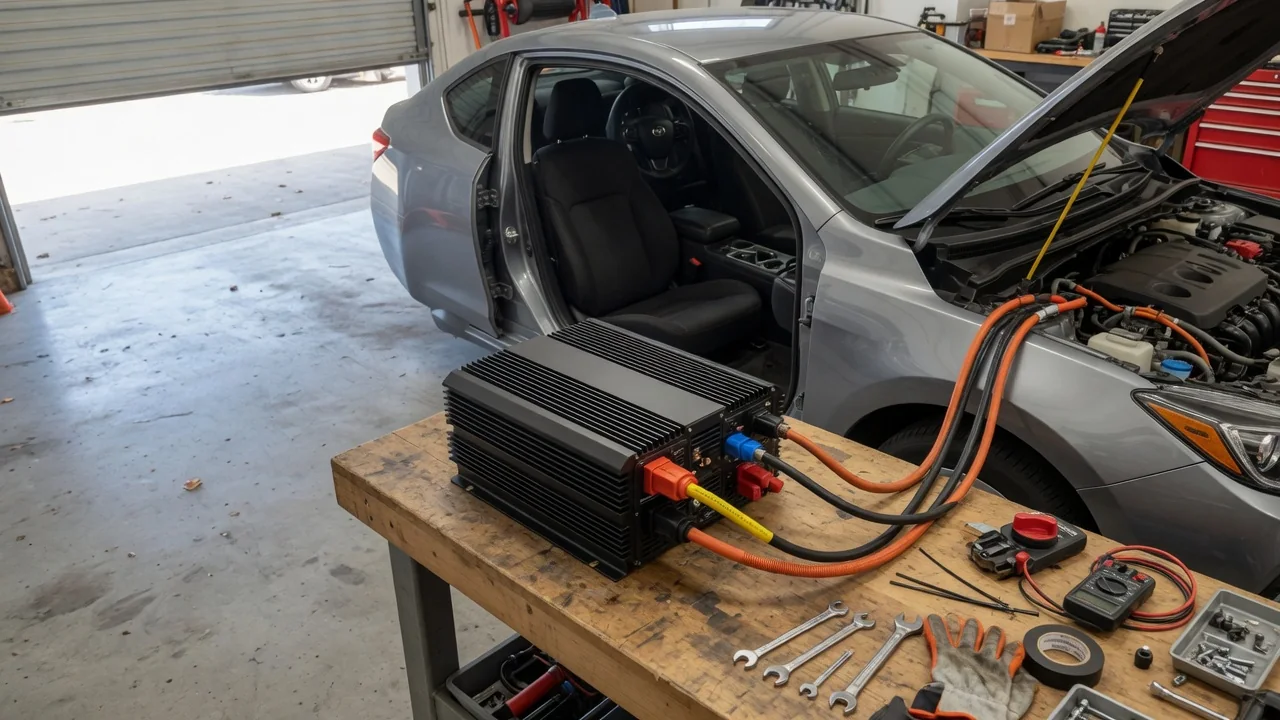
Anyone asking what is a hybrid inverter is really asking how a battery and an electric motor manage to work together. The battery stores direct current, while the traction motor runs on alternating current. The inverter sits between them, converting power in both directions so the car can accelerate on electricity and recover energy when it slows down.
Power flow
During acceleration, the high-voltage battery supplies direct current to the inverter. Inside, fast-acting power transistors switch that current on and off in a controlled pattern, building three-phase alternating current for the motor. By changing the frequency and timing of that output, the control electronics set motor speed and torque. A gentle pull away from a stop sign calls for modest current, while a highway merge demands much more, and the inverter adjusts continuously without the driver feeling any individual step.
The flow reverses when the driver lifts off the accelerator or presses the brake. The motor becomes a generator, producing alternating current that the inverter rectifies back into direct current for the battery. Many hybrids also house a boost stage that raises battery voltage before conversion, and a separate converter that steps high voltage down to charge the twelve-volt system. Whether these functions share one housing or sit in separate units depends on the manufacturer, so the layout under the hood differs between vehicles.
Cooling
Switching large currents thousands of times each second is efficient, but never perfectly so. The small fraction of energy lost appears as heat in the power transistors, and semiconductors tolerate only a limited temperature range. For that reason, most hybrid inverters are liquid cooled. Coolant passes through channels beneath the power modules, carries heat to a radiator at the front of the car, and returns. Heat load rises with sustained climbing, towing, or repeated hard acceleration, when current through the electronics stays high.
Many hybrids use a dedicated loop for the electronics, separate from the engine cooling system, with its own electric pump, reservoir, and section of radiator. Others combine circuits or route coolant through the motor and transaxle as well. An owner can usually find a labeled reservoir under the hood and check that the level sits between its marks. The correct coolant type and any replacement schedule are vehicle specific, so the owner's manual or service information is the right reference rather than a general rule.
Warning signs
Because the inverter controls all electric drive power, problems tend to show up as changes in how the car moves. A hybrid system warning message, a check engine light, reduced power, or a refusal to enter its ready state can all involve the inverter. Some drivers notice the car relying on the gasoline engine more than usual, hesitating under acceleration, or losing regenerative braking feel. An overheating warning for the hybrid system may point toward the cooling circuit rather than the electronics themselves.
None of these symptoms identifies the inverter on its own. A weak battery pack, a failed coolant pump, a wiring or connector fault, or a motor problem can produce similar behavior. Stored fault codes help narrow the search, but a code describes a condition the control module detected, not a confirmed failed part. Many hybrid codes are also manufacturer specific, so their meaning has to be confirmed against information for that exact vehicle before any conclusion is drawn about what needs repair.
Everyday Use and Observations
In normal driving, a healthy inverter is almost invisible. The clearest evidence of its work is the energy flow display found in many hybrids, which shows power moving from battery to wheels during acceleration and back toward the battery during deceleration. Each change of direction on that screen represents the inverter switching between making alternating current for the motor and turning generated alternating current back into direct current. Smooth transitions between electric and engine power are another sign that conversion is working properly.
Some drivers hear a faint high-pitched whine at low speeds or during braking. That sound often comes from the switching frequency of the electronics and the motor responding to it, and on many vehicles it is normal. A small pump may also run briefly after shutdown to circulate coolant. What counts as ordinary varies by model, so the useful comparison is against how the same car has always behaved. A new noise, or one that grows louder, deserves more attention than a familiar one.
Limits and Next Steps
The inverter is not an owner-serviceable component. It handles voltages far above those of a conventional car's electrical system, and capacitors inside can hold a dangerous charge after the vehicle is switched off. High-voltage cabling is commonly marked with orange insulation as a warning to keep clear. Sensible owner involvement stops at visual checks, such as watching the coolant reservoir level, looking for leaks beneath the car, and noting any warning messages along with the conditions in which they appeared.
When a warning does appear, the practical next step is a diagnosis by a technician trained and equipped for hybrid systems. They can read manufacturer-specific data, test the cooling circuit, and verify insulation and wiring before condemning an expensive part. It is also worth asking whether the vehicle has any open recalls or extended hybrid component coverage, since terms differ by manufacturer and model year. Sharing clear notes about when the problem occurs, such as after long climbs or in hot weather, makes that diagnosis faster.