What Is a Homelink-Style Garage Door Control in a Car?
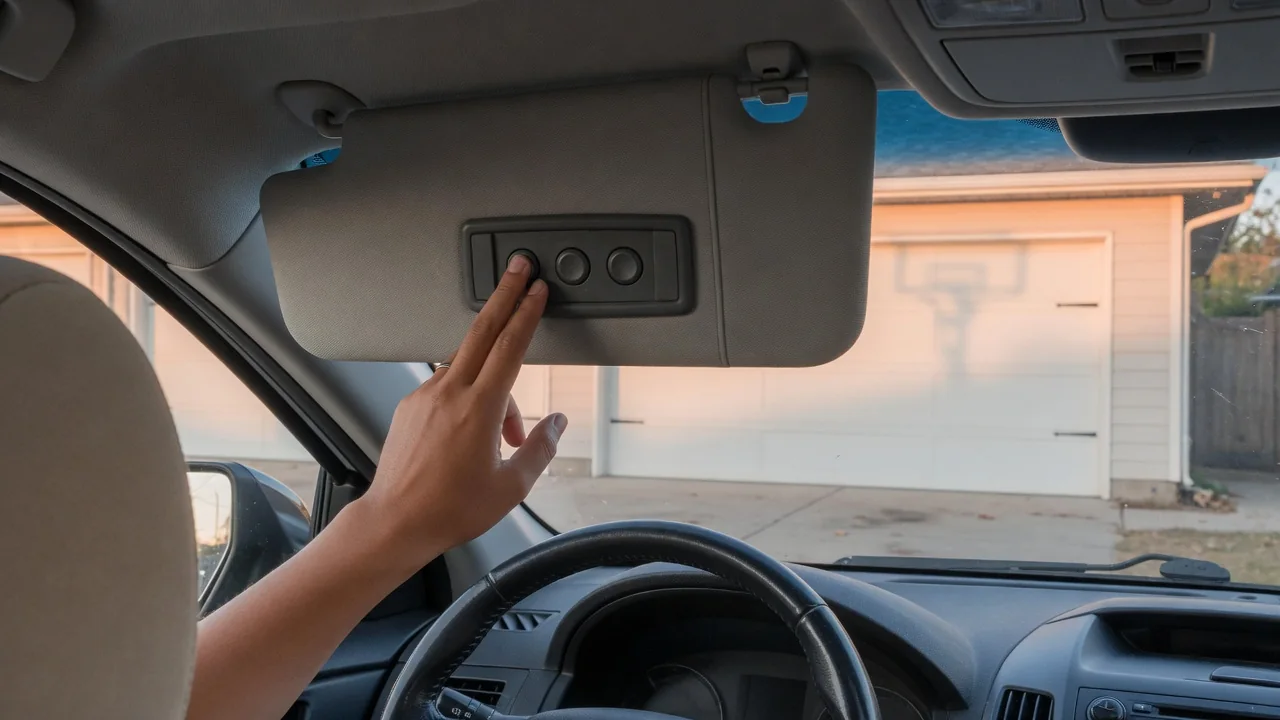
Many drivers notice a small row of buttons on the mirror, visor, or overhead console and wonder what it does. So what is a HomeLink-style garage door control in a car? It is a built-in transmitter that learns to send the same kind of signal as a handheld garage remote, letting the vehicle itself open the door, a gate, or other compatible devices.
Pairing
Pairing is the process that teaches the car's built-in transmitter to speak the same language as the garage door opener. Out of the factory, the buttons do nothing, because they hold no signal. During pairing, the vehicle either copies the radio signal from an existing handheld remote or is introduced directly to the opener motor unit, depending on the design. Once that relationship is stored, the car keeps it in memory, so the paired button works on every drive without the original remote being present.
Many modern openers use rolling codes, where the signal changes with each press to resist copying. With these, pairing usually involves an extra step at the opener itself, often a learn button on the motor housing, so the opener accepts the vehicle as a trusted transmitter. Older fixed-code openers tend to need only the remote. The exact sequence, timing, and indicator behavior differ between automakers and opener manufacturers, which is why the owner's manual for the specific vehicle is the right reference rather than a generic routine.
Buttons
The controls are typically a cluster of three buttons, though the count and layout depend on the vehicle. Common locations include the underside of the rearview mirror, the driver's sun visor, and the overhead console near the map lights. Some newer vehicles replace physical buttons with icons on the central touchscreen, sometimes tied to location so the prompt appears as the car approaches home. Physical versions are often marked with a small house symbol or simple dots that distinguish one button from the next.
Each button stores its own signal, so one can operate the main garage door, another a second door, and a third a driveway gate or a compatible lighting or entry system. A small indicator light near the buttons usually shows what is happening, glowing or flashing while a signal is sent or while the system is learning. The meaning of slow flashing, rapid flashing, or a steady light is not universal, so drivers should interpret those patterns using the documentation for their own vehicle.
Security cleanup
Because the paired signal lives in the car rather than in a removable remote, it stays with the vehicle when ownership changes. A car that is sold, traded in, or returned at the end of a lease with its buttons still programmed can, in principle, still open the previous owner's garage. Clearing the stored codes before handing over the keys is the built-in equivalent of taking the clip-on remote off the visor, and most systems offer a way to erase all buttons at once.
The same thinking applies in the other direction. Anyone buying a used vehicle is better off erasing whatever the last owner stored before pairing their own door, so no unknown signals remain in memory. A fuller cleanup also involves the opener, since many motor units can wipe their list of accepted transmitters, which blocks any remote or vehicle that was paired earlier. How each erase is performed varies by vehicle and opener brand, so the respective manuals should guide the specifics.
Everyday Use and Observations
In daily driving, the system behaves much like a handheld remote that never gets lost or slides under the seat. The driver presses the stored button while approaching the driveway, the indicator light confirms a transmission, and the door begins to move. Because the transmitter draws power from the vehicle's electrical system, there is no coin battery to replace. Some vehicles allow the buttons to work with the ignition off, while others require the ignition or accessory mode to be on, which can also limit use by someone who enters a parked car.
Range is something owners notice quickly. The built-in transmitter may reach slightly farther or shorter than the original remote, and results can shift with the angle of approach, the position of the opener's antenna, and nearby sources of radio interference. Certain LED bulbs in or near the opener are a known cause of weakened reception. A door that responds inconsistently from the car but reliably from the handheld remote points toward signal or pairing issues rather than a mechanical problem with the door itself.
Limits and Next Steps
A built-in control is not guaranteed to work with every opener. Compatibility depends on the frequencies and code formats that a particular generation of vehicle hardware supports, and newer openers sometimes use security schemes that older cars cannot learn. In those cases, a compatibility bridge or repeater from the opener or system maker may close the gap, but whether one is needed, or available, has to be confirmed for the exact vehicle year and opener model. The system also sends a command without knowing whether the door actually finished closing.
That last point is why watching the door complete its travel remains a sensible habit, just as with any remote. For a driver who has confirmed the vehicle has the feature, the practical next steps are to identify the opener's brand and age, read the relevant section of the owner's manual, and check compatibility before attempting to pair. If the buttons will not learn or stop working after an opener replacement, a dealer or a garage door professional can help determine whether the limitation lies with the car, the opener, or the pairing.