What Is a Half Shaft on a Car? Function, Joints and Failure Signs
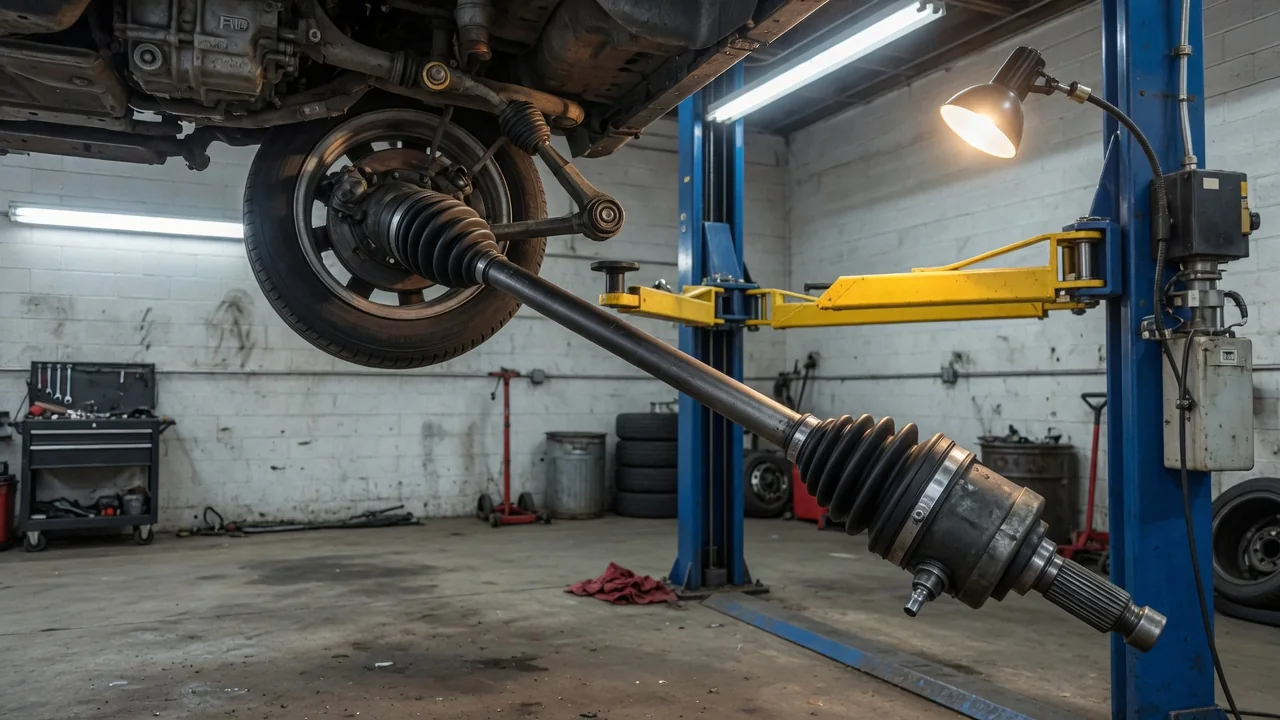
A half shaft is the drive axle that carries power from a car's differential to one driven wheel. Because the differential splits torque between the left and right sides, each driven wheel gets its own shaft, which is where the name comes from. In everyday use, the car half shaft meaning overlaps with terms such as CV axle and drive axle. This guide explains where the half shaft sits, how its joints work, and which symptoms suggest it needs attention.
Differential to Wheel: Where the Half Shaft Fits
The differential is the gear set that receives engine torque and divides it between two wheels while letting them turn at different speeds, which they must do whenever the car goes around a corner. On a front-wheel-drive car the differential is usually built into the transaxle, the combined transmission and final drive unit. On rear-wheel-drive and all-wheel-drive vehicles with independent suspension, a separate differential unit is fed by a driveshaft from the transmission or transfer case. In either layout, the half shaft is the final link. Its inner end connects to a differential output, typically by splines that slide into a side gear or by bolts to a flange, and its outer end engages the wheel hub, commonly through splines secured by an axle nut. When the shaft turns, the hub and wheel turn with it.
The term is used a little differently depending on the suspension design. Vehicles with a solid rear axle carry their axle shafts inside a rigid housing, and those shafts are sometimes called half shafts too, but they do not have to accommodate independent wheel movement. The exposed shafts discussed here belong to independent suspension layouts, which are common on front-wheel-drive cars and many all-wheel-drive and rear-wheel-drive models. Because the transaxle on a front-wheel-drive car is often mounted off center, the two shafts may be different lengths. Some designs add an intermediate shaft with its own support bearing so the left and right shafts are closer to equal, which can help reduce torque steer.
Joints: How a Half Shaft Flexes and Steers
A half shaft has to keep delivering torque while the suspension moves the wheel up and down and, on the front axle, while the steering turns it. A simple universal joint can transmit power at an angle, but its output speed rises and falls slightly during each revolution when it operates at an angle, which would cause vibration and uneven drive. That is why most half shafts use constant velocity joints, usually shortened to CV joints. A CV joint is arranged so that the output turns at the same speed as the input throughout each rotation, even when the shaft is bent at a significant angle. This property is what lets a front-wheel-drive car accelerate smoothly while the wheels are steered.
A typical half shaft has two CV joints with different jobs. The outer joint, next to the wheel, is usually a fixed ball-type design that can operate at the large angles needed for steering. The inner joint, next to the differential, is usually a plunging design, such as a tripod joint or a double-offset ball joint, that allows the shaft's effective length to change slightly as the suspension compresses and extends. Each joint is enclosed in a flexible boot made of rubber or thermoplastic, held in place by clamps and packed with grease formulated for CV joints. The boot keeps lubricant in and keeps water, dust and road grit out. Some vehicles, particularly in certain rear-drive applications, use other joint types, so the exact configuration should be checked for the specific model.
Failure Signs of a Worn Half Shaft
The most widely recognized symptom is a rhythmic clicking or popping noise when the car accelerates while turning, such as pulling out of a parking space or taking a tight corner. This pattern usually points to a worn outer CV joint, because the outer joint works at its sharpest angles during turns. Another common early sign is grease thrown onto the inside of the wheel, the suspension parts or the brake components. That residue typically means a boot has split or a clamp has loosened. A torn boot does not cause noise by itself, but once grease escapes and contaminants get in, joint wear tends to speed up.
Wear in the inner joint more often shows up as vibration or shudder under acceleration, or as a clunk when shifting between drive and reverse or when getting on and off the throttle. These symptoms are less specific than outer-joint clicking. Out-of-balance tires, bent wheels, worn engine or transmission mounts, and failing wheel bearings can produce similar sensations, and a humming or growling noise that changes with speed is more often associated with a wheel bearing than with the half shaft. Visual inspection of the boots and a check for play in the joints help narrow down the cause.
In advanced cases, a joint can wear to the point of coming apart, or a shaft can be bent by an impact with a curb or road debris. If a half shaft separates, power no longer reaches that wheel, and the car may not move even though the engine runs and the transmission is in gear. Loss of drive at the wrong moment can create a hazardous situation, so persistent clicking, clunking or shaking deserves attention rather than continued driving.
Practical Implications and Limits
For owners, the most useful habit is a quick look at the CV boots whenever the car is raised for tire service, an oil change or brake work. A crack or tear found before the joint becomes noisy may allow the boot alone to be replaced, although many repair shops prefer to install a complete new or remanufactured shaft assembly because the labor involved is similar and the condition of the joint inside is hard to judge. Once a joint is audibly worn, replacing the boot will not reverse the damage. Changes that alter suspension geometry, such as lifting or lowering a vehicle, change the operating angles of the joints and can affect how long they last.
There are also clear limits to what general guidance can tell you. Axle nut torque, whether that nut may be reused, the method for releasing the inner end from the transaxle and whether transmission fluid is lost during removal all vary from one vehicle to another, so the service manual for the specific model is the reference to follow. The number of half shafts also depends on the drivetrain: a front- or rear-wheel-drive car with independent suspension typically has two, while an all-wheel-drive vehicle with independent suspension front and rear may have four. Replacement parts can differ in fit and boot material, so matching the part to the exact vehicle and drivetrain version matters. When symptoms are ambiguous, a hands-on inspection is more reliable than diagnosis by sound alone.