What Is a Generator on an Older Car? Output, Regulation and Alternator Differences
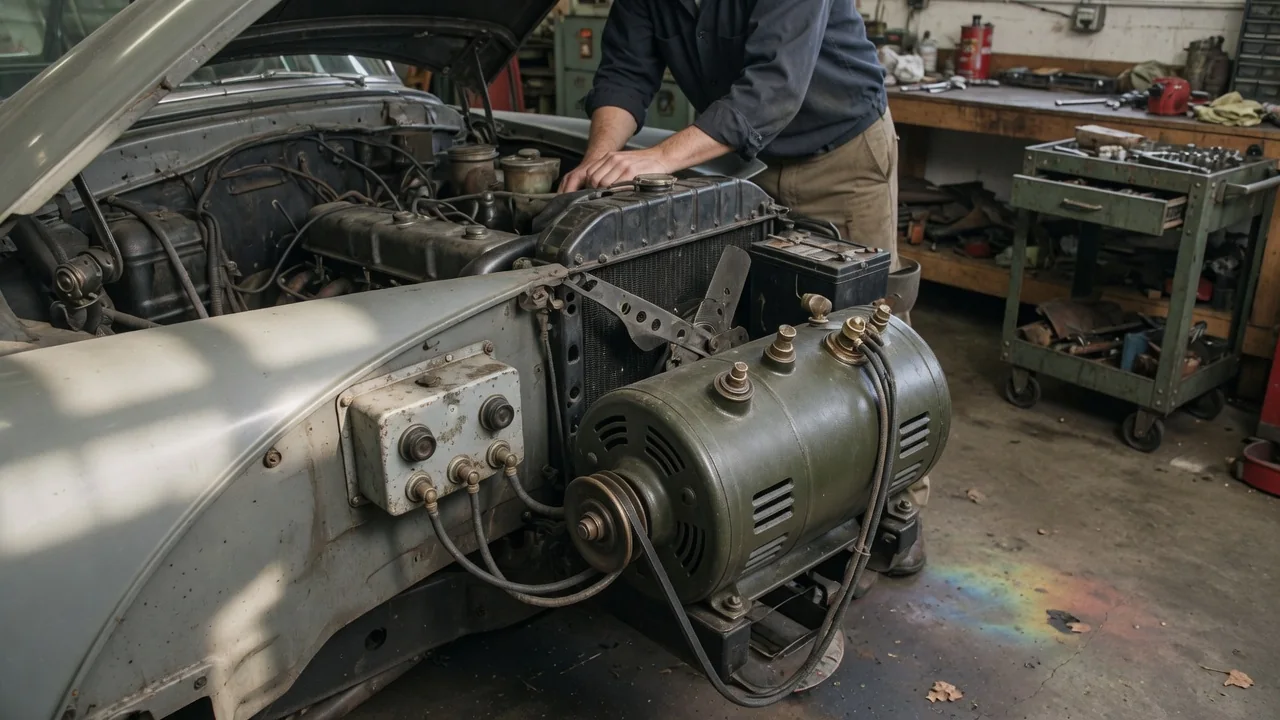
On many older cars, the component that charges the battery and powers the electrical system while the engine runs is a generator rather than an alternator. A classic car generator is a belt-driven machine that produces direct current, works alongside a separate regulator, and behaves differently from the alternators found on most later vehicles. Understanding how it produces power, how that power is controlled, and where it falls short helps explain charging behavior on vintage vehicles.
Electrical Output: How a Generator Produces Power
The generator is usually mounted on the engine and turned by a belt from the crankshaft pulley, often the same belt that drives the fan or water pump. Inside its cylindrical housing, a rotating armature made of wire windings spins between stationary field coils wrapped around iron pole shoes. When current flows through the field coils, they create a magnetic field, and the spinning armature windings cut through that field, inducing voltage. The armature naturally produces alternating current, but a segmented copper commutator on the armature shaft, contacted by carbon brushes, switches the connections as it turns so that the output leaving the generator is direct current suitable for charging a battery.
Output depends heavily on how fast the armature turns. At engine idle, a typical generator produces little or no usable charging current, and the battery may supply most of the electrical load. As engine speed rises, output increases until the generator reaches its designed limit. The generator also relies on a small amount of residual magnetism left in the field pole shoes to begin producing voltage; that initial voltage feeds current into the field coils, strengthening the magnetic field and building output further.
Because the full charging current passes through the brushes and commutator, these parts generate heat and wear over time, and they help set a practical ceiling on how much current the unit can deliver continuously. Very early automotive systems sometimes used third-brush generators, in which an extra brush position was adjusted to limit output, an arrangement later replaced by external regulators on most designs.
Regulation: How the Charging System Is Controlled
A generator left uncontrolled would produce voltage and current that rise with engine speed, eventually overcharging the battery, overheating the generator, and damaging lamps and other equipment. To prevent this, most generator-equipped cars use a separate regulator, usually a small metal-covered box mounted on the fender, firewall, or another nearby surface. A common design contains three electromechanical units, each built around an electromagnet coil and a set of contact points.
The first unit is the cutout relay, sometimes called the reverse-current relay. When the generator is stopped or turning slowly, its voltage is lower than the battery's, and without protection the battery would push current back through the generator windings. The cutout keeps the circuit between generator and battery open until generator voltage rises high enough, then closes its contacts so charging can begin. When generator output falls below battery voltage again, the reverse current causes the contacts to open.
The other two units control output by managing current in the field circuit. The voltage regulator opens and closes its contacts rapidly, inserting resistance into the field circuit whenever system voltage reaches its setting, which weakens the magnetic field and holds voltage near a target level. The current regulator works the same way but responds to output current, limiting it to protect the generator when a discharged battery or heavy electrical load demands more than the unit can safely supply. Many such regulators also include temperature compensation, and their settings and wiring must suit the specific generator and electrical system they are used with.
Alternator Contrast: What Changed
An alternator reverses the basic layout of the generator. Instead of a rotating armature inside stationary field coils, it uses a rotating field, called the rotor, inside stationary output windings, called the stator. The rotor receives a relatively small field current through smooth slip rings and brushes, while the heavy output current is produced in the stator, which does not move. The stator generates alternating current, which a set of diodes, often called a rectifier, converts into direct current for the vehicle.
This design changes charging behavior in several ways. Alternators can generally produce meaningful output at lower engine speeds, including at or near idle, which suits stop-and-go driving and higher electrical loads. Because the brushes carry only field current and there is no segmented commutator, alternators are typically able to spin faster and wear their brushes more slowly. The rectifier diodes block current from flowing back from the battery, so a separate cutout relay is not needed. Alternator regulators control field current to hold voltage steady, and while early versions could be external electromechanical units, later designs moved to solid-state regulators, frequently built into the alternator itself.
For a given output, alternators are also often lighter and more compact. These advantages are the main reason alternators largely displaced generators in passenger cars, which is why the generator is now associated mainly with older and classic vehicles.
Practical Implications and Limits
For owners, the generator's speed-dependent output shapes everyday use. An ammeter showing a discharge at idle, or a charging warning light that glows faintly at low engine speeds, can be normal behavior rather than a fault, depending on the vehicle. Long periods of idling, slow traffic, or short trips with headlights, heater fan, and wipers in use can gradually drain the battery because the generator never spends enough time at speed to replace what was used. Adding modern accessories with significant current draw can push demand beyond what the original system was designed to supply.
Generator systems also require attention to matching and setup. The generator, regulator, battery, and wiring must agree on system voltage, polarity, and field circuit arrangement, and some older vehicles use positive-ground electrical systems rather than the negative-ground layout common today. After a generator or regulator is replaced or disconnected, many service procedures call for polarizing the generator so its residual magnetism matches the battery's polarity; the correct method depends on how the field circuit is wired, so the vehicle's service manual should be followed rather than a generic shortcut.
Routine wear points include brushes, the commutator surface, bearings, and the regulator contacts, and some generators were designed with provisions for periodic lubrication. Converting to an alternator is a common modification when electrical demand rises, but it involves wiring, mounting, gauge, and regulator changes and may affect originality. The explanations here describe general principles; exact output ratings, regulator settings, and test values vary by design and should come from documentation specific to the vehicle.