What Is a Gateway Module in a Vehicle? Network Bridging, Diagnostics and Security
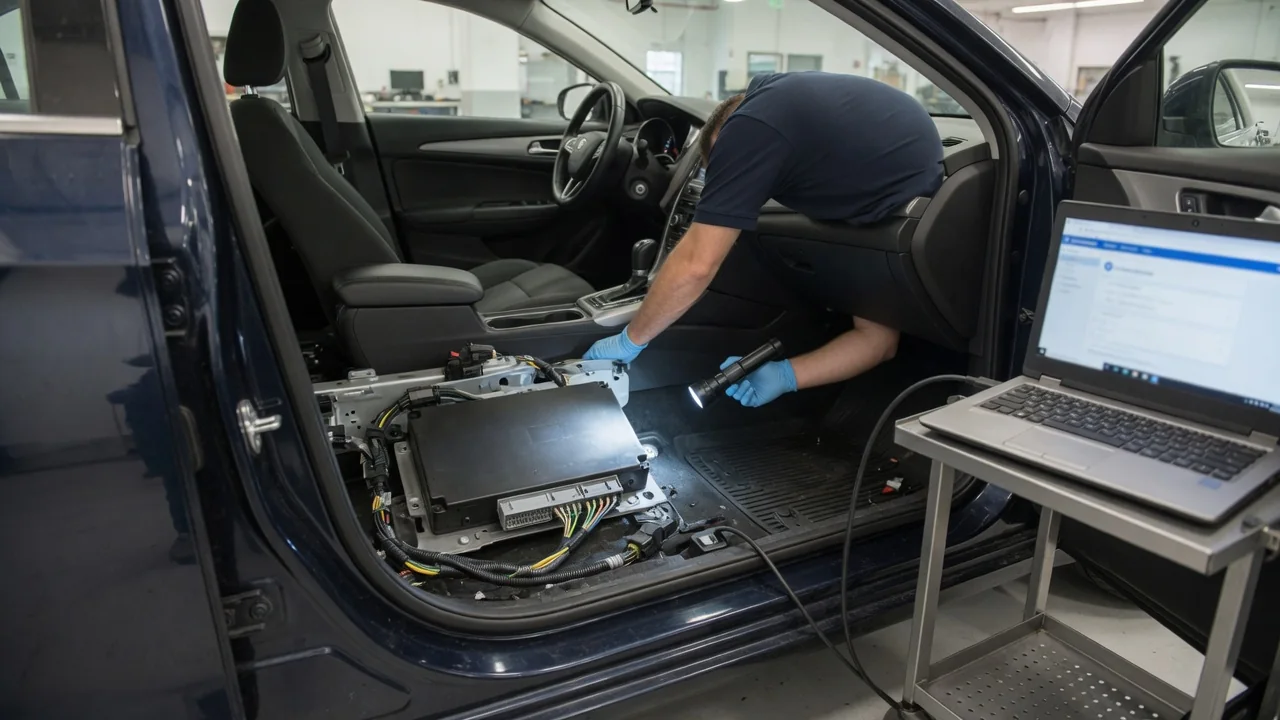
A gateway module is the electronic control unit that connects a vehicle's separate data networks and manages what passes between them. Modern cars spread their control modules across several networks, each suited to different speed, cost, and reliability needs. The gateway sits where those networks meet. It forwards the messages each network needs, holds back the ones it does not, and often serves as the entry point for diagnostic tools. Knowing how a car network gateway works explains why a single fault can affect many systems at once.
Network Bridging: Connecting Separate Vehicle Networks
Most vehicles do not run every module on one shared wire pair. Engineers usually group modules by function, such as powertrain, chassis and braking, body and comfort, and infotainment, and give each group a network that fits its job. Controller Area Network (CAN) is the most common, often in more than one speed variant on the same vehicle. Simpler devices like window switches or sensors may use the lower-cost Local Interconnect Network (LIN), usually through a master module rather than directly through the gateway. Depending on the design, a vehicle may also use FlexRay, MOST, or automotive Ethernet for high-bandwidth or time-critical data. Separating networks keeps traffic manageable, limits how far an electrical fault can spread, and lets each network run at a suitable speed.
Separate networks still have to share information, and that is the gateway's core job. It receives messages from one network, checks them against its configuration, and forwards only the ones another network needs. Sometimes it passes a message on unchanged. Other times it repackages the data with a different identifier, a different timing, or a different protocol format, because networks running at different speeds or standards cannot read each other's traffic directly. Vehicle speed is a typical example. The braking or powertrain system calculates it, and the instrument cluster, infotainment unit, and driver-assistance functions may all need it. The gateway makes sure each of those receivers gets the value in a form it can use.
Many gateways also coordinate network management, the process of waking networks up and letting them go to sleep. When a door opens or the ignition turns on, modules need to come online. When the vehicle is parked, they need to shut down so they do not drain the battery. Architectures differ in where the gateway function lives. Some vehicles use a dedicated central gateway module. Others build the function into the body control module, instrument cluster, or another unit. Newer designs may spread it across zone or domain controllers.
Diagnostics: The Gateway as the Path to Scan Tools
In many vehicles the diagnostic connector under the dashboard is wired to the gateway rather than to every internal network. When a scan tool sends a request, the gateway routes it to the target module and returns the response. This lets a technician reach modules on networks that are not physically present at the connector. It also keeps a tool plugged into the port from loading down every bus in the vehicle. Emissions-related OBD-II data follows standardized formats. Deeper manufacturer-specific functions, such as reading enhanced codes, running actuator tests, or configuring modules, commonly use diagnostic protocols like Unified Diagnostic Services (UDS). Vehicles with Ethernet-based architectures may support diagnostics over IP, which can move large amounts of data faster during software updates.
The gateway is also a useful diagnostic witness. Because it watches traffic across several networks, it can detect when an expected message stops arriving or when a module goes silent, and it may store network communication codes, often called U-codes. Many scan tools build a list or map of installed modules from what they can reach through the gateway. That map gives a quick view of which modules respond and which do not, and the pattern of missing modules can point toward a specific network branch rather than a single component.
Module programming usually travels through the gateway too. Reflashing or replacing a control unit means sending software and configuration data across the gateway to the module being updated. An interruption or unstable supply voltage during that process can cause problems, which is why service procedures typically call for a battery maintainer during programming.
Security: Controlling What Reaches Critical Systems
Because the gateway decides which messages cross between networks, it also acts as a firewall. Systems that connect to the outside world, such as telematics units, infotainment with wireless connectivity, and the diagnostic port, can be kept on separate networks from steering, braking, and powertrain controls. The gateway forwards only the message types its configuration permits and drops unexpected traffic. Without this barrier, a compromised or faulty device on a less critical network could flood or spoof messages that safety-relevant modules rely on.
Some manufacturers go further with what is often called a secure gateway. In these designs, reading data and codes may remain open, while actions that change vehicle behavior, such as clearing codes, running active tests, or programming modules, require an authenticated tool session. How that authentication works, and which functions it covers, varies by manufacturer. Industry attention to vehicle cybersecurity has grown, reflected in frameworks such as ISO/SAE 21434 and UN Regulation No. 155. As a result, gateway designs may also include features like message authentication, logging, or intrusion detection. These features are design choices that differ between vehicles, not universal traits of every gateway.
Practical Implications and Limits for Owners
Because so much traffic depends on one component, gateway-related faults often look dramatic. Common signs include several warning lights at once, gauges or features that stop working together, or a scan tool that cannot talk to the vehicle. Those symptoms do not prove the gateway itself has failed. Damaged wiring, corroded connectors, a poor power or ground supply, a missing termination resistor, a low battery, or one faulty module disrupting a shared network can all produce similar results. A sound approach starts with battery condition, fuses, power, and grounds, then uses the manufacturer's wiring diagrams and network layout to isolate the fault before replacing any module.
If replacement is necessary, it is rarely plug-and-play. A gateway usually has to be configured for the specific vehicle and its installed equipment, so a used or new unit may not work correctly until it is coded or programmed with suitable tools. On vehicles with secure access requirements, generic scan tools may read data but be blocked from certain write functions. Aftermarket devices that plug into the diagnostic port, such as monitoring dongles or accessory interfaces, may also find their access limited by gateway filtering.
The general picture in this article holds for many modern vehicles, but the details do not transfer automatically from one vehicle to another. Which networks exist, where the gateway function lives, which functions require authentication, and which procedures apply all depend on the manufacturer, model, and model year. For any repair or programming decision, the service information for that exact vehicle is the reference that matters.