What Is a Frunk Release Mechanism?
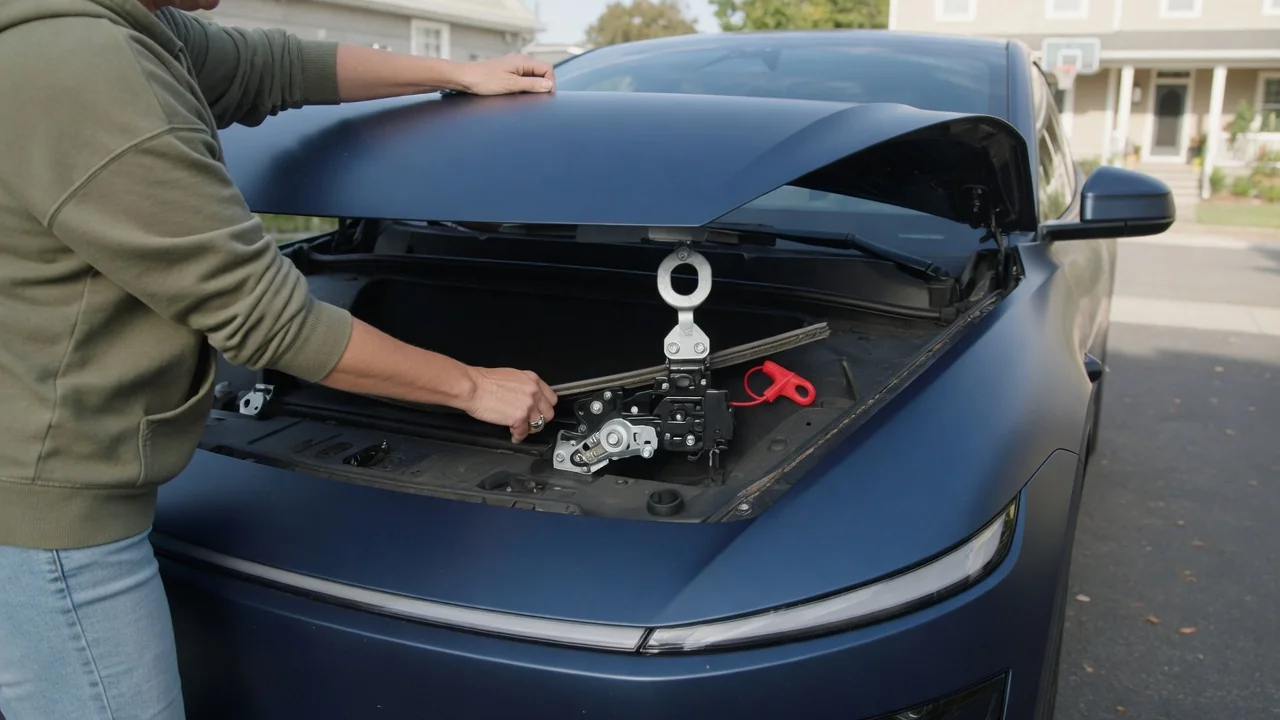
A frunk is the front trunk found on many electric and some mid- or rear-engine vehicles, and it needs a way to stay shut at speed yet open on request. So what is a frunk release mechanism? It is the combination of latches, cables or actuators, and control logic that decides when the front lid may unlatch, and how.
Release control
Release control is the part of the system that takes a request from the driver and turns it into movement at the latch. On older or simpler designs, an interior lever pulls a cable that runs forward to the latch, much like a conventional hood release. On many electric vehicles, the request is electronic instead: a touchscreen button, a key fob press, a phone app command or an exterior touch pad sends a signal to a control module, which then powers a small actuator at the latch.
The opening logic sits between the request and the actuator. A control module typically checks conditions before it allows the latch to release, such as whether the vehicle is stationary, whether it is unlocked and whether a valid key is present. Drivers may notice this as a button that is grayed out or a request that is simply ignored while moving. The exact conditions, the location of the controls and whether the lid lifts under power or only pops up slightly all vary by manufacturer and model.
Safety latch
Because a front lid that flies open at speed can block the driver's view, frunk latching normally involves more than one stage of retention. A primary latch holds the lid fully closed against its striker, while a secondary catch is designed to hold the lid partly raised if the primary latch lets go. On cable-operated designs, the secondary catch is often released by hand through the gap at the front edge. On electrically operated designs, a second actuation or a two-step command may do the same job.
Many frunks also include an interior emergency release, usually a glowing handle or button inside the compartment, intended to let someone trapped inside open the lid from within. What an owner can observe depends on the vehicle: some lids rise only an inch until a lever is moved, others open fully once both stages release, and the emergency release may work only when the car is stationary. The owner's manual is the reliable reference for how those stages behave on a particular model.
Service care
Frunk latches live at the front of the vehicle, where they face road spray, salt, dust and temperature swings. Over time, dirt and dried lubricant can make a latch slow to release or reluctant to catch, and cables can stretch or bind. Routine inspections usually include a look at the latch, striker and rubber seals, and a check that the lid closes evenly on both sides. Which lubricant is appropriate, and how often attention is needed, depends on the manufacturer's guidance rather than a universal rule.
Electrically released frunks add another service consideration: they rely on the low-voltage battery. If that battery is discharged, the normal release may not work, so many vehicles provide a backup method, such as a mechanical pull or dedicated terminals for supplying external power. These provisions differ widely and are sometimes hidden behind trim panels or a tow-eye cover. Knowing where the backup access is located before it is needed is worthwhile, and the correct procedure should come from the vehicle's own documentation.
Everyday Use and Observations
In daily use, a healthy release mechanism is easy to recognize. A request produces a distinct click or brief whir from the front of the car, the lid rises to its first position or opens fully, and the instrument display or app shows the frunk as open. Closing should end with a firm, single latching sound and the warning clearing. Some manufacturers specify where to press when closing, since lightweight aluminum lids can dent if pushed in the wrong spot, and some models close themselves under power.
Small changes in behavior are useful observations. A lid that needs several attempts to release, sits unevenly along one edge, rattles over bumps or triggers an open warning while apparently shut is telling the owner something about latch alignment, striker position or a sensor reading. Cold weather can also freeze seals or stiffen a latch temporarily. Noting when the symptom occurs, and whether it follows washing, freezing temperatures or a recent repair, gives a technician far more to work with than a general complaint.
Limits and Next Steps
A high-level explanation has limits, because frunk hardware and software differ from one vehicle to the next. The number of latches, the type of actuator, the conditions the control module checks and the form of the emergency and backup releases are all design choices. A warning message or stored fault code pointing at the frunk latch is evidence to interpret, not proof that the latch itself has failed, since wiring, connectors, a switch, low battery voltage or misalignment can produce similar symptoms. Manufacturer-specific codes need vehicle-specific confirmation.
When the frunk will not open, will not stay latched or reports its status incorrectly, the sensible next step is the owner's manual, followed by a qualified technician if the issue persists. Forcing the lid, prying at the front edge or probing wiring can damage paint, bend panels or create new faults. A lid that may not be securely latched deserves prompt attention before driving at speed, because the secondary catch is a backup, not a substitute for a primary latch that is working as designed.