What Is a Front Splitter on a Race Car?
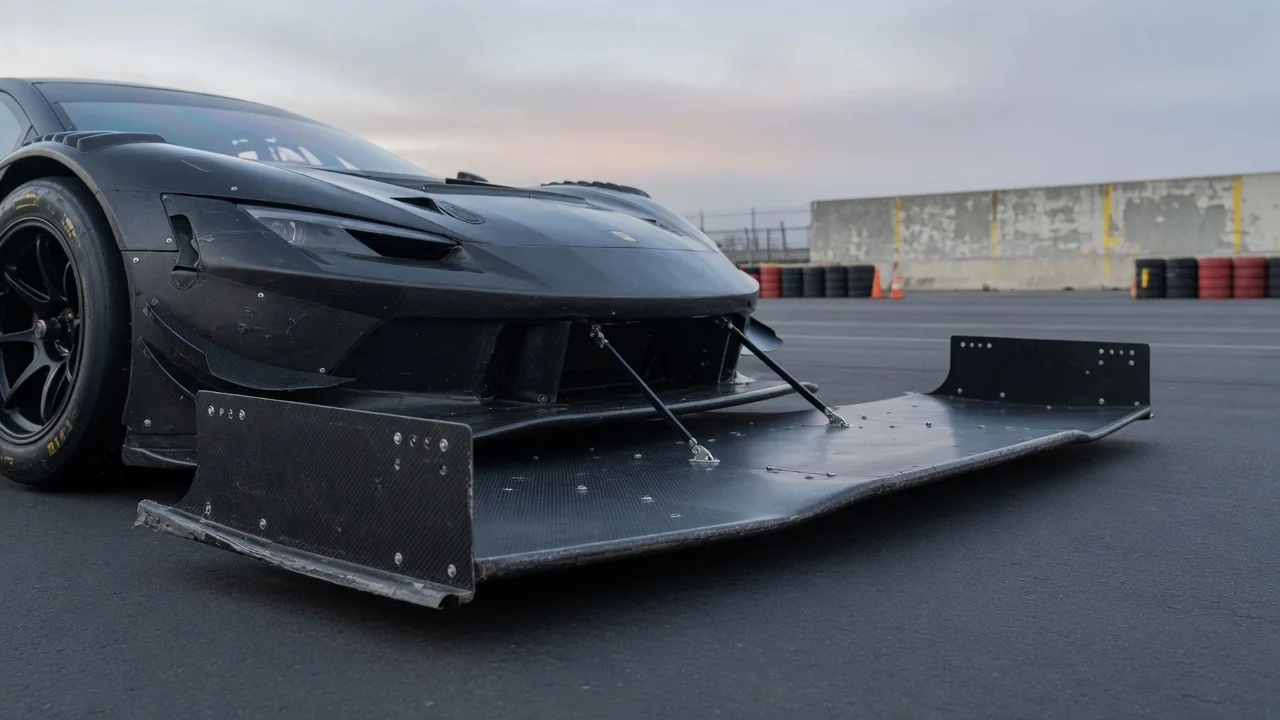
A front splitter is the flat, horizontal panel that extends forward from the bottom edge of a race car's front bumper or air dam. It looks like a simple shelf, but a race car front splitter is an aerodynamic device. It adds downforce on the front axle and limits how much air flows under the car. To understand what a front splitter on a race car does, you need to look at three things: air pressure, how it is mounted, and where it matters on track.
Air Pressure: How a Splitter Creates Front Downforce
When a car moves, oncoming air hits the front bumper and slows sharply. This forms a region of elevated pressure, often called a stagnation zone, across the nose. The splitter sits below this zone and reaches forward into it, so the high-pressure air presses down on the splitter's upper surface. Some of the pressure that would otherwise only resist forward motion is turned into vertical load on the front of the car.
Under the splitter, air flowing between the panel and the track tends to move faster and sit at lower pressure. This is especially true when the splitter feeds into a flat undertray that keeps the underside smooth. Higher pressure above and lower pressure below produce a net downward force. The splitter also blocks some of the air that would push under the nose. That matters because high-pressure air spilling beneath the chassis tends to create front-end lift.
Aerodynamic forces generally grow with roughly the square of speed. The splitter's effect is therefore small in slow corners and much larger at high speed. Height above the ground also matters. Running closer to the track usually strengthens the low-pressure region underneath, but it makes the splitter more sensitive to changes in ride height, pitch, and roll. How much downforce a given splitter produces depends on the car's body shape, the splitter design, and the setup, so no single figure applies across vehicles.
Mounting: Getting the Load Into the Chassis
Downforce acts directly on the splitter, so the mounting has to carry that load into the car's structure. On a purpose-built race car, the splitter is commonly bolted to the chassis, a front subframe, or a crash structure. On production-based race cars, builders usually add brackets that tie into structural points. They avoid relying on the plastic bumper cover, which is not designed to carry aerodynamic loads and can deform or tear away.
The front edge is often held by adjustable support rods or turnbuckles that run up to the bumper structure, chassis, or a crossmember. These supports limit flex and let the team set the splitter's height and angle. A splitter that bends under load drops lower and changes angle as speed rises, which changes front grip. The driver feels this as balance that shifts from corner to corner. Many racing series set rules on splitter dimensions, and some check how far a splitter deflects under a set load. The exact requirements vary by series.
Common materials include plywood, aluminum composite panels, fiberglass, and carbon fiber. Each trades off stiffness, weight, cost, and how well it survives contact with curbs or other cars. Splitters scrape the track at times, so some designs add replaceable wear strips or skid elements underneath to protect the main panel. Mounts are often designed for quick removal, which makes repairs, replacements, and trailer loading easier.
Track Context: Where a Splitter Earns Its Keep
How much a splitter helps depends on the circuit. On tracks with long, fast corners, extra front load can help the car hold speed through turns and resist the understeer that often grows with speed. On tight, slow circuits the airspeed is lower, so the aerodynamic benefit shrinks. The added drag and the reduced ground clearance remain, which is why teams weigh the trade-off differently from venue to venue.
Track surface and curbing matter as much as corner speed. Tall curbs, bumpy sections, and compressions at the bottom of hills can push the splitter into the pavement. That can scrape it, crack it, or load its mounts beyond what they were built for. Teams pick a ride height that balances aerodynamic gain against the risk of grounding. A splitter that hits the track or runs too close to it can lose downforce suddenly, so ride height and splitter settings are often adjusted for each circuit.
Racing in traffic changes the picture again. Close behind another car, the turbulent wake reduces the clean air reaching the nose, so front downforce can drop and the car may understeer in that situation. In wheel-to-wheel and endurance racing, splitters also take damage from contact and off-track excursions. Durability, quick repair, and spare parts become part of race planning, not just setup.
Practical Implications and Limits
A splitter is one part of the car's aerodynamic balance. If you add front downforce without matching it at the rear, for example with a wing or spoiler, the balance can shift forward. The car may then oversteer in fast corners, which is unsettling exactly where stability matters most. The splitter works as a system with the rear aerodynamics, suspension settings, alignment, and tires. Make changes in small steps rather than all at once.
Street-registered cars used for track days face extra limits. A low, protruding splitter can catch on driveways, speed bumps, and parking curbs. Depending on local regulations, it may also raise concerns about legality or pedestrian safety. It should not block airflow to the radiator, intercooler, or brake ducts. A flexible decorative lip without proper supports may look similar to a functional splitter but is unlikely to produce meaningful, consistent downforce.
Inspection is part of owning one. Check for cracks, delamination, loose fasteners, and bent support rods after track sessions, because a damaged splitter can behave unpredictably at speed. A splitter cannot make up for worn tires or a poor chassis setup. Its real benefit on a particular car can only be confirmed through that car's own testing and data, not general claims. In organized competition, the class rulebook decides what is allowed before any performance question comes up.