What Is a Flywheel in a Car?
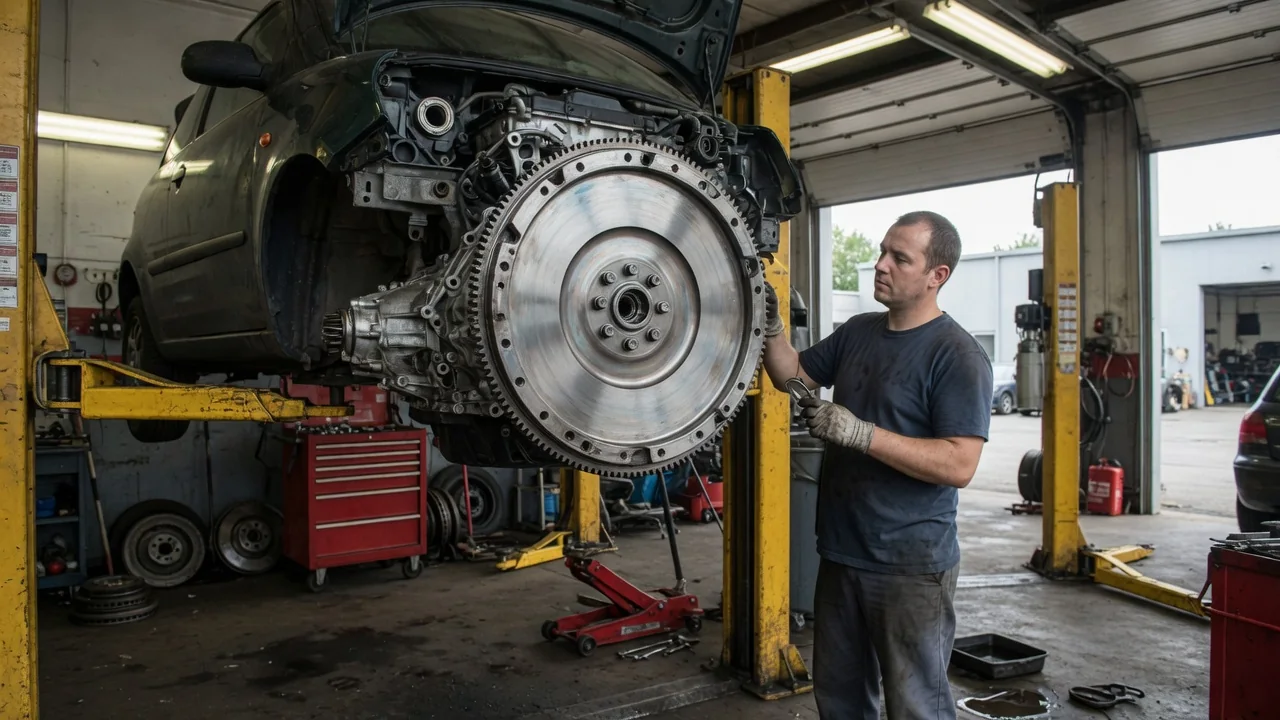
Anyone asking what is a flywheel in a car is really asking how an engine turns separate bursts of combustion into smooth, usable motion. The flywheel is a heavy disc bolted to the rear of the crankshaft, where it stores rotational energy, steadies engine speed, and provides the surface that links the engine to the transmission.
Rotating mass
An engine does not produce power continuously. Each cylinder delivers a brief push during its power stroke, then coasts through exhaust, intake, and compression. Without something to carry the crankshaft through those gaps, rotation would speed up and slow down many times per second. The flywheel solves this with inertia. Its weight, concentrated toward the outer rim, absorbs energy during each power stroke and releases it between them, so the crankshaft keeps turning at a steadier pace.
How much mass a flywheel carries depends on the engine and its purpose. Engines with fewer cylinders have longer gaps between power strokes and generally benefit from more smoothing, while engines with many cylinders overlap their pulses more naturally. A heavier flywheel tends to make idling calmer and pulling away easier, though the engine gains and loses revs more slowly. A lighter one lets the engine respond faster but can make low-speed driving feel less forgiving. Manufacturers choose the balance for each vehicle.
Clutch interface
On a manual transmission vehicle, the flywheel is one half of the connection between engine and gearbox. Its machined face sits against the clutch disc, and the pressure plate bolted to the flywheel clamps that disc tightly. With the pedal released, friction locks the disc to the flywheel and engine torque passes through to the transmission input shaft. Pressing the pedal relieves the clamping force, the disc spins free, and the engine is disconnected so a gear can be selected.
The outer edge usually carries a ring gear, a band of teeth the starter motor engages to crank the engine. Many modern manual cars use a dual-mass flywheel, which splits the disc into two sections joined by springs and dampers to soak up torsional vibration before it reaches the gearbox. Vehicles with a conventional automatic normally use a thinner flexplate attached to a torque converter instead, so the exact layout always depends on the drivetrain fitted to a particular model.
Symptoms of trouble
Because the flywheel is a friction surface, heat is its main enemy. Repeated clutch slip can create hard spots, fine cracks, or uneven patches on the face, and the driver often feels this as a shudder or judder when moving off from a stop. A vibration through the clutch pedal or floor, a burning smell after hard use, or a clutch that grabs unevenly can all point toward the flywheel face, although a worn disc or pressure plate produces similar sensations.
Dual-mass designs add their own signs when the internal dampers wear. Drivers may notice a rattle or knocking at idle that changes when the clutch pedal is pressed, or a thump when the engine is started or shut off. Damaged ring gear teeth tend to show up as grinding or a harsh whirring during cranking, sometimes only intermittently. None of these noises confirms a failed flywheel by itself, since engine mounts, starter problems, and transmission bearings can sound much the same.
Everyday Use and Observations
In normal driving the flywheel does its work without being noticed. It is the reason an engine settles into an even idle rather than stumbling between firing pulses, and the reason a car can ease away from a standstill at low revs without stalling immediately. The stored energy also carries the engine through the brief interruption of a gear change, so revs fall at a predictable rate rather than dropping instantly when the clutch pedal is pressed.
Driving habits influence how long the friction face stays healthy. Holding a car on a hill by slipping the clutch, resting a foot on the pedal, or launching with high revs all generate heat at the flywheel surface. Towing and heavy stop-and-go traffic add to the load as well. The part is hidden inside the bellhousing, so owners cannot inspect it casually, which makes changes in feel, sound, and smell the most practical everyday clues to its condition.
Limits and Next Steps
Symptoms alone have limits. A judder on takeoff might come from the flywheel, but contaminated clutch linings, worn mounts, or an engine misfire can feel alike from the driver's seat. Warning lights and stored fault codes related to misfires or crankshaft speed are also only evidence to interpret, not proof that the flywheel itself has failed, and code meanings can differ between manufacturers. A proper diagnosis considers the whole clutch and drivetrain rather than a single suspect part.
Confirming flywheel condition generally requires separating the transmission from the engine, which is substantial work best left to a qualified workshop. For that reason, the flywheel is commonly inspected whenever the clutch is replaced, and a technician can judge whether the surface can be refinished or whether replacement makes more sense. Some designs, particularly dual-mass units, may not be suitable for resurfacing. Checking the service information for the specific vehicle is the reliable way to settle those details.