What Is a Dry Sump Lubrication System? Pumps, Tank and Layout
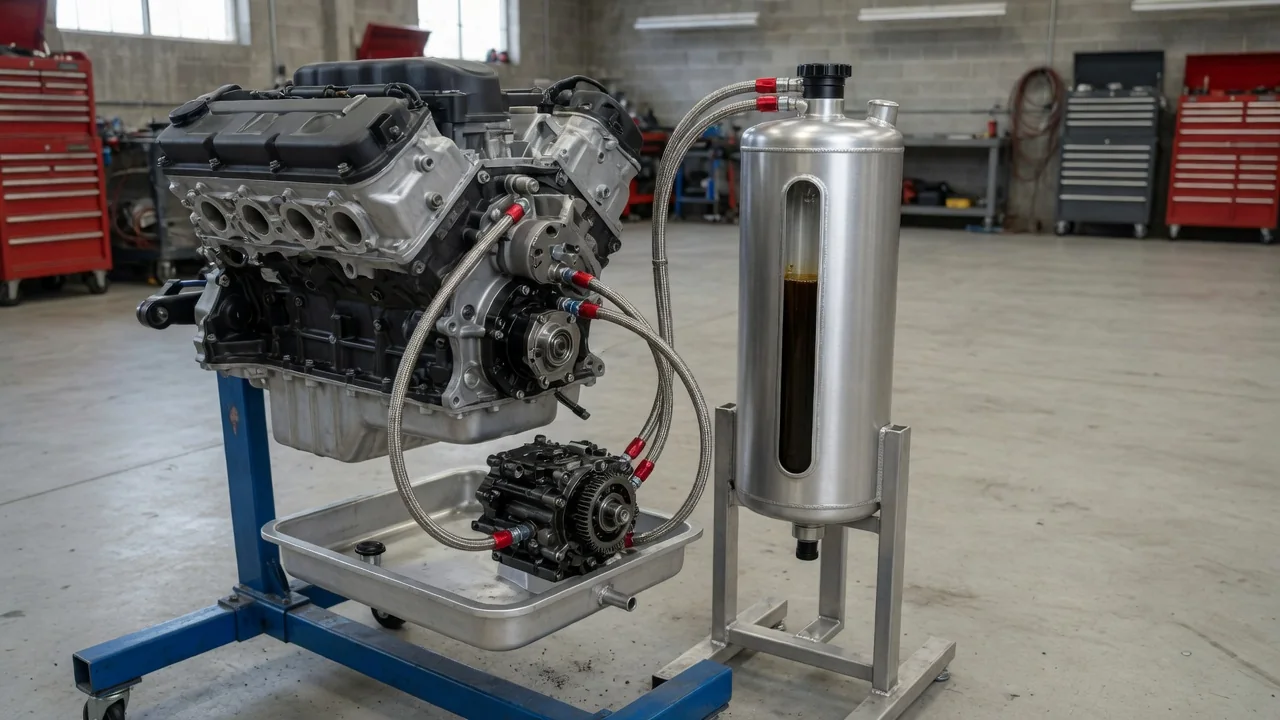
A dry sump lubrication system is an engine oil layout that does not store oil in a deep pan under the crankshaft. Pumps pull oil out of the crankcase almost as soon as it drains down and send it to a separate reservoir. A pressure pump then feeds the engine from that reservoir. A dry sump engine oil system comes down to three ideas: how scavenge pumps empty the crankcase, how the reservoir prepares the oil, and how the layout changes engine packaging.
Scavenge pumps: emptying the crankcase
In a conventional wet sump, oil drains into the pan by gravity and sits there until a single pump draws it through a pickup. In a dry sump, a shallow collection tray or a set of pickup points replaces the deep pan, and one or more scavenge pumps actively pull the oil out. Many designs use several scavenge stages. Each stage draws from a different area, such as the front and rear of the crankcase, the cylinder heads, or a turbocharger drain. This keeps oil from pooling where the engine tilts or where forces in a corner push it. The scavenge stages are usually stacked on a common shaft with the pressure stage and driven by the engine, commonly through a belt or gears. Gear and gerotor pump designs are common, but the exact construction varies by manufacturer.
Scavenge stages generally have more total capacity than the pressure stage. They do not move clean liquid. They move a mixture of oil, air and blow-by gases churned up by the spinning crankshaft. If scavenge capacity only matched the oil being supplied, oil would slowly build up in the crankcase. Extra capacity keeps the crankcase drained, and in many systems it also creates some vacuum inside it. Lower crankcase pressure can reduce windage losses, which is the drag created when the crankshaft and connecting rods whip through oil mist, and it can help the piston rings seal. How much any particular engine gains depends on its design, and a general description cannot put a number on it.
Reservoir: storing and de-aerating the oil
Because the crankcase no longer stores oil, the system needs an external reservoir, often called the tank. Scavenged oil returns to it carrying a lot of trapped air, and one of the tank's main jobs is to separate that air before the oil goes back to the bearings. Aerated oil is compressible and supports loads less effectively than solid liquid. Feeding foamy oil to the pressure pump weakens the oil film that keeps metal surfaces apart. Reservoirs are typically tall and fairly narrow. The inlet is usually arranged so incoming oil swirls around the tank wall instead of plunging straight into the pool. Internal baffles or screens slow the oil and give bubbles time to rise.
The outlet that feeds the pressure stage sits at the bottom of the tank, where the oil is most settled and least likely to slosh away from it during acceleration, braking or cornering. A vent at the top lets separated air and vapor escape, commonly into the engine's crankcase ventilation system or a breather or catch arrangement. The tank holds the working supply as a tall column instead of a wide, shallow puddle. That keeps the outlet covered in situations that could uncover the pickup in a conventional pan. A dry sump also often holds more total oil than a comparable wet sump. The extra volume can give the oil more time to release air and shed heat between trips through the engine, although volume and cooling arrangements differ widely between applications.
Packaging: what the layout changes
Removing the deep oil pan changes how an engine can sit in a vehicle. With only a shallow tray below the crankshaft, designers can mount the engine lower in the chassis without giving up ground clearance, which lowers the vehicle's center of gravity. In some layouts, the shallower bottom end also frees space for suspension parts, crossmembers or exhaust routing. The reservoir can go wherever it best suits weight distribution, service access or available space, instead of being fixed under the engine.
The trade-off is more hardware. A dry sump needs a separate tank, a multi-stage pump, and lines or passages connecting them, along with fittings, filters and sometimes an oil cooler in the circuit. Every external connection is a possible leak point and has to be routed away from heat sources and moving parts. The pump assembly needs its own drive and mounting space on the engine. The extra parts add cost and, in many cases, weight compared with a simple pan and pickup. Some manufacturers build the reservoir and passages into the engine structure to reduce external plumbing, while others use separate tanks and hoses. Neither approach is universal.
Practical implications and limits
The main advantage of a dry sump is a reliable oil supply under sustained high loads, such as long hard corners, heavy braking and steep grades, where oil in a conventional pan can slosh away from the pickup. That is why the design is closely tied to racing and high-performance engines. In ordinary driving, a well-designed wet sump with proper baffling usually supplies oil adequately. A dry sump is not automatically better. It solves a specific problem at the cost of extra complexity.
Owning a dry sump engine differs in a few practical ways. Checking the oil level often follows a procedure set by the manufacturer, which may require the engine to be warm, running or recently shut off. This is because the split of oil between the crankcase and the tank changes with temperature and with time since shutdown. A reading taken the way you would on a wet sump engine can be misleading, so the owner's manual or service documentation is the authority for each vehicle. Oil changes may involve more than one drain point. Lines and fittings should be checked during routine inspections for seepage or chafing.
There are limits to what the system can do. A dry sump does not make up for a low oil level, the wrong oil grade, a clogged filter or worn bearings. It also cannot prevent wear caused by contamination or overheating. A worn scavenge pump or a blocked pickup screen can let oil build up in the crankcase. That reduces the intended benefits and may increase oil consumption through the ventilation system. Aftermarket conversions require pump capacity, tank volume, ventilation and line sizes to be carefully matched to the engine. Specific requirements should come from the engine or component manufacturer rather than from general rules.