What Is a Differential Ring and Pinion?
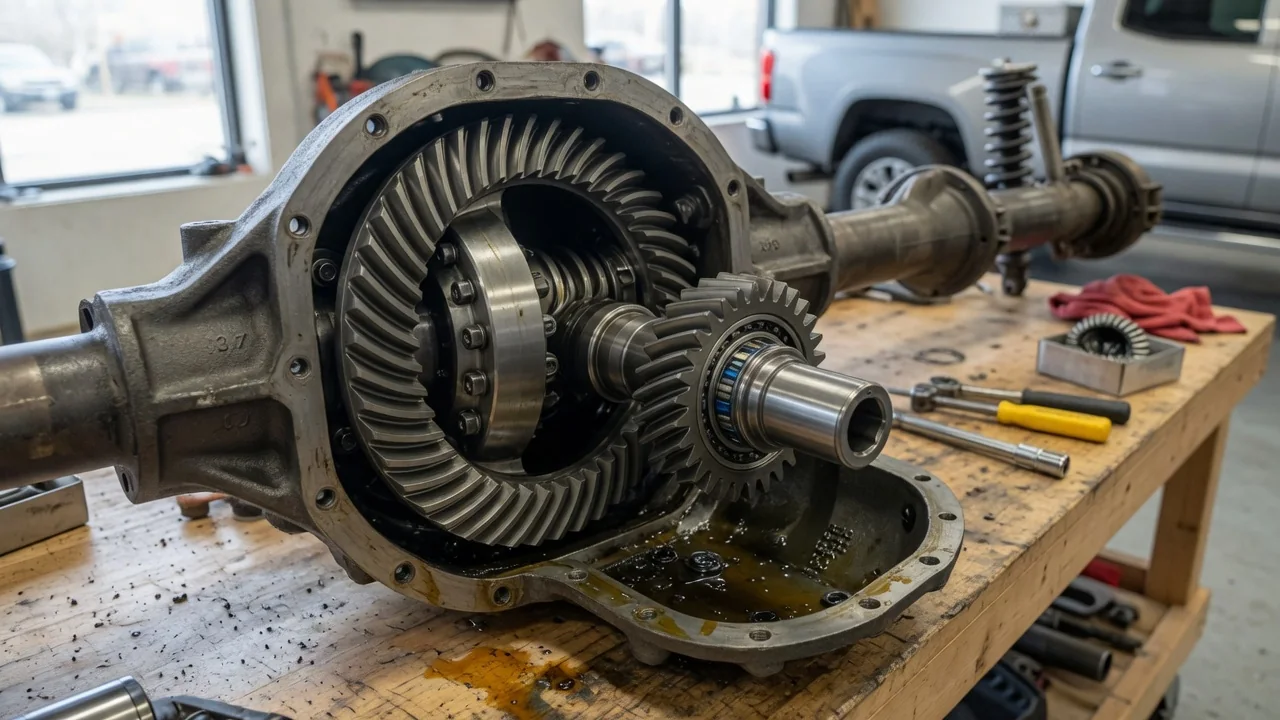
A differential ring and pinion is the pair of gears inside an axle housing or transaxle that takes power from the driveshaft or transmission and sends it toward the wheels. The small pinion gear drives a much larger ring gear, which is bolted to the differential carrier. Together, these differential ring and pinion gears set the final drive ratio and carry all of the drive torque. They are also a common source of driveline noise when wear or setup problems develop.
Final drive: what the ring and pinion do
In a typical rear-wheel-drive or four-wheel-drive axle, the driveshaft spins the pinion, which points along the length of the vehicle. The pinion's teeth engage the ring gear, which sits roughly at a right angle to it. This turns the rotation through about 90 degrees toward the axle shafts. The ring gear is fastened to the differential carrier, and the carrier holds the side gears and spider gears that let the left and right wheels turn at different speeds in corners. In a front-wheel-drive transaxle, the final drive is usually packaged with the transmission. It often uses gears on parallel shafts instead of a right-angle set, but it still provides the same final reduction.
The pinion has far fewer teeth than the ring gear, so it must turn several times for each turn of the ring gear. That reduction is the final drive ratio. You find it by dividing the ring gear tooth count by the pinion tooth count. For example, a ring gear with 41 teeth driven by a pinion with 11 teeth gives a ratio of about 3.73:1. The reduction multiplies torque at the axle and lowers speed. It works together with the transmission's gear ratios to set how fast the engine turns at a given road speed. A numerically higher ratio, often called a lower or shorter gear, favors acceleration and pulling. A numerically lower ratio favors lower engine speed at cruise.
Most modern rear axles use hypoid gears. In a hypoid set, the pinion's centerline is offset from the ring gear's centerline, usually below it. The offset allows a lower driveshaft and a larger, stronger pinion for a given ring gear size. The trade-off is that hypoid teeth slide against each other as well as roll, which creates high contact pressure and heat. That is why hypoid axles typically need gear oil formulated for extreme pressure, and why using the lubricant listed in the vehicle's service information matters.
Gear mesh: how the teeth engage
Gear mesh describes how the ring gear and pinion teeth meet under load. To run quietly and carry torque without excessive wear, the teeth must make contact in the right place on each tooth face. Several adjustments control this. Pinion depth sets how far the pinion reaches into the ring gear and is typically adjusted with shims. Backlash is the small amount of free movement between the teeth, and it is adjusted by shifting the ring gear and carrier from side to side. Bearing preload keeps the pinion and carrier from moving under load. Depending on the design, it is set with shims, a crush sleeve or threaded adjusters.
Technicians check the result with a contact pattern. They apply gear marking compound to the ring gear teeth, rotate the gears under light resistance, and read the marks to see where the teeth touch. Both faces of each tooth matter. The drive side carries load during acceleration, and the coast side carries load when the vehicle slows with engine braking. A pattern that sits too close to the tip, root, toe or heel of the tooth points to a specific adjustment that needs correcting. Ring and pinion gears are normally made and sold as matched sets, often lapped together at the factory. Many carry markings that help the installer pair them correctly and reach the intended setup.
Noise: what ring and pinion problems can sound like
A ring and pinion in good condition is usually quiet in normal driving. When the mesh is wrong or the teeth are worn, the most common symptom is a whine or howl whose pitch rises with vehicle speed. How the noise changes with load is a useful clue. A whine that appears mainly on acceleration often relates to the drive side of the teeth. One that appears when you lift off the throttle points toward the coast side. Noise in both conditions can indicate wear, loose bearing preload or an incorrect setup.
Not every axle noise comes from the gears themselves. Worn pinion or carrier bearings tend to make a rumble or growl that follows road speed and may change less with throttle. A clunk when shifting into gear, or when switching between acceleration and deceleration, can come from excessive backlash. It can also come from worn U-joints, CV joints, mounts or slip yokes. Tires, wheel bearings and exhaust parts can make sounds that are easily mistaken for differential noise. Low or contaminated gear oil speeds up wear on all of these parts, so fluid condition is often checked early.
Because several drivetrain parts can make similar sounds, noise alone rarely confirms a ring and pinion fault. Diagnosis usually combines a road test under different loads, an inspection of the fluid for metal debris, and, with the axle opened up, measurements of backlash and bearing play.
Practical implications and limits
For owners, the ring and pinion matter most when a ratio change, repair or rebuild is planned. Changing the final drive ratio alters engine speed at highway cruise and changes how acceleration and towing feel. It often affects the speedometer and other speed-based calibrations, which may then need reprogramming. On four-wheel-drive and all-wheel-drive vehicles, the front and rear final drive ratios must match the system's design, because a mismatch can bind the driveline. Whether a different ratio fits a particular axle also depends on the carrier. Some ratios require a different carrier or case.
Setting up a ring and pinion is precision work. It typically calls for a dial indicator, an inch-pound torque wrench or preload gauge, shims, and a press or puller for the bearings, along with the specifications for that exact axle. Many manufacturers and gear suppliers also specify a break-in procedure. This may include avoiding heavy loads for an initial period and changing the gear oil afterward. These requirements vary by design, so follow the vehicle's service manual or the gear maker's instructions rather than general guidance.
This article explains the general mechanism. Gear type, adjustment method, fluid specification, limited-slip additive requirements and acceptable backlash all differ from one axle to another. The correct values come only from the documentation for the specific vehicle or component. If a noise or vibration persists after basic checks, a professional inspection is the reliable way to tell a gear problem apart from the many other drivetrain sources that can sound similar.