What Is a Differential in a Car?
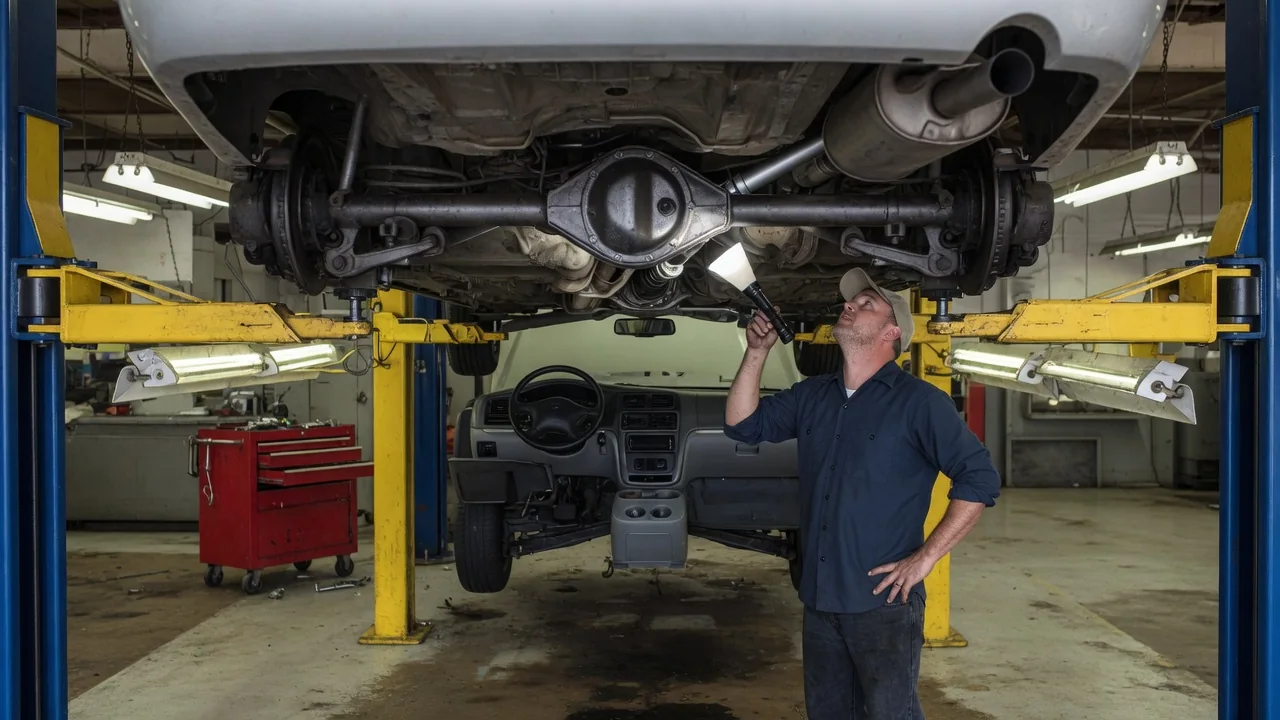
If you have ever wondered what a differential in a car actually does, the short answer is that it lets the driven wheels on the same axle rotate at different speeds while still receiving engine power. That ability matters every time the vehicle turns, because the inside and outside wheels travel different distances through the same corner.
Turning path
When a car rounds a corner, each wheel traces its own arc. The outside wheels follow a larger radius than the inside wheels, so they cover more pavement in the same amount of time. Covering more distance in the same time means spinning faster. On a tight turn into a parking space, the gap between inside and outside wheel speed is large; on a gentle highway curve, it is small but still present. The front and rear axles also follow slightly different paths.
If both driven wheels were locked to a single solid shaft, they would be forced to turn at the same speed. One tire would have to slip or scrub across the pavement to make up the difference, which wears tread, strains the axle, and makes the vehicle resist turning. The differential solves this by splitting drive between the two axle shafts through a gear set that allows one side to speed up as the other slows down, keeping both tires rolling rather than dragging.
Open differential
The open differential is the simplest and most common design. The driveshaft or transmission output turns a ring gear attached to a carrier. Inside the carrier, small spider gears mesh with a side gear on each axle shaft. Driving straight, the spider gears do not rotate on their own pins, and the whole assembly turns as one unit. In a corner, the spider gears begin to walk around the side gears, letting the outside wheel gain speed by the same amount the inside wheel loses.
Where the unit sits depends on the drivetrain layout. A rear-wheel-drive car typically carries it in a housing at the middle of the rear axle. A front-wheel-drive car usually builds it into the transaxle alongside the transmission. All-wheel-drive and four-wheel-drive vehicles may have a front and a rear unit, plus a center differential or coupling that manages speed differences between the axles. The exact arrangement varies by manufacturer, so the owner's manual or service information is the reliable reference for a specific vehicle.
What drivers notice
A healthy differential is something drivers rarely notice at all. The car turns smoothly in parking lots, the tires do not chirp or hop on dry pavement, and the steering does not fight back in tight maneuvers. That quiet behavior is the differential at work, constantly adjusting wheel speeds without any input. The clearest demonstration of its limits comes on a slippery surface, when one driven wheel sits on ice or mud and spins freely while the other, on firm ground, barely moves.
That one-wheel spin happens because an open design sends equal torque to both sides, and the amount is limited by the wheel with the least grip. Many vehicles counter this with a limited-slip or locking differential, or with traction control that brakes the spinning wheel to redirect effort across the axle. Drivers may feel that intervention as a pulsing sensation or see a flashing indicator on the dash. Which system a given car uses, and how it behaves, depends on the model and its equipment.
Everyday Use and Observations
In daily driving, the speed difference between wheels is at work in situations that seem unremarkable. Pulling out of a driveway at full steering lock, circling a roundabout, or making a U-turn all require the outside wheel to turn noticeably faster than the inside one. Even on a straight road the gears make tiny corrections, because tires are never perfectly identical in diameter. Uneven wear, different inflation pressures, or a mismatched replacement tire all cause small, continuous rotation differences that the gear set absorbs.
That constant compensation is one reason tire matching matters, particularly on all-wheel-drive vehicles, where significant diameter differences can keep the differentials or center coupling working harder than intended. Drivers of part-time four-wheel-drive trucks may notice a related effect: with the system engaged on dry pavement, the vehicle can feel like it binds or hops in tight turns, because the front and rear axles are locked together with no way to accommodate their different paths. Manufacturer guidance on tire replacement and four-wheel-drive use should be followed.
Limits and Next Steps
A differential depends on gear oil to protect closely meshed gears and bearings under heavy load. That fluid ages, and manufacturers specify the type and the change schedule for each vehicle, sometimes with special requirements for limited-slip units. Signs worth attention include a whine or howl that changes with speed or throttle, clunking when shifting between drive and reverse, vibration, or dark oil seeping from the housing or axle seals. These symptoms suggest a problem but do not identify the cause by themselves.
Similar noises can come from wheel bearings, tires, driveshaft joints, or axle shafts, so a proper inspection is the sensible next step rather than assuming the differential has failed. A technician can check fluid level and condition, look for metal debris, and road test the vehicle to isolate the source. Because internal repairs involve precise gear setup, they are generally work for a qualified shop. For any specific vehicle, the service documentation confirms the correct fluid, the layout, and the recommended maintenance.