What Is a Degas Bottle? How a Pressurized Coolant Tank Works
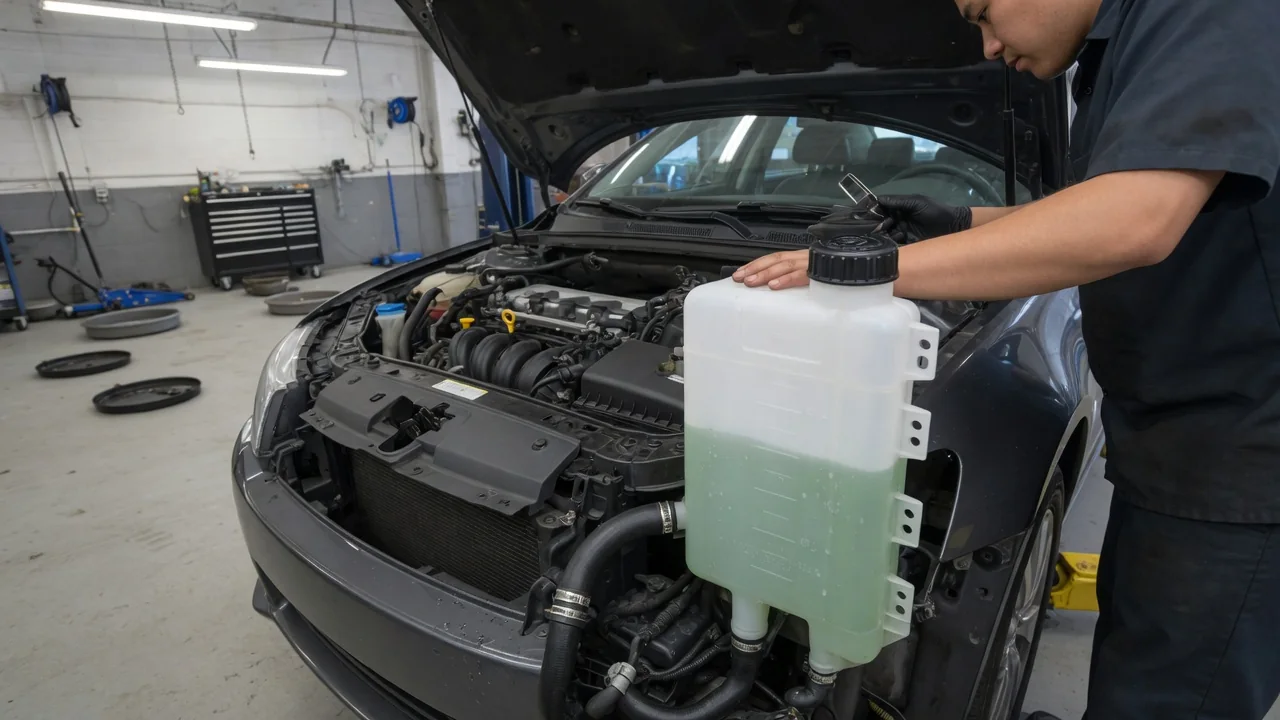
A degas bottle is a pressurized coolant reservoir that is part of the active circulation path in many modern cooling systems. Unlike a simple overflow jug, it holds coolant under system pressure, usually carries the pressure cap, and continuously receives small streams of coolant from the engine and radiator. Its main jobs are to pull trapped air and vapor out of the coolant, provide room for thermal expansion, and give owners a convenient place to check the level. Understanding how a car degas bottle fits into cooling helps explain several common symptoms.
Air separation inside the degas bottle
Air and vapor can enter a cooling system in several ways: during a coolant change or repair, through a small leak that draws air in as the system cools, or when coolant boils locally at hot spots. Air pockets carry heat far less effectively than liquid coolant, so a bubble trapped against a cylinder head or around a temperature sensor can cause localized overheating, erratic gauge readings or weak cabin heat. Entrained air also reduces water pump effectiveness and can contribute to cavitation and corrosion.
A degas bottle gives that air a continuous way out while the engine runs. Small bleed hoses are typically connected to high points in the system, such as the top of the radiator or an outlet near the thermostat housing, where bubbles tend to collect. These lines carry a modest flow of coolant, along with any trapped air, into the bottle. Inside the larger tank the coolant slows down, so bubbles rise to the air space at the top. Deaerated coolant leaves through an outlet near the bottom and returns to the system, commonly on the suction side of the water pump.
Because the bottle sits under system pressure and feeds the pump inlet, it also helps keep that inlet supplied with liquid coolant rather than vapor. A conventional overflow reservoir works differently: it is not pressurized and only collects coolant pushed out during expansion, then returns it as the engine cools. Hose routing, the number of bleed lines and internal baffles vary by design, so the principle is consistent even when the layout is not.
Coolant level in a degas bottle
Most degas bottles are translucent plastic with level markings molded into the side, such as MIN and MAX lines or a COLD FILL mark. The wording and position are specific to each vehicle, and the owner's manual is the reference for the correct level. The space above the mark is intentional: coolant expands as it heats, and the air at the top of the bottle acts as a cushion for that expansion while the pressure cap limits maximum system pressure.
Since coolant volume changes with temperature, the level is normally checked with the engine cold, ideally after the vehicle has sat for several hours. A hot reading can sit noticeably higher than a cold one without indicating a problem. Never open a hot degas bottle. Unlike an overflow jug, it is part of the pressurized system, and removing the cap while hot can release scalding coolant and steam. Some vehicles also have a low-coolant sensor on the bottle that triggers a dashboard warning.
A level that keeps dropping means coolant is leaving the system. Possible causes include external leaks at hoses, the radiator, water pump or heater core, a cap that no longer holds pressure, or an internal leak such as a failing head gasket. In a sealed, pressurized system, evaporation is not a normal explanation, so recurring loss deserves diagnosis rather than repeated topping off.
Service and maintenance of the degas bottle
Routine service starts with the coolant type specified for the vehicle, because coolant chemistries differ and mixing incompatible types can reduce corrosion protection or form deposits. Concentrate must be diluted to the manufacturer's ratio, typically with distilled water, while premixed coolant goes in as supplied. For a top-off on a cold system, add coolant through the bottle's fill opening to the correct mark and reinstall the cap firmly.
After a drain, hose replacement or any repair that opens the system, the refill matters more. The degas bottle removes air during operation, but a large air pocket can still block circulation or leave the heater core and upper engine passages partly empty. Procedures vary: some vehicles use bleeder screws, some call for running the engine with the heater on while watching the level, and many shops use vacuum-fill equipment that evacuates the system before drawing coolant in. Following the published procedure for the specific vehicle, then rechecking the cold level after the first few drives, is the reliable approach.
The bottle itself also wears. Plastic tanks endure repeated heat and pressure cycles and can become brittle, develop hairline cracks or seep at seams and hose connections. Look for dried coolant crust, dampness around the tank or a persistent sweet smell. Because the bottle's cap usually is the system pressure cap, its seal can harden or weaken; a cooling system pressure tester can check both the cap and the system for leaks. Oil, sludge or a milky film inside the bottle points to contamination that calls for further diagnosis.
Practical implications and limits
For everyday driving, the degas bottle is mainly a window into the cooling system. A quick cold-level check during routine inspections can reveal a slow leak before it becomes an overheating event. Symptoms that relate to the bottle's functions include gurgling behind the dashboard, cabin heat that comes and goes, temperature readings that swing unexpectedly and coolant pushed out around the cap after a drive. None of these identifies a single cause, but each suggests that air, pressure or coolant volume is not where it should be.
What the bottle can show is limited. A correct level in the tank does not prove the engine and heater core are full after service, since an air pocket elsewhere may not register there right away. A few bubbles shortly after a refill can be normal purging, while steady bubbling on a fully bled system can indicate combustion gases entering the coolant, which calls for proper testing. The bottle also cannot compensate for a stuck thermostat, worn water pump, clogged radiator or inoperative cooling fan.
Designs also differ. Not every vehicle uses a degas bottle; some pair a radiator-mounted pressure cap with an unpressurized overflow reservoir, and the two can look similar. Checking where the pressure cap is located and reading the warnings on the cap and in the owner's manual is the simplest way to tell which type is fitted.