What Is a Dead Pedal in a Car? Footrest Function Explained
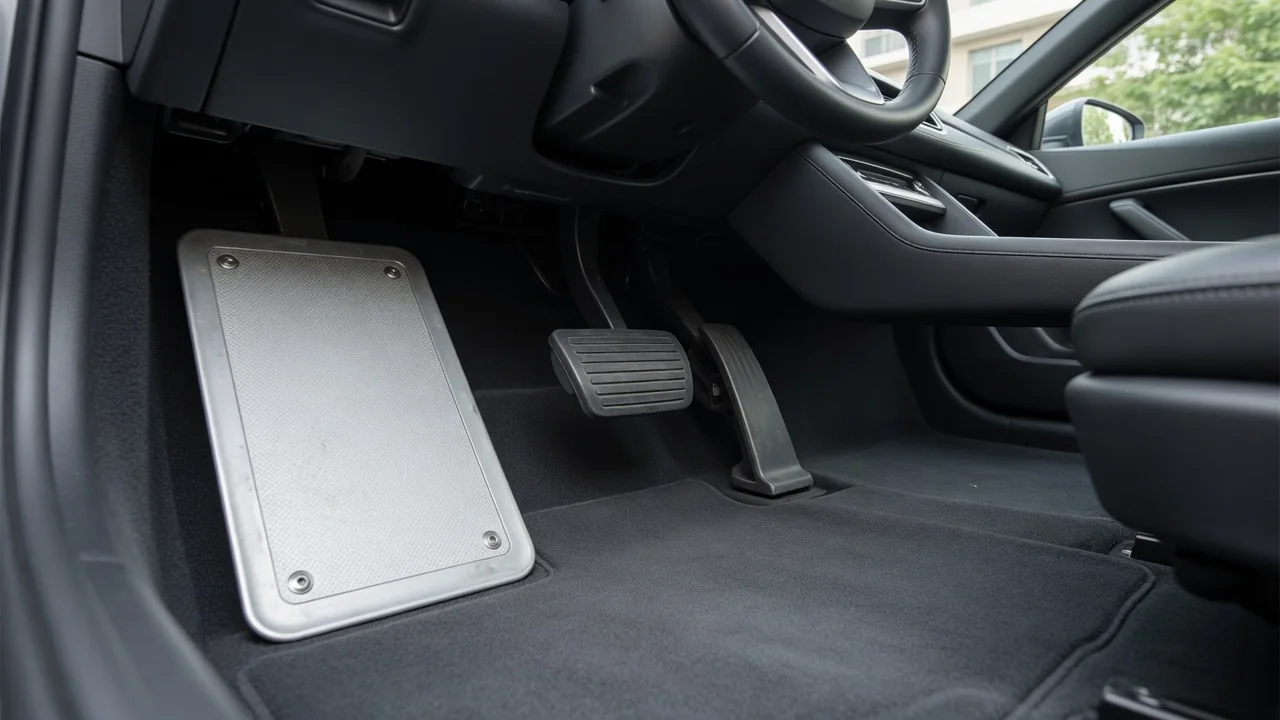
A dead pedal is a fixed footrest, usually mounted at the far left of the driver's footwell in a left-hand-drive car, that gives the left foot a place to rest and brace. It has no mechanical function and is called "dead" because pressing it controls nothing. What a dead pedal in a car is for, and why some footwells offer a more useful one than others, comes down to three things: foot support, driving position, and packaging.
Foot support
The primary job of a car footrest dead pedal is to give the left foot a stable, defined surface when it is not operating a clutch. In a car with an automatic transmission, the left foot has no control duties during normal driving, and in a manual car it is idle between gear changes. Without a dedicated rest, the foot tends to hover, lie flat on the floor at an awkward angle, or drift toward the brake or clutch. A dead pedal provides a solid platform roughly in line with the other pedals, so the foot can sit at a natural angle with the heel on the floor.
Its second job is bracing. When a car corners, brakes, or accelerates, the driver's body is pushed sideways and forward or back. The steering wheel should not be the main anchor point, because gripping it to hold the body in place reduces steering precision. Pushing lightly against the dead pedal lets the left leg take some of that load and helps keep the hips planted in the seat. The feature is often associated with performance driving, but the same benefit applies on winding roads, long highway curves, and in everyday traffic.
Construction varies. Some dead pedals are a raised, angled section molded into the floor or covered by carpet; others are a separate bracket with a rubber or trimmed pad fastened to the floor or footwell side panel. Surface grip, angle, and size differ from one design to another, so the general function is consistent while the feel is specific to each vehicle.
Driving position
A dead pedal works as one reference point in the overall driving position, alongside the seat, the steering wheel, and the operating pedals. Common seating guidance has the driver set seat distance so the knee stays slightly bent when the brake or clutch is fully pressed. A well-placed footrest supports that setup by letting the left leg rest at a similar bend, so both legs sit in comparable positions and the pelvis is not twisted toward one side.
That balance matters over long drives. If the left foot has nowhere comfortable to go, drivers often tuck it back under the seat, stretch it out fully, or keep shifting their weight, habits that can lead to fatigue in the hip, lower back, or leg. A footrest at a usable height and distance encourages a stable, repeatable posture. Gentle forward pressure from the left leg also helps keep the back against the seatback, allowing the backrest and side bolsters to support the body as intended.
Because drivers differ in leg length and seating preference, the same dead pedal can feel ideal to one person and slightly out of reach or cramped to another. Most dead pedals are not adjustable, so the seat and steering column adjustments do the work of fitting the driver. The footrest is simply a fixed point the rest of the position is arranged around.
Packaging
Packaging is the engineering term for fitting components into limited space, and the driver's footwell is one of the tightest areas in a vehicle. The dead pedal shares room with the brake and accelerator, the clutch pedal in manual cars, the steering column, and the footwell side wall. In many vehicles the front wheel well intrudes into the footwell, and the shape of that intrusion strongly influences where a footrest can go and how much room the left foot actually has.
These constraints explain why footrests vary so much. In some layouts the footwell is wide enough to place the dead pedal at a natural angle; in others, wheel well intrusion or a wide center tunnel pushes the pedals and footrest closer together, and the driver may sit slightly offset from the pedal set. Vehicles with a foot-operated parking brake place that pedal in the same far-left zone, which can limit the size or shape of the footrest. When a vehicle is built in both left- and right-hand-drive versions, the footwell layout has to be mirrored, and the space available on each side is not always identical because of engine bay and steering components.
Spacing is part of the same problem. The footrest needs enough clearance from the clutch or brake that a shoe cannot catch on both at once, yet it must be close enough that moving the foot from rest to pedal feels quick and natural. A margin that seems generous in light shoes can feel tighter in bulky footwear such as winter boots.
Practical implications and limits
For most owners, the practical takeaway is to use the dead pedal deliberately. In an automatic, resting the left foot there keeps it away from the brake, lowering the chance of dragging the brake or pressing it by reflex. In a manual, returning the foot to the rest after each shift avoids leaving it on the clutch, where even light pressure can partially disengage the clutch and accelerate wear.
Floor mats deserve attention. A mat of the wrong shape, one that is unsecured, or one stacked on top of another can bunch up near the footrest and creep toward the pedals. Mats designed for the vehicle and anchored with its retention points, where fitted, help keep the area clear. Aftermarket footrests and pads exist for some vehicles, but any add-on must be fastened securely and must not reduce clearance around the operating pedals; the owner's manual or a qualified technician is the right reference for a specific car.
A dead pedal also has clear limits. It cannot compensate for a poorly adjusted seat, and it is not a substitute for correct seat belt use; in a collision, the restraint systems protect occupants, not leg bracing. Its comfort benefit depends on the individual driver and the particular footwell, so a footrest that suits one person may not suit another. An absent or awkwardly placed footrest is not a defect in itself, but it does mean the driver should pay closer attention to seat position and foot placement to stay comfortable and in control.